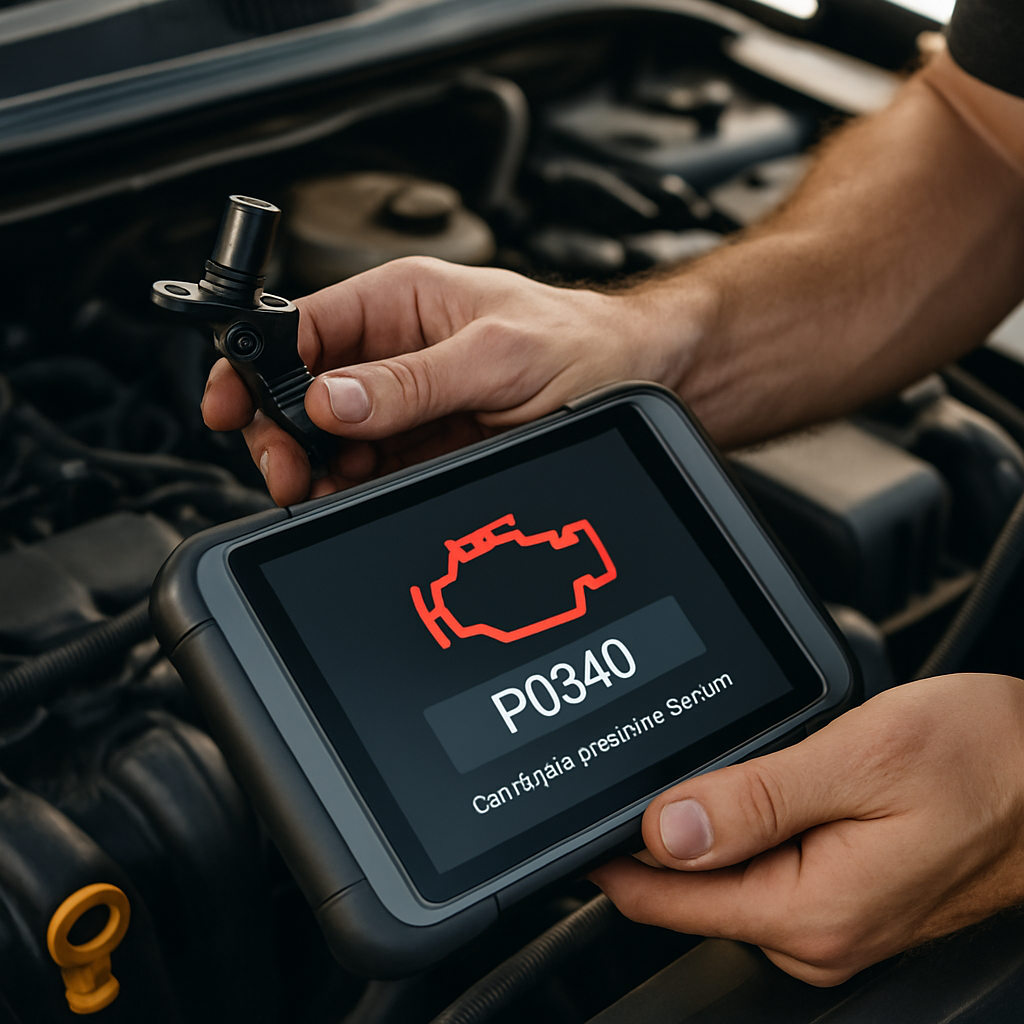
A failing camshaft position (CMP) sensor can be associated with extended cranking, difficult starting or a no-start condition on some vehicles, rough idle, misfires, stalling, reduced acceleration, poorer fuel economy and a check-engine light. Some drivers also notice an erratic tachometer. Those are possible symptoms, not proof that the sensor itself has failed: ignition, fuel-system, crankshaft-sensor, wiring, connector and mechanical-timing faults can produce much the same complaints.
The CMP sensor reports camshaft position and speed to the engine computer. The computer uses that information when calculating fuel injection and/or ignition timing. On many newer engines with variable valve timing (VVT), there may be more than one CMP sensor rather than one sensor for the entire engine. A weak, missing or implausible signal can therefore affect how the engine starts and runs, but the outcome varies by vehicle, engine design and whether the fault is constant or intermittent.
Common Symptoms of a Bad Camshaft Position Sensor
The following seven signs are a useful way to recognise a possible CMP-related fault. They can occur one at a time or together. They should lead to diagnosis, not automatic parts replacement.
| Possible symptom | What it may feel like | Why it needs diagnosis |
|---|---|---|
| Hard starting or extended cranking | The engine takes longer than normal to fire, particularly after an intermittent fault develops. | Starting problems also have many battery, ignition, fuel and crankshaft-signal causes. |
| Cranks but will not start | The starter turns the engine, but it does not run. Some vehicles can be more sensitive to a lost CMP signal than others. | A no-start does not identify one failed part. See our guide to why a car can crank but not start intermittently for other possibilities. |
| Rough idle or misfire | The engine may shake, stumble or run unevenly at idle or under load. | Misfires can originate in ignition, air/fuel or mechanical systems, as well as engine-position signals. |
| Stalling | The engine may stop unexpectedly at idle or while driving. | An intermittent circuit problem, crankshaft-sensor fault or other engine-management problem can look similar. |
| Reduced power or hesitation | Acceleration may feel flat, hesitant or inconsistent. | Poor performance is broad; it does not distinguish a CMP sensor from fuel, ignition or timing-related faults. |
| Check-engine light and stored codes | The malfunction indicator lamp may illuminate, sometimes with a cam-sensor circuit code. | A code identifies a system or condition to test, not necessarily a failed sensor. |
| Fuel-economy or tachometer changes | Fuel use may worsen, and the rev counter can occasionally behave erratically. | These are secondary observations and are not sufficiently specific to diagnose the sensor. |
Rough running and misfires deserve particular care. A CMP signal issue can be one explanation, but it is not the only one; our guide to the P0300 random/multiple-cylinder misfire code explains why a misfire diagnosis needs to consider more than one component.
Published symptom guides similarly associate failing CMP sensors with hard starting, stalling, rough running, loss of power and reduced economy, while emphasising that the sensor provides timing information to the engine-control system. See this overview of CMP sensor symptoms, diagnosis and replacement for further background.
When to stop driving and arrange help
Do not make a drivability decision solely from a warning light or a code. However, an unexpected stall, a no-start, severe or persistent misfiring, or substantial loss of power warrants prompt diagnosis and may make continued driving impractical or unsafe. If the engine is stalling in traffic, misfiring heavily or cannot maintain power predictably, arranging recovery or qualified assistance is generally the more cautious option than continuing to drive it.
Will a Bad Camshaft Sensor Throw a Code?
Often, yes. Many 1996-and-newer OBD-II-equipped vehicles in the United States can set one or more diagnostic trouble codes (DTCs) when there is a CMP sensor or circuit fault. Common examples include P0340, P0341 and P0344. Other CMP circuit examples listed in diagnostic references include P0342, P0343, P0365 and P0366. A useful code list is available in this camshaft position sensor diagnostic overview.
That said, a CMP-related code is a starting point, not a verdict. Depending on the vehicle and code, the underlying issue can be the sensor, its connector, damaged or corroded wiring, a poor ground, circuit integrity, installation, reluctor alignment or a timing-related condition. Exact definitions also vary by manufacturer: bank designation, sensor letter and the required test procedure must be checked in factory repair information for the precise year, model and engine.
Do not assume that every cam-timing code means the CMP sensor has failed. For example, a timing-performance code can require a different diagnostic path; see what a P0011 camshaft-timing code can mean. Equally, the absence of a code does not identify a failed component. Symptoms and code status need to be assessed alongside proper circuit and signal testing. This is especially important for intermittent faults.
How to Diagnose a Suspected Camshaft Position Sensor Fault
Replacing a sensor because the symptoms seem to match is a gamble. A sensible diagnosis progresses from basic evidence to vehicle-specific testing:
- Scan the vehicle. Retrieve stored and pending codes, and preserve freeze-frame data if the scan tool provides it. Note the complete code text, not just the first few characters.
- Inspect the accessible circuit. With the ignition off and following appropriate vehicle safety procedures, check the sensor connector, terminals, visible harness routing and grounds for loose fitment, corrosion, broken insulation, oil contamination or obvious damage.
- Use the manufacturer procedure. The correct repair information will specify how to test circuit integrity and sensor output for that engine. Resistance testing and signal-output testing may form part of the process; a technician may use an oscilloscope where appropriate.
- Consider alternatives before fitting parts. Wiring or connector repair may be the remedy. Where the evidence points there, the diagnostic process must also consider reluctor alignment and timing-related faults rather than treating the sensor as automatically guilty.
- Confirm the repair. A repaired circuit or replaced sensor should be verified using the vehicle-specific procedure and by checking for returning codes or symptoms.
Do not use universal online pinouts, voltage figures, resistance values, sensor locations, tightening torques or relearn instructions. CMP sensors and their circuits differ substantially between engines. Factory repair information and the manufacturer’s safety procedures should govern any vehicle-specific work.
Professional diagnosis is especially sensible for an intermittent stall, no-start, severe misfire, unclear harness fault or a code suggesting a timing issue. VVT-related faults can overlap with CMP symptoms and codes, so it can also help to understand VVT-solenoid symptoms and diagnosis before assuming a sensor is the answer.
Camshaft vs. Crankshaft Position Sensor: Why Symptoms Can Overlap
The crankshaft position sensor tracks crankshaft speed (RPM) and position. The CMP sensor monitors camshaft position and helps the engine-management system coordinate valve timing, fuel delivery and combustion cycles. They work together, so a problem with either can be associated with difficult starting, stalling, rough running or misfires, reduced performance, lower fuel economy and stored diagnostic codes.
That overlap is why symptoms alone cannot reliably tell an owner whether the camshaft or crankshaft sensor is at fault. A no-start is not proof of one or the other, and neither sensor has a universal restart pattern across all makes and engines. Use the stored codes, a careful wiring inspection and the correct vehicle-specific signal tests instead of swapping sensors based on a symptom list. The functional distinction and shared symptom pattern are also described in this overview of crankshaft and camshaft position sensors.
What About a Bad Exhaust Camshaft Position Sensor?
Late-model VVT-equipped engines may have a CMP sensor for each camshaft. That is why service information and scan tools may distinguish intake and exhaust cam sensors. The general possible symptoms remain similar: a warning light or codes, starting trouble, rough running, misfire, stalling and reduced power.
Those symptoms do not reliably identify an exhaust-side sensor rather than an intake-side sensor. Nor is there a universal bank or sensor-letter convention that can safely be applied across makes. Obtain the full code wording, then use the exact year, engine and factory service information before naming a sensor or ordering a replacement part.
Are the Symptoms Different on a Silverado, Chevy or Ford?
The broad symptoms in this article can apply to a Chevrolet Silverado, another Chevrolet, a Ford or many other vehicles. The diagnostic principle does not change: engine symptoms and a CMP-related code require confirmation before a part is replaced.
What does change is the detail. Model year, engine, sensor count, sensor location, code wording, connector design and test procedure may all differ. A VVT-equipped engine may use multiple camshaft sensors, but that arrangement should not be assumed for every Silverado, Chevy or Ford. Before purchasing a sensor or following any repair guide, match the vehicle’s exact year, model, engine and VIN/service information, and record the complete DTC. For an example of why a repair article must be vehicle-specific, see these 2012 Jeep Wrangler camshaft sensor replacement details; they should not be transferred to a different engine.
Camshaft Position Sensor Replacement Cost: What Affects the Bill
There is no reliable universal camshaft sensor price. The purchase price of the sensor is not the same as the installed repair cost. The final bill depends on the make and model, sensor type, access, local labour rates, shop type, whether diagnosis is billed separately and whether the actual repair is a sensor, connector or harness repair.
One published broad estimate places mainstream-vehicle crankshaft or camshaft sensor replacement at about $200–$400, but it should be treated as an example rather than a current quote or a parts-only price. The estimate is discussed in the Five Star Ford sensor guide. A timing-related fault or wiring repair can change the cost materially, which is another reason to obtain a vehicle-specific quote after diagnosis rather than authorising a sensor on the strength of a code alone.
What to Do Next
- Record the symptoms: when they occur, whether the engine cranks, whether it stalls, and whether the problem is intermittent.
- Scan for stored and pending codes, but do not treat a CMP code as proof of a failed sensor.
- Inspect accessible connectors and wiring for clear damage or corrosion.
- Use factory information for the exact vehicle and engine for any electrical or signal testing.
- Seek qualified diagnosis promptly for a no-start, stall, severe misfire, major power loss or uncertain timing-related fault.
In short, the symptoms of a bad camshaft position sensor are useful warning signs, but the correct repair may be the sensor, its wiring or connector, or another engine-management or timing-related fault. Careful diagnosis is what separates a plausible symptom from a confirmed cause.