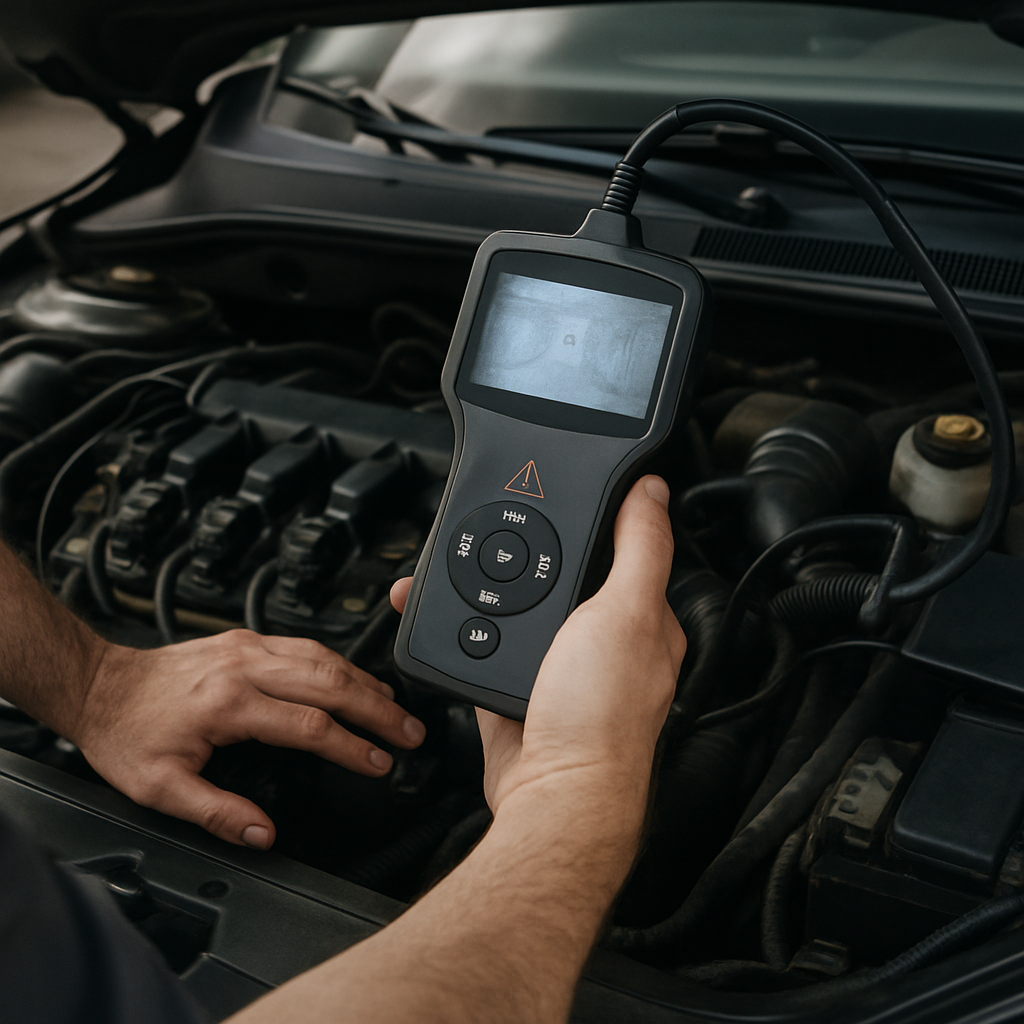
A scan tool showing P0300 Random/Multiple Cylinder Misfire Detected is reporting a diagnostic fault code, not identifying a failed part. The code should be treated as the starting point for diagnosis: record the complete code report and the conditions in which the problem appeared, then establish the underlying fault before authorising repairs or replacing components.
The wording “random/multiple” should not be read as proof that every cylinder has the same problem, that a particular ignition or fuel-system part has failed, or that the engine has suffered internal damage. A P0300 can appear alongside other stored or pending codes, and the full fault record matters. For a broader explanation of what a code reader can—and cannot—tell you, see our guide to how diagnostic trouble codes work.
P0300: What Random/Multiple Cylinder Misfire Detected Means
P0300 is the label reported by the vehicle’s on-board diagnostic system for a random or multiple-cylinder misfire condition. It is useful information, but it is not a component diagnosis and it does not provide a universal repair. The same code can require very different investigation paths depending on the vehicle, engine, fuel type, mileage, maintenance history, accompanying codes and the operating conditions recorded when the code set.
In practical terms, a proper diagnosis has to answer two separate questions:
- What did the vehicle detect? The stored code, any pending codes, freeze-frame information where available, warning-lamp status and the conditions under which the fault was logged.
- What caused it on this vehicle? That requires inspection and appropriate testing using the service information that applies to the exact vehicle and engine.
This distinction matters because a code can point an owner towards a system for investigation without proving why that system produced the report. Replacing parts solely because they are often mentioned in generic P0300 discussions can waste money and leave the original fault unresolved.
Possible Multiple-Cylinder Misfire Symptoms
An active fault may be accompanied by a change in how the engine runs, but the presence, absence and severity of symptoms vary. A code reader result should not be dismissed simply because the vehicle seems to drive normally, and an engine-running complaint should not be assumed to be P0300 without reading the stored codes.
Useful observations to record for the technician or repairer include:
- Whether the engine feels different at idle, under acceleration, when cold or once fully warmed up.
- Whether the concern is constant or intermittent.
- Whether it began after refuelling, servicing, a long journey, prolonged storage or another identifiable event.
- Whether the warning lamp is steady or flashing, exactly when it appears, and whether any other messages or warning lamps are displayed.
- Whether starting, acceleration, fuel consumption or exhaust smell have changed.
These are observations, not diagnoses. They can help establish a repeatable pattern, but they cannot confirm a faulty plug, coil, injector, sensor, fuel supply issue, air leak, timing issue or mechanical problem. Avoid interpreting one symptom as proof of a particular repair.
What Can Cause a P0300 Code?
A multiple-cylinder misfire report may lead a technician to consider more than one system. The relevant categories can include ignition, fuel delivery, intake-air or unmetered-air faults, engine mechanical condition, timing-related concerns, sensor inputs and vehicle-specific calibration or service-information issues. Which of those areas applies cannot be determined from P0300 alone.
| Diagnostic area | Why it needs investigation | What P0300 does not prove |
|---|---|---|
| Ignition-related components and wiring | The ignition system may need to be assessed using the procedure for the specific vehicle. | That a spark plug, lead or ignition coil is the failed item. |
| Fuel delivery and fuelling control | Fuel supply and delivery may be relevant to the fault pattern and accompanying data. | That a fuel pump or injector needs replacement. |
| Air intake and unmetered-air faults | Airflow-related issues may require inspection and system-specific tests. | That an intake leak is present or is responsible for the code. |
| Mechanical condition and timing | Engine condition and timing-related factors may need professional evaluation where indicated by the diagnostic evidence. | That the engine has internal damage or a timing fault. |
| Sensor inputs, software and vehicle-specific information | The repair process may depend on the vehicle manufacturer’s service information, updates and applicable diagnostic routine. | That any individual sensor has failed or that a software update applies. |
This is a diagnostic framework rather than a list of “usual fixes”. No cause category should be converted into a parts order without evidence from the vehicle being inspected.
Can You Still Drive With a P0300 Code?
Do not treat a generic P0300 article as clearance to continue driving. The appropriate decision depends on the vehicle’s behaviour, the warning indication, all stored faults and the instructions in the owner’s handbook for that exact model.
If the engine is running poorly, power is reduced, the warning lamp is flashing, other serious warnings are present, there is a fuel smell, or the handbook tells you to stop, avoid relying on the vehicle for further travel and arrange suitable professional help. If the vehicle appears to run normally and the lamp is steady, it still needs timely diagnosis; a code alone does not establish that continued use is harmless.
Do not attempt to judge urgency by clearing the code and seeing whether it returns. Clearing it can remove useful stored information and can make an intermittent fault harder to trace. Preserve the scan report first and follow the manufacturer’s warning guidance.
What to Do Before You Clear the Fault
The most useful first step is information preservation, not parts replacement. Before clearing P0300, take a photograph or save a report from the scan tool. Include every stored and pending code, not only P0300, plus freeze-frame data if the tool displays it. Note the vehicle identification details, engine, if known, mileage, recent maintenance and the conditions in which the warning appeared.
Low-risk owner actions
- Record the full diagnostic report before any codes are cleared.
- Check the owner’s handbook for the exact warning-lamp instructions for your model.
- Note drivability changes and whether they occur during cold starts, idling, cruising, acceleration or particular weather conditions.
- Tell the repairer about recent refuelling, maintenance, repairs or modifications without assuming they caused the fault.
- Provide the model year, engine, fuel type and complete code list when seeking advice.
Work that needs suitable equipment and information
Confirming the cause may require a scan tool capable of reading relevant live and stored data, targeted system testing and the manufacturer’s procedure for the exact vehicle configuration. That is the point at which a qualified technician or a workshop with the appropriate service information becomes valuable. The aim is to verify the fault, carry out the repair supported by the findings, then clear the codes and confirm whether the concern has actually been resolved.
Sensor and timing-related information is one possible diagnostic route, not an assumed answer to P0300. If separate testing or additional codes point in that direction, our overview of camshaft position sensor symptoms and diagnosis explains why a code and a confirmed component failure are not the same thing.
How Do You Fix a P0300 Cylinder Misfire?
You fix P0300 by repairing the verified underlying fault, not by treating the code itself as a repair instruction. Depending on the findings, the eventual repair may involve maintenance-related work, an ignition, fuel, air-intake, sensor, mechanical or vehicle-specific remedy. The P0300 label does not establish which of those outcomes is correct.
- Capture the evidence. Save the complete code report, freeze-frame information where available and a clear description of the driving conditions.
- Identify the exact vehicle. The model year, engine, fuel type and market can affect the applicable information and diagnostic procedure.
- Assess the whole fault picture. A technician should consider accompanying codes and the recorded conditions rather than treating P0300 in isolation.
- Test before replacing parts. Use the appropriate manufacturer procedure and equipment to confirm the suspected fault.
- Repair what testing supports. A repair should address the confirmed cause, not a generic internet parts list.
- Verify the result. After the fault has been addressed, clear codes only as part of the repair process and confirm whether the vehicle remains fault-free under the relevant conditions.
That approach is slower than guessing, but it is more likely to avoid repeated expenditure on components that were never proven faulty.
Is a P0300 Expensive to Fix?
P0300 is a diagnostic code, not a quotation. There is no responsible single price for it because the cost depends on the confirmed fault, the vehicle and engine layout, access to the affected area, required parts, labour rates, the quality of replacement parts and whether more than one issue or secondary damage is present.
Diagnosis may also be charged separately from the final repair. Ask a workshop what diagnostic work is proposed, what findings support the recommended repair, whether the quoted work addresses all stored faults, and how the repair will be verified afterwards. Do not assume that a seemingly simple P0300 will be inexpensive, but do not assume it requires major engine work either.
No current, attributable repair-cost evidence for a specific market or vehicle configuration was supplied for this article, so no price range is quoted here. A meaningful estimate requires the vehicle details and a confirmed diagnostic finding.
If You Have a Ford P0300 Code
A Ford P0300 diagnosis cannot be generalised across the brand. Ford vehicles use different engines, ignition arrangements, fuel systems, software strategies and service procedures across model years and markets. Provide the exact model, model year, engine and full code report before accepting Ford-specific advice.
Without model- and engine-specific Ford documentation, it would not be responsible to name a Ford-wide common cause, repair, campaign or recall. Use the general evidence-preservation process above, consult the owner’s handbook for warning guidance, and ask a technician to use information applicable to your configuration.
If You Have a Nissan P0300 Code
The same caution applies to Nissan. A P0300 on one Nissan model or engine does not establish the cause on another. Record the model year, engine, fuel type, market and all accompanying codes, then obtain diagnosis using Nissan information that applies to that vehicle.
This article does not claim a Nissan-wide fault pattern, recall, warranty position or repair because none can be established from P0300 alone. A diagnosis-first process remains the appropriate route.
If You Have a Chevy or Chevrolet Silverado P0300 Code
“Chevy” covers many different Chevrolet vehicles and powertrains. A Chevrolet Silverado is a specific model line, but its diagnosis still depends on model year, engine, fuel system, operating conditions and the complete fault record. A repair that applies to one Silverado configuration should not be assumed to apply to another Silverado, or to every Chevrolet vehicle.
For either a Chevrolet or a Silverado, avoid accepting a claimed “known fix” without confirmation that it applies to the exact vehicle. Ask for the model year, engine and relevant GM service information to be checked before approving model-specific repairs, technical bulletin work or recall-related claims.
What It Means When a VW Shows P0300, P0301 and P0302 Together
A Volkswagen displaying P0300 alongside P0301 and P0302 needs a model-, engine- and fault-data-specific diagnosis. The presence of multiple codes can provide a technician with more information than P0300 alone, but it does not prove that the affected cylinders share one failed component or that a particular repair will solve the issue.
Do not use a generic code-combination discussion to justify swapping components, replacing plugs or coils, carrying out injector work or attempting mechanical tests without Volkswagen information that applies to the vehicle. Preserve the entire report, including any pending codes and freeze-frame data, and have the combination interpreted through the applicable Volkswagen diagnostic procedure.
When Manufacturer-Specific Guidance Matters
Manufacturer-specific information is especially important where a vehicle has additional codes, an intermittent concern, a history of repairs, or a possible software, campaign or service-information issue. A technical service bulletin is not the same as a safety recall, and neither should be assumed to apply without checking the exact vehicle and, where relevant, its VIN.
Mercedes-Benz owners looking for a marque-specific next step can read our Mercedes-Benz-specific P0300 guidance. As with Ford, Nissan, Chevrolet, Silverado and Volkswagen vehicles, it should supplement—not replace—the diagnostic information for the exact model and engine.
The Practical Bottom Line
P0300 Random/Multiple Cylinder Misfire Detected is a reason to investigate, not a reliable instruction to replace a particular part. Save the code report, note the conditions and symptoms, follow the vehicle’s own warning guidance, and obtain diagnosis that matches the exact vehicle. That is the soundest way to answer the three questions that matter most: whether the vehicle should be driven, what is actually wrong and what the repair is likely to involve.