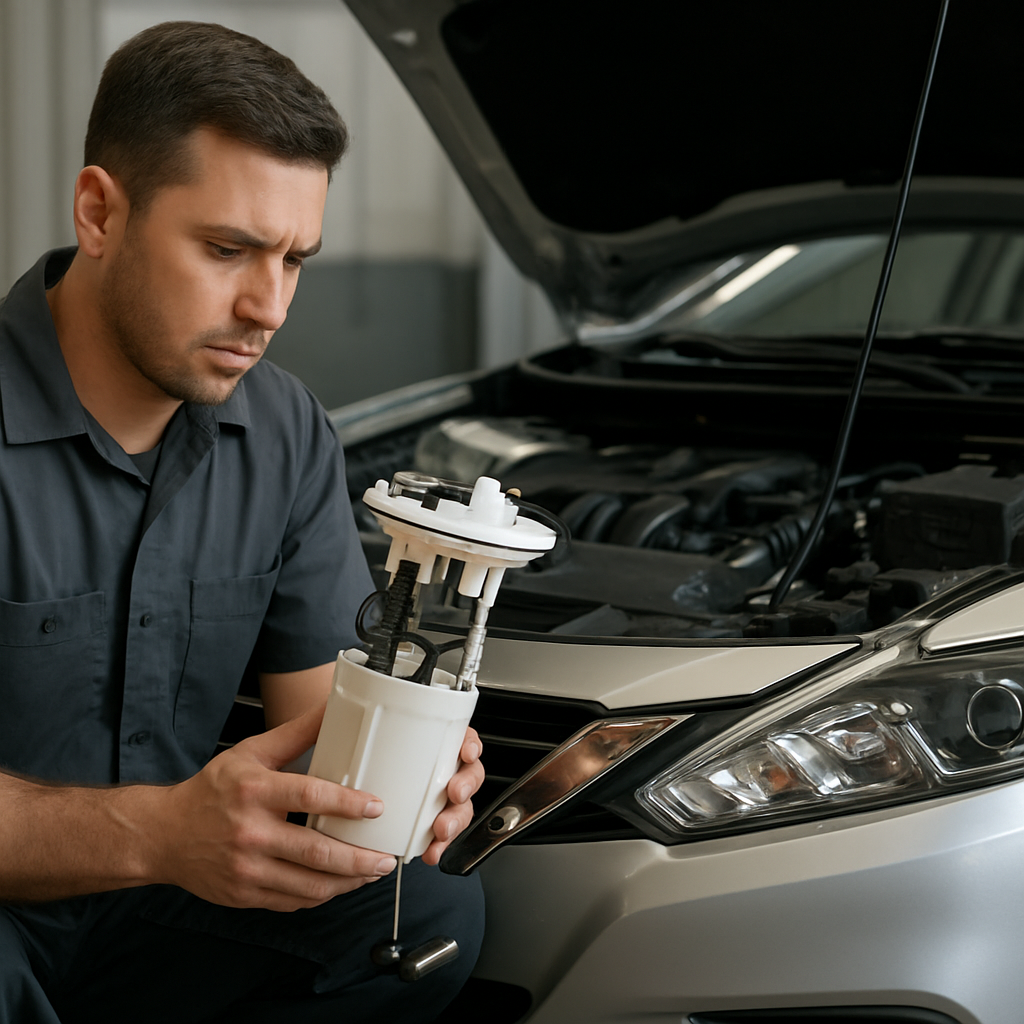
A weak or interrupted fuel supply in a Nissan Maxima may be associated with rough idling or a sudden loss of power, but those symptoms do not confirm that the fuel pump has failed. Hard starting, sputtering, stalling, or an unusual pump-area noise can also be clues, yet the available evidence does not establish a single symptom pattern for every Maxima model year. Diagnosis should distinguish a pump that is not being activated from one that runs but may not deliver adequate fuel.
Possible fuel pump problem symptoms in a Nissan Maxima
Watch for changes in how the engine runs, particularly rough or unstable idling and loss of power while driving. A weak fuel supply could contribute to these issues, but faults elsewhere can produce similar behavior. For more on one alternative cause of rough running, see our guide to other causes of a random or multiple-cylinder misfire.
- Hard starting or a crank-but-no-start: These can occur when fuel is not reaching the engine, but a pump fault is only one possibility. A no-start may also involve the pump circuit, a security-system issue, or another engine-management fault. See other reasons a car may crank but not start.
- Rough running or sputtering: An inadequate or inconsistent fuel supply may be involved, but ignition, air-intake, and other faults can cause similar symptoms.
- Loss of power or stalling: A fuel-delivery problem is one possible explanation. If the Maxima repeatedly loses power or stalls, stop in a safe place and arrange professional assistance; do not assume it is safe to continue driving.
- An unusual sound near the tank: A change in pump-area noise is worth noting and reporting, but sound alone cannot establish whether the pump is faulty or producing the correct pressure.
A Nissan dealer’s overview describes rough idling and sudden power loss as possible signs of a fuel-pump issue, while stressing that symptoms may appear in different ways. This is general guidance, not a confirmed symptom profile for every Maxima year; see Nissan fuel-pump issue guidance.
When symptoms begin, record the Maxima’s model year, whether the engine cranks, starts, and stays running, and when any power loss or roughness occurs. Access details and diagnostic procedures can vary by year, so do not assume that instructions for an older Maxima apply to yours.
How to tell whether the fuel pump needs replacement
Symptoms alone are not enough to justify replacing the pump. A sound diagnosis should establish whether there is a fuel-delivery problem and whether the pump itself or its electrical circuit is responsible.
A technician can check fuel pressure against the correct specification for the vehicle’s model year and configuration. The available information does not provide a Maxima-wide pressure value, so do not use a figure intended for a different year or vehicle. Electrical checks may also be needed to establish whether the pump is receiving power and whether the relevant fuse, relay, or wiring is at fault.
There is an important difference between a pump that does not activate and one that operates but may not provide sufficient pressure or flow. A non-activating pump does not prove that the pump itself has failed: a fuse, relay, wiring fault, or, in some cases, a security-system issue may be involved. A Maxima-owner forum discussion also raises the security system as a no-start check after a pump replacement; treat this as a troubleshooting lead, not evidence that it is a common Maxima fault.
Do not replace the pump solely because you cannot hear it or because the engine runs poorly. If the vehicle stalls, repeatedly loses power, or will not restart, professional diagnosis is the safer next step. Fuel-pressure and electrical testing, as well as work that opens the fuel system, should be left to someone equipped to do it safely.
A general Nissan fuel-pump recall news report does not establish that a particular Maxima is affected. Check recall eligibility using the vehicle identification number (VIN) through Nissan or an authoritative recall lookup; do not infer coverage from symptoms or a report about other Nissan vehicles.
What you can check without a fuel-pressure gauge
A brief listening check may provide a clue, but it cannot confirm pump condition. With the vehicle stationary and in a quiet place, listen near the rear-seat area as the ignition is switched on. A Nissan owner-forum discussion describes a pump-prime sound lasting roughly one to two seconds. This is community guidance, not a factory test for every Maxima year.
- If you hear a sound: It does not prove that the pump is producing correct pressure or flow.
- If you hear nothing: It does not prove the pump is defective. The pump may not be receiving power, or a fuse, relay, wiring, or other issue may be involved.
- Check the owner’s manual: You can consult the correct model-year manual for fuse and relay information. Do not rely on an unverified fuse number or relay location.
A forum discussion suggests checking the fuse and relay when the pump does not engage, but those checks cannot measure fuel pressure or establish that the pump is healthy. For confirmation, a technician needs a suitable pressure test and the correct year-specific specification. Avoid opening fuel lines, probing live wiring, or bypassing a relay as a DIY test.
Where is the Nissan Maxima fuel-pump relay?
The available information does not identify a relay location that can safely be applied to all Maxima model years. Check the fuse-box diagram in the owner’s manual for your exact year or consult authoritative service information or a qualified technician. Do not use a location or designation taken from a different Maxima year as a substitute.
What is the most common problem in Nissan?
The evidence available for this article cannot establish a single most common problem across Nissan vehicles. That question requires a defined model and year range and comparative reliability or repair-frequency data. Individual owner reports and isolated symptoms are not enough to support a brand-wide ranking. For a Maxima with possible fuel-pump symptoms, focus on diagnosing that vehicle rather than assuming a general Nissan fault.
When to seek help
Arrange professional diagnosis if the Maxima repeatedly stalls, suffers severe or recurring power loss, cranks without starting, or shows symptoms that are getting worse. If it stalls while driving, move to a safe place if possible and arrange assistance rather than continuing to drive. Give the technician the model year and a clear account of what happens, including whether the pump can be heard; these details can help guide testing but do not replace it.
If the engine cranks but will not start, another possible diagnostic avenue is the symptoms of a failing crankshaft position sensor. That is not a diagnosis of your Maxima, but it is one reason a no-start should be investigated rather than automatically attributed to the fuel pump.