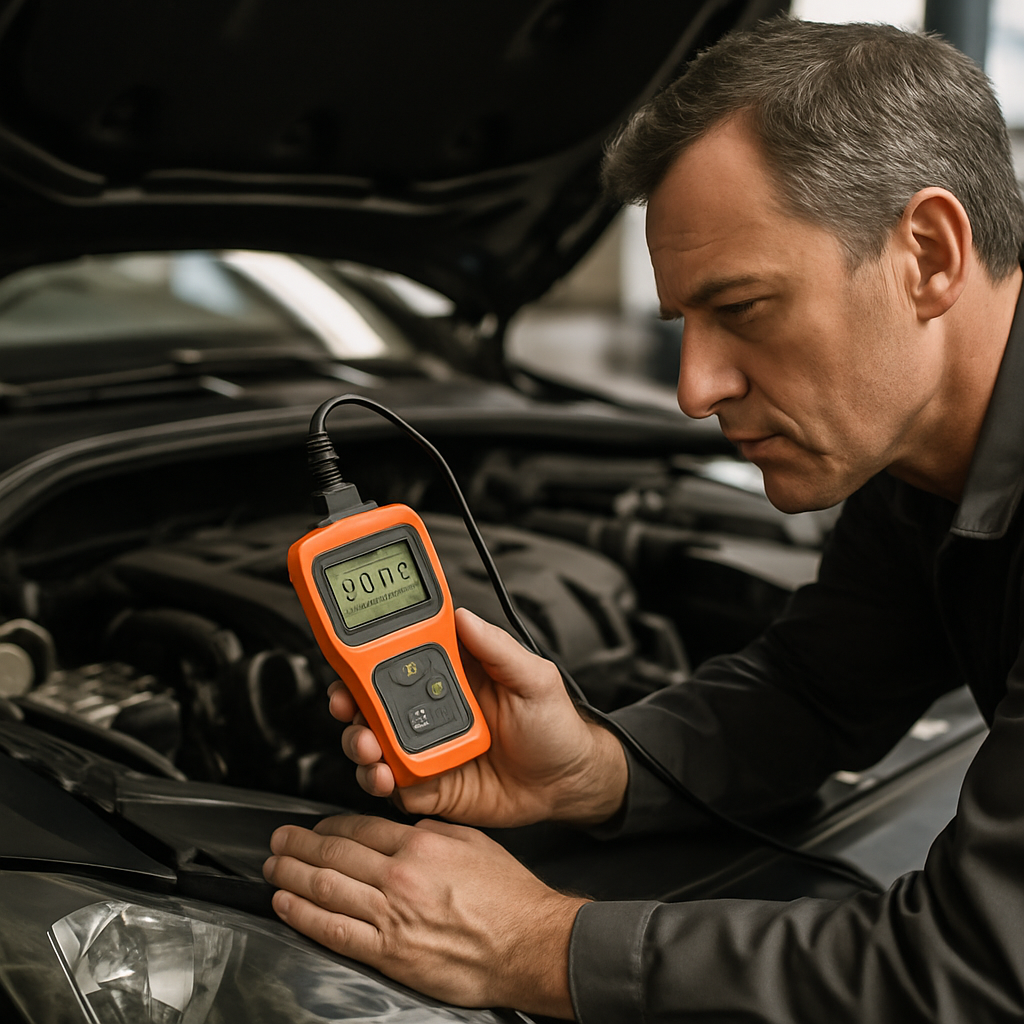
P0017 means the engine computer has detected a mismatch between crankshaft and camshaft position signals involving Bank 1, Sensor B. It points to a timing-correlation problem, but it does not prove that the camshaft sensor is faulty or identify one specific repair. Causes can include an oil or variable valve timing (VVT) issue, damaged wiring, a faulty sensor or incorrect mechanical timing. The right fix depends on diagnosis and the exact vehicle.
Because an underlying timing problem can be serious, arrange prompt diagnosis and avoid unnecessary driving until you know more. Do not replace parts or simply clear the code as a substitute for finding its cause.
What P0017 means and how to diagnose and fix it
P0017 is commonly described as a crankshaft and camshaft position correlation fault involving Bank 1, Sensor B. The engine computer compares position signals to check that the engine’s rotating components are synchronised. A discrepancy can arise from an electrical fault, an oil-related VVT problem or mechanical timing that is out of position. The code alone cannot tell you which of these has happened.
Possible symptoms include rough idling, sluggish acceleration and reduced fuel economy. A car may have some, all or none of these symptoms; their presence does not confirm which component has failed. A technical overview of P0017 and camshaft-position correlation also describes the code as a camshaft/crankshaft synchronisation issue.
A sensible diagnostic sequence is:
- Check the engine oil. With the car parked safely and following its handbook, check the oil level and condition. Confirm that the oil meets the specification for your vehicle. Low, contaminated or incorrect-viscosity oil can affect VVT operation. An oil and filter change using the specified oil may help if oil condition or level is contributing, but it is not a universal P0017 fix. P0017 diagnostic guidance includes checking the oil and oil-control component.
- Inspect relevant wiring and connections. Look for visible damage, loose connections or corrosion around the relevant sensor and oil-control component connectors. A visual check cannot rule out an internal circuit fault; further testing may be needed.
- Test the sensor circuits and components. A technician should use the correct procedure for the vehicle to assess the camshaft and crankshaft sensor signals, wiring and related components. The code does not establish that either sensor has failed. See our guides to symptoms and checks for a faulty crankshaft position sensor and how camshaft sensor symptoms are diagnosed.
- Assess the VVT oil-control component and passages. Depending on the vehicle and test results, a sticking or faulty oil-control valve or a restricted oil passage may need attention. Cleaning or replacing a component should follow diagnosis, not guesswork. Related codes such as P0012 and P0011 also concern cam timing or VVT operation, but they are not interchangeable with P0017 and do not prove the same fault.
- Verify mechanical timing when indicated. If tests point to a timing problem, or the code appeared after engine or timing-system work, the chain or belt timing may need to be checked against the vehicle’s service information. A damaged, stretched or incorrectly installed timing component is one possible cause. Mechanical timing work can be complex; use a qualified technician if you lack the correct tools or experience.
Depending on what testing finds, a repair might involve correcting the oil level or specification, changing contaminated oil and the filter, repairing wiring, cleaning or replacing a confirmed faulty VVT oil-control component, replacing a confirmed faulty sensor or correcting mechanical timing. P0017 repair guidance also discusses oil, sensors and VVT components as possible repair paths. These are possibilities, not a parts list to replace in sequence.
After a sensor replacement, some vehicles require a sensor or crankshaft-position-system relearn. The requirement and process vary by vehicle and may call for capable diagnostic equipment. If the code returns after a repair, further diagnosis is preferable to fitting more parts. Use service information for the exact year, make, model and engine.
Is P0017 serious, and can you drive with it?
P0017 should not be ignored, but the code alone does not confirm that mechanical timing has failed. The practical risk depends on the cause and the vehicle. If mechanical timing is incorrect in an interference engine, pistons and valves can contact each other and cause major engine damage; that is a serious possibility, not an inevitable outcome of every P0017 code.
Sources differ in how strongly they advise against driving: one recommends towing, while another says driving may be technically possible but is not recommended. There is not enough information in the code alone to assure you that your car is safe to drive. Arrange diagnosis promptly and avoid unnecessary journeys. Do not drive if the engine is running poorly, losing power, making abnormal noises, stalling or otherwise feels unsafe. In those circumstances, or if mechanical timing failure is suspected, arrange recovery or towing rather than driving to a garage. Follow your vehicle handbook and get qualified advice for your specific car.
How much does it cost to fix P0017?
As broad examples, OBDeleven’s P0017 cost guidance reports roughly $200 including labour for common camshaft- or crankshaft-sensor replacement, and about $15–$150 for a DIY sensor. It gives $1,000 or more as an estimate for more serious timing-chain work. The source notes that luxury models may cost more.
These are indicative figures, not a quote or guaranteed market prices. Actual costs vary with the vehicle, location, parts, labour, access to the component and the repair required. A sensor repair and timing-chain work are very different jobs, so the lower estimate should not be treated as the expected cost for every P0017 fault. Ask for the cause to be confirmed and request an itemised estimate before authorising parts replacement.
Where is Bank 1 Sensor B?
Bank 1, Sensor B is the code’s designation for the relevant camshaft-position correlation on Bank 1. It does not provide a universal physical location that applies to every engine, and the code does not prove that the named sensor itself has failed. Sensor position and identification depend on the exact year, make, model and engine.
Check vehicle-specific service information to identify Sensor B and distinguish it from other camshaft sensors. Do not rely on a generic front, rear, left, right, intake or exhaust location. If you cannot confidently identify the correct component, ask a technician before disconnecting or replacing anything.
How to check and replace a camshaft position sensor
First, treat a suspected camshaft sensor as one possible cause—not the diagnosis. P0017 can also result from wiring or connection faults, a crankshaft sensor problem, oil or VVT issues, or mechanical timing that is out of position. A sensor should be replaced only when testing supports that conclusion.
The appropriate high-level process is to identify the correct sensor using service information for the vehicle, inspect its connector and wiring, and test the sensor and circuit using the manufacturer’s applicable diagnostic procedure. Replace it if the results confirm a fault, then check whether that vehicle requires a relearn. There is no universal sensor location, pinout, resistance value or removal procedure for all cars. If you lack suitable tools or the code remains after replacement, seek professional diagnosis rather than replacing additional components.
A Bank 1 Sensor A circuit code is a different diagnostic description from P0017’s Sensor B correlation fault. Our guide explains how a Bank 1 camshaft sensor circuit code differs; it is not a direct repair guide for P0017.
Do P0017 fixes differ by make?
The general diagnostic approach—checking oil, wiring, sensor signals, VVT operation and mechanical timing—can help frame a P0017 investigation on a Nissan, Ford, Chevrolet or Mercedes. However, the available evidence does not establish a brand-specific common failure, repair procedure, sensor location or price for any of these makes.
Parts, access, oil requirements, timing procedures and relearn needs can vary by model, year and engine, including within the same make. Use service information for your exact vehicle or consult a qualified technician before attempting a sensor, VVT or timing repair. Do not assume that a repair described for another manufacturer or model applies to your car.
How P0016 relates to P0017
In the limited generic distinction available here, P0016 is described as a Bank 1 Sensor A crankshaft/camshaft correlation code, while P0017 involves Sensor B. A supplied P0016 definition comes from a Facebook result, not authoritative Chevrolet service information, so it should not be treated as a verified diagnosis for a Chevrolet Traverse or as applicable to every Traverse year and engine.
Neither code alone identifies the failed part or the correct repair. If a Traverse displays P0016, P0017 or both, use diagnostic information for its exact year and engine or have a qualified technician investigate. Do not infer a sensor location, cause or repair from the code number alone.