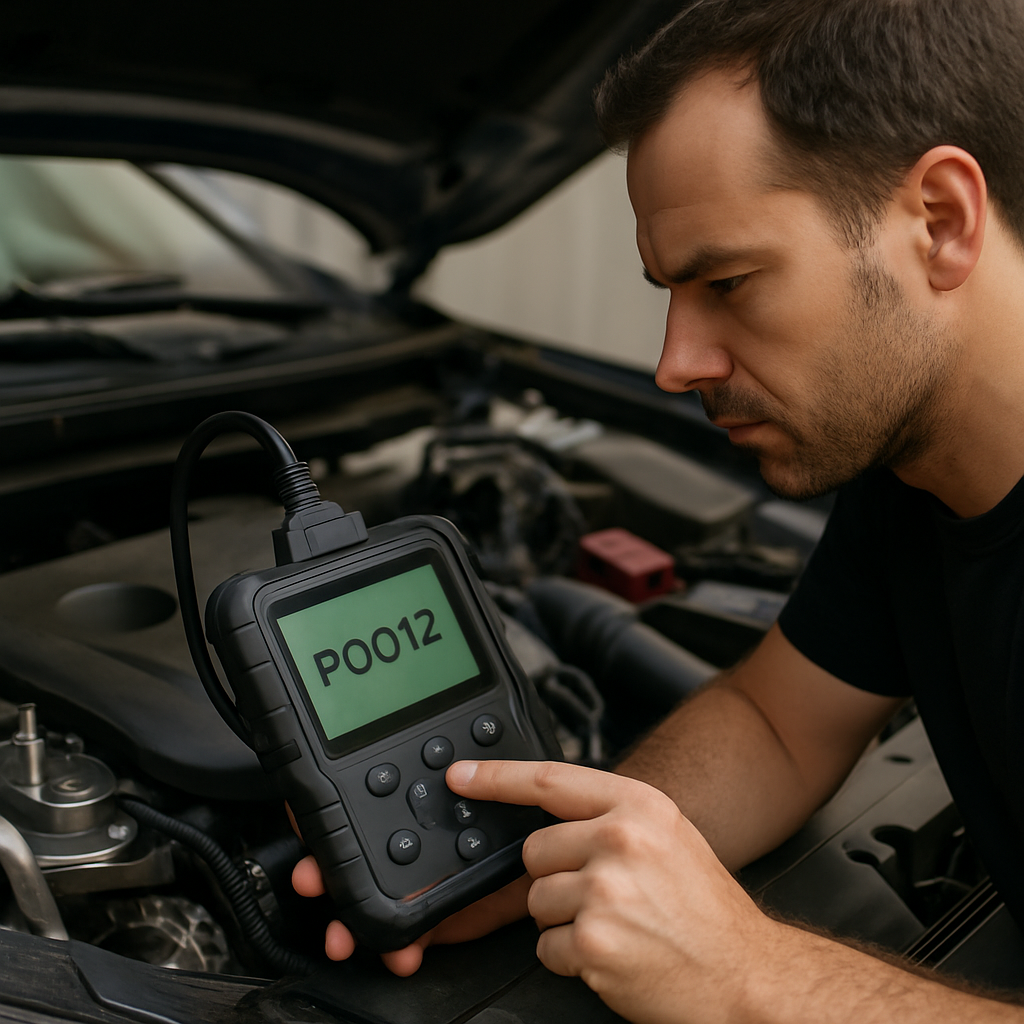
P0012 means the engine control module (ECM) or powertrain control module (PCM) has detected that the Bank 1 intake camshaft is more retarded than commanded or has not moved to the commanded timing position quickly enough. In plain terms, the camshaft timing is later than the computer expects. The code identifies a timing-performance problem, but it does not prove that the camshaft position sensor—or any other particular part—has failed.
What P0012 means
The standard description is “Intake (A) Camshaft Position Timing – Over-Retarded (Bank 1).” The “A” generally identifies the intake camshaft, although terminology can vary by vehicle. The ECM or PCM compares the camshaft position it requests with feedback about the position the engine actually reaches. P0012 is stored when the timing remains more delayed than the computer allows or does not respond as expected.
Many engines use variable valve timing (VVT) to adjust when the intake valves open and close. The control module can command a timing change through an oil-control solenoid; engine oil pressure then operates a camshaft actuator, also called a phaser. Camshaft-position feedback helps the computer monitor the result. A problem with oil supply, electrical control, the actuator or mechanical timing can therefore produce a similar code. The P0012 explanation from CarParts.com describes the difference between commanded and actual camshaft position and the VVT system’s role.
P0012 is not, by itself, a diagnosis of a bad camshaft position sensor. A sensor or its wiring may need testing, but the code can also arise when the timing system is not moving as commanded. If your scan tool reports a sensor circuit fault rather than a timing-performance code, see our guide to the separate Bank 1 camshaft sensor circuit code. You can also read about how to recognise and diagnose a bad camshaft position sensor.
What Bank 1 means and how to locate it
Bank 1 is the side of the engine that contains cylinder 1. It does not universally mean the driver’s side, passenger side, front or rear of the vehicle. On an engine with only one cylinder bank, Bank 1 still refers to the bank containing cylinder 1.
This definition applies to Toyota and Ford vehicles too, but it does not establish the physical side for every model or engine configuration. Check the service information for your exact vehicle, or ask a qualified technician, before disconnecting parts or starting a repair. Do not rely on a general online diagram to identify Bank 1 on a particular engine.
How over-retarded timing differs from over-advanced timing
“Retarded” and “advanced” describe opposite directions of camshaft timing error. P0012 specifically indicates that the Bank 1 intake camshaft is more retarded than commanded; it does not describe an over-advanced condition. If your scan tool reports a different code for over-advanced timing, check that code’s definition for your vehicle. Our guide to the P0011 code is a related resource for readers comparing camshaft timing codes.
How Bank 2 codes differ from P0012
On an engine with two cylinder banks, Bank 2 is the bank opposite Bank 1. Its physical position depends on the engine layout, so the code alone does not tell you which side of the vehicle to inspect. P0012 refers to Bank 1, not Bank 2. P0022 is a related over-retarded camshaft code associated with Bank 2 in the supplied code reference, but check the exact definition and component description for your vehicle before drawing conclusions.
P0015 is a different code from P0012. The available information here does not establish its exact camshaft or component definition, so verify it using authoritative service information for your vehicle rather than assuming it describes the same fault.
Common causes, symptoms and diagnostic steps
P0012 can have several causes. The code is a clue for diagnosis, not proof of a specific failed component.
Possible causes
- Low engine oil, oil in poor condition or oil that does not meet the vehicle’s specified grade.
- Low oil pressure or restricted oil passages that interfere with VVT operation.
- A sticking or failed VVT solenoid, also called an oil-control valve, or a fault in its wiring or connectors.
- A problem with the camshaft actuator or phaser.
- Worn, stretched, slipped or incorrectly installed timing-chain or timing-belt components.
- A camshaft-position sensor, related wiring or another control-system fault that requires testing to confirm.
These possibilities are consistent with the P0012 diagnostic overview from YourMechanic, which also describes checking oil, electrical connections, the oil-control valve and mechanical timing as part of diagnosis.
Possible symptoms
The check-engine light may be the only noticeable sign. Depending on the cause and how the camshaft is behaving, other symptoms can include reduced power, rough or erratic idling, hesitation, hard starting, stalling or increased fuel use. Symptoms vary: some vehicles may run poorly, while others may not show an obvious change in drivability.
What to check first
- Check the oil level and condition. Follow the procedure in your owner’s manual and use the vehicle’s specified oil grade. If you need a refresher, see how to get an accurate engine-oil reading.
- Look for other stored codes. Additional codes can help a technician understand whether the issue involves a circuit, another timing condition or a wider engine problem. Record the codes before clearing them.
- Arrange diagnosis if the code returns or symptoms are present. A technician may review scan-tool data, assess oil condition and oil pressure as appropriate, inspect wiring and connectors, test the oil-control solenoid and relevant sensors, and check mechanical timing when indicated.
Do not assume that an oil change will fix P0012, and do not switch to an unapproved oil viscosity in an attempt to clear it. Likewise, replacing the camshaft position sensor solely because P0012 is stored can waste money if the underlying problem is elsewhere. Timing-system inspection and repair should follow the correct vehicle-specific service information and require suitable tools and expertise.
What a P0012 repair may cost
There is no dependable price range or labour-time estimate in the available research, and a code by itself is not enough to quote a repair. The cost depends on the confirmed cause, the vehicle and engine, parts and local labour rates. Oil or control-valve work may be very different from repairing wiring, replacing an actuator or phaser, or correcting a timing-chain or timing-belt problem.
A camshaft position sensor replacement estimate may not answer the real cost question: P0012 does not confirm that the sensor has failed. Ask the repair shop for an estimate that separates diagnostic charges, parts and labour, and identifies the fault found before you authorise repairs. The RepairPal overview of P0012 also cautions that identifying a code is only the start of a diagnostic process; replacing a part without confirming the cause may not resolve the problem.
Can you drive with P0012?
There is no supported safe number of miles or days to drive with P0012. The risk depends on the cause and how the engine is running, so the code alone cannot guarantee that continued driving is safe. Arrange prompt diagnosis rather than continuing routine driving and hoping the fault clears.
If the engine is stalling, running severely rough, losing a substantial amount of power or showing another serious warning, stop in a safe place and arrange professional assistance rather than continuing. If there are no severe symptoms, that still does not confirm the vehicle is safe for an extended journey; use the owner’s manual and the vehicle’s behaviour to guide your immediate response, and get the fault checked promptly. A suspected bad intake camshaft sensor is not confirmed by P0012 alone, so driving advice should be based on the actual symptoms and diagnosis—not an assumption that the sensor is the only problem.