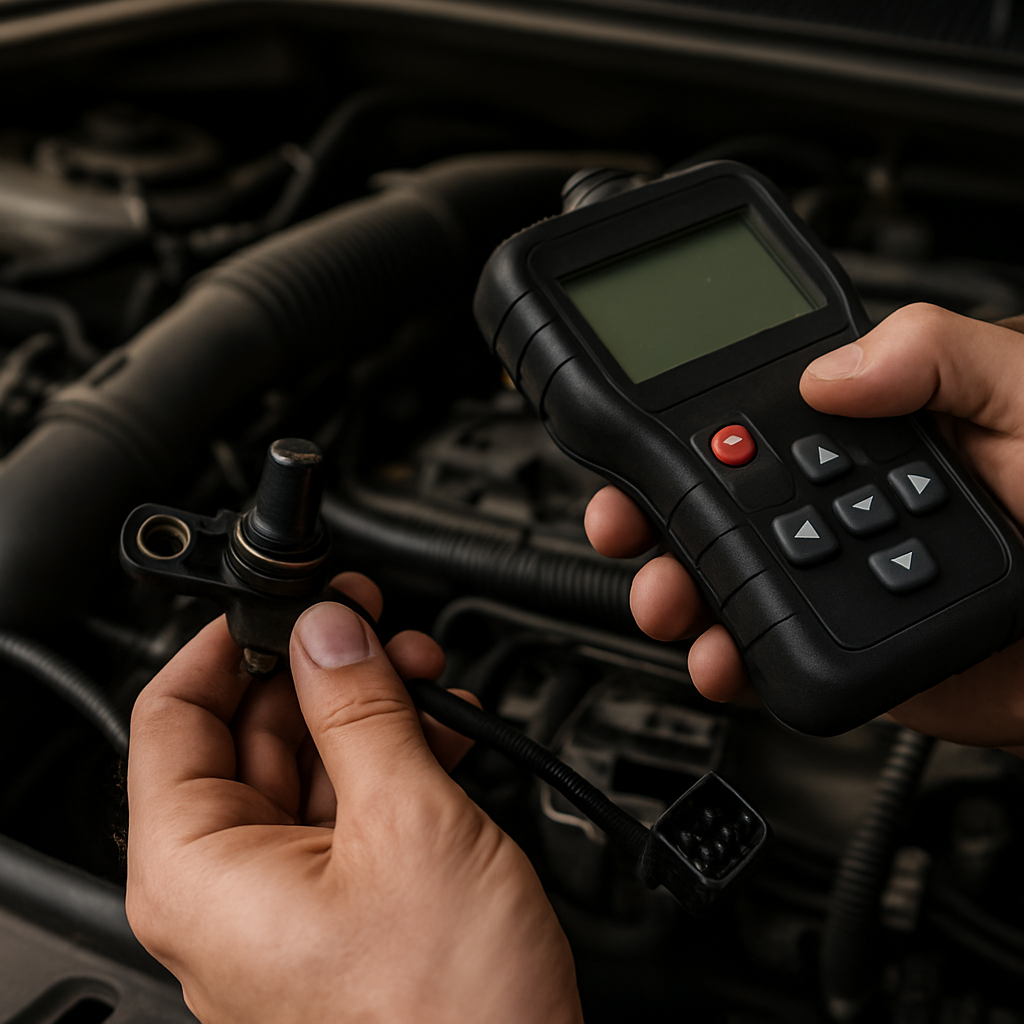
Hard starting or a crank-but-no-start condition, intermittent stalling, rough idle, misfires, hesitation, an erratic RPM or tachometer signal, and a Check Engine Light can all be consistent with a failing crankshaft position sensor. None of these symptoms, on its own, proves the sensor is faulty: wiring, connector, ignition, fuel-delivery, or camshaft-sensor problems can cause similar behavior.
What a crankshaft position sensor does—and symptoms that may point to a problem
The crankshaft position sensor monitors the crankshaft’s position and rotational speed, then sends that information to the engine control unit. The computer uses the signal in engine-management decisions, including ignition timing and fuel-injection control. If the signal becomes unreliable or disappears, the engine may run poorly, stall, or fail to start. The precise response depends on the vehicle.
Possible symptoms include:
- Hard starting or no-start: The engine may crank without starting, particularly if the computer is not receiving a usable crank signal. A fault may be intermittent, so the vehicle might start at one time and fail at another.
- Intermittent stalling: The engine may cut out unexpectedly if the signal is interrupted. Stalling can also have other causes, including a wiring problem, so it does not identify the sensor by itself.
- Rough idle or misfires: Irregular engine operation can occur when engine-management information is unreliable, but ignition and other engine faults can produce similar symptoms.
- Hesitation or reduced acceleration: Some drivers may notice the engine hesitate or feel less responsive. This is a general drivability symptom, not a specific crank-sensor test.
- Erratic tachometer or RPM reading: An RPM signal that drops out or behaves unexpectedly can be a clue to investigate, especially during cranking, but it is not conclusive proof of a bad sensor.
- Check Engine Light: The light may come on, sometimes with a crankshaft-position-related diagnostic code. It may also be absent, so its presence or absence cannot settle the diagnosis.
Reduced fuel efficiency, engine vibration, or backfiring may also be reported with engine-running problems, but these are nonspecific and should not be treated as reliable identifiers. Symptoms do not follow a universal sequence. A summary of possible crankshaft position sensor symptoms likewise describes overlapping signs rather than serving as a substitute for diagnosis.
If the main issue is an intermittent crank-but-no-start condition, other faults can cause the same pattern. See our guide to other causes of an intermittent crank-but-no-start.
What a crank sensor code can—and cannot—tell you
Codes in the P0335–P0339 family are associated with crankshaft-position sensor circuits or signals. A code is a diagnostic clue, not confirmation that the sensor itself has failed. The issue may be in the sensor circuit, connector, wiring, ground, or signal path; the exact interpretation depends on the vehicle and its service information.
A scan tool can help narrow down the problem. If it supports live data, a technician or suitably equipped owner may observe engine RPM or crank-signal data while the engine is cranking. Missing RPM or signal dropouts are clues that warrant further checks, not a stand-alone verdict. A code mentioning the crankshaft sensor should therefore lead to circuit and signal diagnosis before parts are replaced.
Other possible causes of similar symptoms include fuel-delivery problems, ignition-coil failures, and a faulty camshaft position sensor. Read our guide to symptoms of a bad camshaft position sensor for more on that overlapping diagnosis. If your scan also shows a P0300 code, see what a P0300 random-misfire code means.
Descriptions of the P0335–P0339 code family and live RPM clues note that other faults can mimic crank-sensor trouble. Use the code and live data alongside the exact vehicle’s diagnostic information; do not assume a particular code confirms a defective sensor.
Can you check a crankshaft sensor without a multimeter?
You can make some preliminary checks without a multimeter, but these checks cannot reliably confirm sensor failure on their own:
- Scan for diagnostic codes. Record the codes before clearing anything. A crankshaft-position-related code helps direct diagnosis, but does not prove the sensor has failed.
- Check live data if your scan tool supports it. Observe engine RPM or crank-signal information while cranking. No RPM reading or a signal that drops out is a reason for further diagnosis, not a definitive test result.
- Look at an accessible connector and harness. With the vehicle switched off, check only what you can safely see for an obviously loose connection or visible wiring damage. Avoid reaching near hot or moving parts, and do not pull on wiring or disconnect components as a test.
There is no supported universal no-tool procedure that can confirm a failed sensor across all vehicle and sensor types. If the scan and visual checks do not resolve the issue, use vehicle-specific service information or have a qualified technician test the circuit and signal.
Is there a temporary fix for a bad crankshaft position sensor?
There is no dependable temporary repair or universal bypass for a failed crankshaft position sensor. If an accessible connector or harness appears loose or visibly damaged, it is a reason to arrange an inspection; reconnecting or cleaning something is not a guaranteed fix, and the fault may be elsewhere in the circuit or engine-management system.
Do not rely on a bypass or reset video as vehicle-specific repair guidance. If the vehicle will not start, avoid repeated restart attempts and arrange diagnosis. If it stalls repeatedly, do not assume continued driving is safe; seek assistance rather than relying on a temporary workaround.
How do you reset a crankshaft position sensor?
The available evidence does not support a universal reset, relearn, or calibration procedure. Clearing a diagnostic code or disconnecting the battery should not be treated as a repair for an underlying sensor or circuit fault. Whether a particular vehicle requires a relearn after repair depends on its service procedure, so check the exact vehicle’s service information or ask a qualified technician.
What happens if you unplug the crank sensor?
The engine computer depends on the crankshaft-position signal for crank angle and RPM information used in engine-control decisions. Interrupting that signal can lead to a no-start, stalling, or related engine-management symptoms, although the result varies by vehicle.
Do not unplug the sensor as a diagnostic shortcut while the engine is running. The available information does not establish a safe, vehicle-independent procedure for doing this. Use a scan tool and vehicle-specific diagnostic instructions instead.
Do crank sensor symptoms differ by vehicle?
The general symptoms described above may occur across makes, but they do not establish a model-specific diagnosis. The available evidence does not support separate symptom lists, sensor locations, code interpretations, or repair and relearn procedures for a Chevrolet Silverado, Chevrolet Malibu, Chevrolet vehicles generally, Nissan, or Ford vehicles.
A matching symptom does not mean the same fault is present on every Silverado, Malibu, Nissan, or Ford. Exact checks and procedures can depend on the model year and vehicle configuration. Consult the service information for your specific vehicle or ask a qualified technician to interpret its codes and test results.
Does “crank sensor pulley” mean the same thing?
No. A crankshaft position sensor and a crankshaft pulley are different components. The phrase “crank sensor pulley” is ambiguous, and the available evidence does not establish symptoms or a diagnostic method for a faulty crankshaft pulley. Do not assume that pulley symptoms are the same as crankshaft-position-sensor symptoms; identify which component is in question before diagnosing or ordering parts.
What to do next
If you notice hard starting, stalling, misfires, or an erratic RPM signal, treat a crankshaft position sensor fault as one possibility rather than a confirmed cause. Record any diagnostic codes, use supported scan-tool data if available, and have the wiring, connector, circuit, and sensor signal assessed against the correct vehicle information before replacing parts. Repeated stalling or a no-start condition calls for diagnosis, not a guess or an improvised bypass.