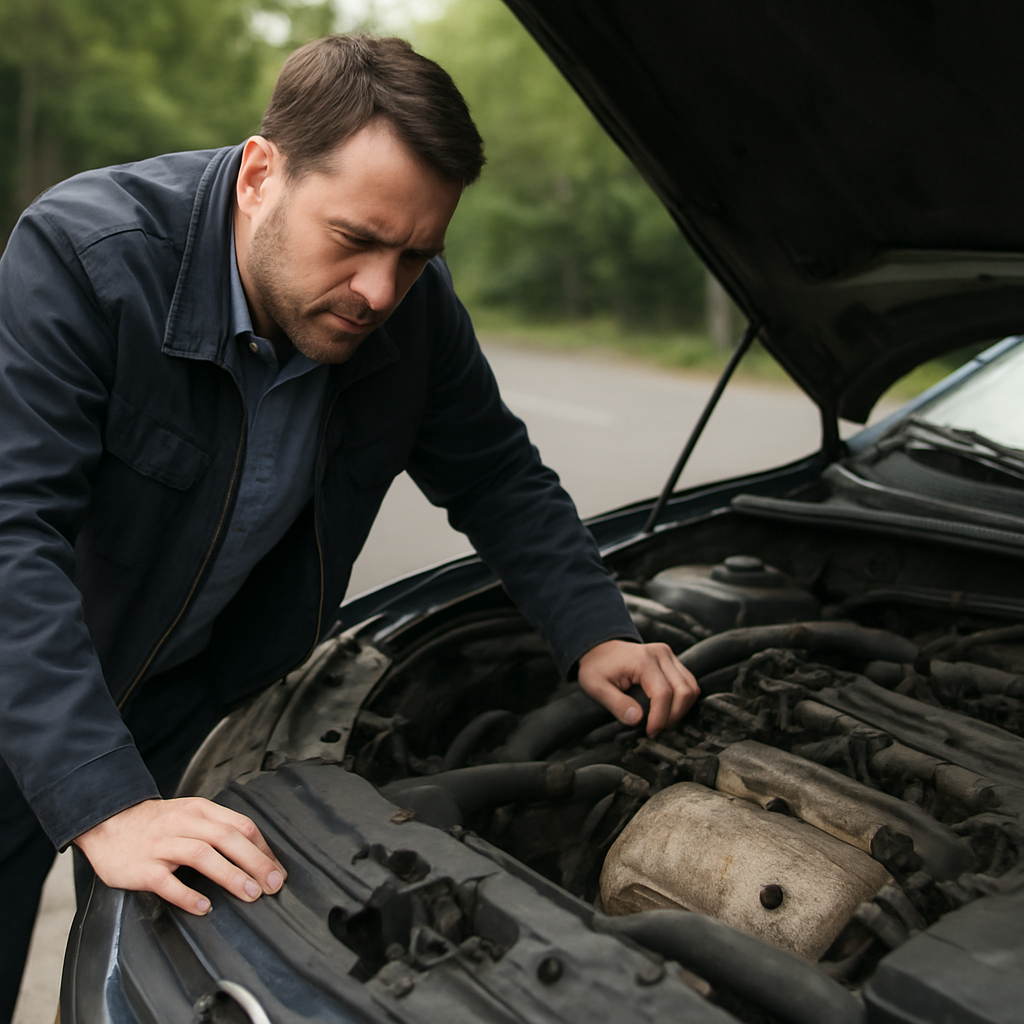
A car with a suspected broken catalytic converter cannot be considered safe to ignore. Some vehicles may remain briefly drivable when symptoms are minor, but that is not a guarantee, and there is no reliable universal number of miles or days that is safe. If the car has major power loss, is overheating or stalling, has a severe exhaust smell, or the converter is rattling, stop normal driving as soon as it is safe to do so and arrange professional help.
A check-engine light on its own is different from those severe symptoms, but it does not confirm that the catalytic converter has failed. Arrange a diagnosis promptly rather than continuing routine use or setting off on a long journey.
Is it safe to drive with a broken catalytic converter?
It depends on what has failed and how the vehicle is behaving. A converter can have an efficiency fault, be physically damaged or become severely blocked; these conditions do not all have the same effect on drivability. A warning light, smell, noise or other symptom is not enough on its own to diagnose the converter.
If the car still drives normally and the only sign is a steady check-engine light, a short local trip to have it assessed may sometimes be possible. That is conditional guidance, not a safety guarantee. Do not treat it as permission to continue normal use, drive a long distance or ignore worsening symptoms.
Major loss of power, overheating, stalling, a severe exhaust odour or rattling from the converter calls for more urgency: stop driving as soon as it is safe and seek professional assessment. One commercial source describes overheating and fire as possible risks from a malfunctioning converter, but this does not mean either outcome is inevitable or establish how likely it is. A catalytic-converter repair source discusses possible overheating risks; the vehicle’s condition needs to be assessed rather than guessed from a symptom.
How long can you drive with a bad catalytic converter or warning light?
The available evidence does not establish a safe number of hours, days or miles. The answer depends on the underlying fault and the vehicle’s symptoms, so there is no sound mileage allowance to rely on and no basis for promising that a long trip is safe.
If the check-engine light is the only symptom and the vehicle has no major power loss, overheating, severe exhaust smell or unusual noise, short local trips may sometimes be possible while arranging diagnosis. This is a limited, conditional possibility, not a fixed safe interval. A short trip to a repair facility is not the same as continuing routine driving or taking a motorway or long-distance journey.
A check-engine light alone neither proves the converter is faulty nor tells you how long it is safe to drive. A scan result such as P0420 also needs interpretation alongside other checks; it should not be treated as proof that the converter itself must be replaced. Read more about what a P0420 code means for driving or see our guide to the P0420 catalyst-efficiency code. If the light is flashing, consult what to do if the check-engine light is flashing; the light’s behaviour does not, by itself, identify the cause.
What happens if you keep driving, and which symptoms are warning signs?
A faulty converter may be associated with reduced engine power or acceleration, poor fuel economy, rough running or stalling, abnormal noise, a sulphur or rotten-egg-like smell, dark exhaust, or unusually high heat beneath the vehicle. These signs can have other causes, so none confirms a catalytic-converter failure on its own. A dealer’s overview of converter symptoms describes this range of possible signs, but diagnosis is still needed.
When a converter is severely blocked, restricted exhaust flow can create backpressure. The supplied repair sources warn that this may contribute to poor performance and possible engine damage if the problem is left unresolved; they do not establish that damage will happen or give a timeline. If power loss is the main issue, other causes are possible too—see other causes of sudden acceleration loss. A misfire may also be relevant to diagnosis, but it does not prove the converter is the cause; read about how a catalytic-converter problem may relate to a misfire.
A rattling converter should be inspected promptly. The sound alone cannot establish what is loose or damaged, or whether the car is safe to continue driving. Do not try to diagnose it by sound or assume that a brief rattle is harmless. Severe or worsening symptoms are a reason to stop normal driving and seek professional assessment.
An exhaust smell is not automatically caused by the catalytic converter: an exhaust leak or another exhaust-system fault may also be involved. A Car Talk discussion raises an exhaust leak as another possible explanation, but that discussion is not a confirmed diagnosis for any particular vehicle. Have the source of the smell checked rather than attributing it to the converter.
Can a catalytic converter unclog itself?
The supplied evidence does not establish that a clogged catalytic converter will clear itself. Do not rely on self-clearing or keep driving in the hope that a blockage will go away. A severe blockage can restrict exhaust flow and is associated with poor performance and possible engine damage, so have the suspected fault inspected.
First establish whether the converter is actually clogged and what the underlying fault is. The available sources do not support promising that a cleaner, a particular drive cycle or another unverified remedy will clear it.
Is it worth fixing a catalytic converter?
There is no universal economic answer. The supplied sources recommend having a faulty converter serviced and describe possible drivability, engine and environmental consequences of leaving a fault unresolved. But a warning light or symptom alone does not show that replacement is needed. Ask for a vehicle-specific diagnosis and repair recommendation before authorising work.
No vehicle-specific quote, repair estimate, warranty details or comparison with the car’s value is available here, so a responsible price or repair-versus-replace verdict cannot be given. Cost and the appropriate repair need to be confirmed for your vehicle. If you have a P0430 code, P0430 repair-cost considerations may help with that code-specific question, but they are not a general catalytic-converter price.
How far can you drive without a catalytic converter?
A removed converter is not the same condition as a damaged or faulty one. The available evidence does not support a safe-distance recommendation or a legal conclusion for driving a vehicle without its converter. Do not use guidance about a faulty converter as approval to drive without one; seek vehicle-specific technical advice and check the requirements that apply where the vehicle is used.