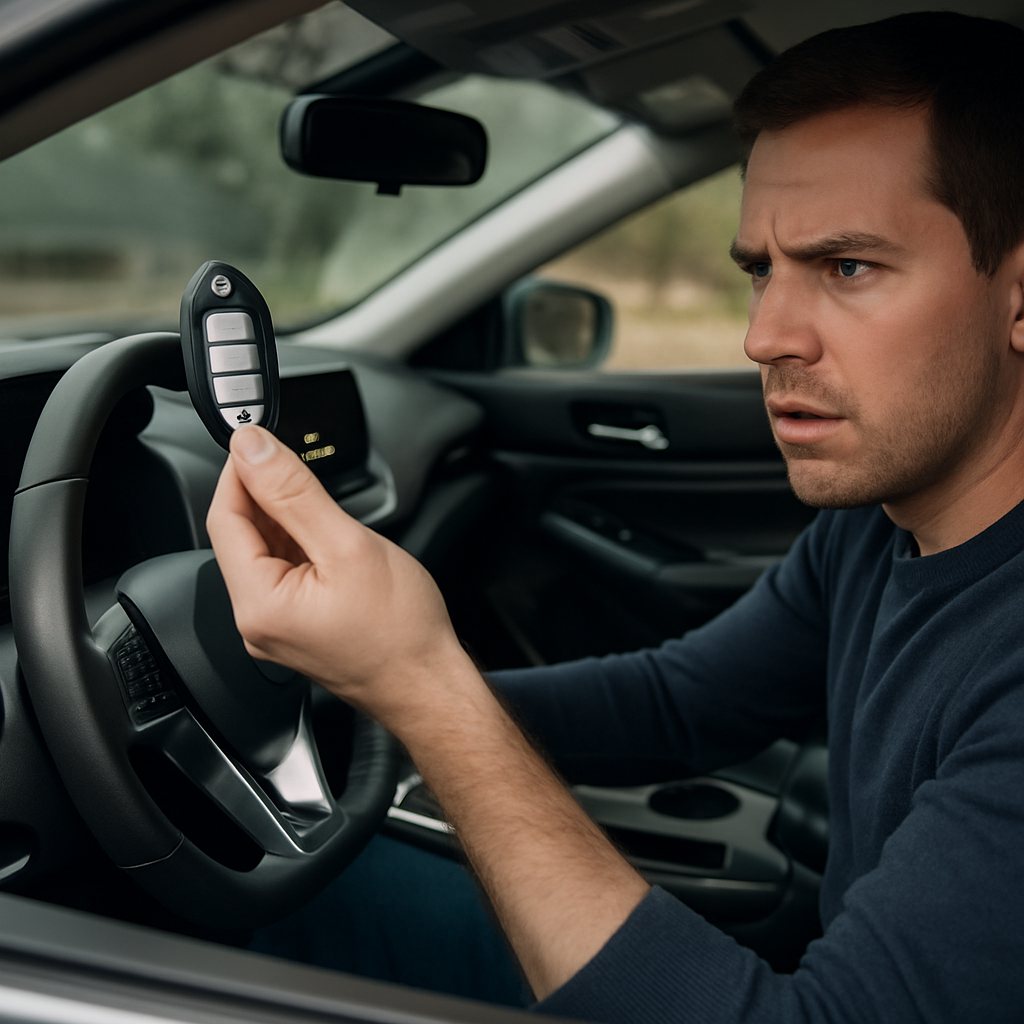
If your Nissan Altima displays “No Key Detected” and will not start, the car is not currently recognising the Intelligent Key fob it needs to authorise keyless starting. Start by treating this as a key-recognition problem rather than assuming the engine has failed. A weak fob battery is a practical first possibility, but fob damage, an incorrectly fitted replacement battery, interference and faults on the vehicle side can produce a similar warning.
First, make sure the intended fob is inside the cabin, the transmission is in Park and the brake pedal is firmly applied. Then try the close-range fob method described below if it is appropriate for your exact Altima. If the car recognises the fob but still will not crank or start, the warning may be separate from the underlying no-start problem.
What to Do First When Your Altima Says “No Key Detected”
Work through these checks in order. They are low-risk observations and do not attempt to defeat the vehicle’s security system.
- Bring the intended fob into the vehicle. Do not leave it in a bag outside the car, on the roof or close to the edge of the key-detection range. Remove other fobs from the immediate area if possible.
- Use normal starting conditions. Put the Altima in Park, press and hold the brake pedal, then press the start/stop button as normal.
- Try the fob at very close range. On some keyless-start Nissan procedures, holding or pressing the fob against the start/stop button while attempting to start can allow the vehicle to read a weak fob at close range. This is a limited emergency attempt, not an immobiliser bypass or a permanent repair. Check the owner’s manual that matches your Altima’s model year and equipment before relying on this method.
- If it starts, do not assume the fault has disappeared. A successful close-range start makes the fob battery, fob condition or normal operating range more suspect. Inspect or replace the fob battery as specified for your exact fob, then confirm that normal starting works repeatedly.
- Try a known-working programmed spare fob. If one fob works consistently and the other does not, the non-working fob, its battery or its recognition/programming is more likely to be involved. If neither fob works, a vehicle-side fault becomes more plausible, although that still is not a diagnosis.
A mechanical emergency key, where your fob has one, may allow you to unlock the door. It does not by itself make a push-button Altima start without a recognised fob. The immobiliser is intended to prevent that. General explanations of Nissan keyless systems similarly note that a correct fob signal is required for most keyless-start Altimas to authorise the engine start.
How to Manually Start a Nissan Altima When the Fob Battery Is Weak
For a driver stranded with a possible weak fob battery, the closest thing to a manual start is the close-range fob attempt: sit in the car with the correct fob, select Park, apply the brake, and hold or press the fob against the start/stop button while attempting a normal start. Reports discussing Nissan fob problems describe this as a possible way to initiate a start when the fob battery is weak, but the exact backup procedure can vary by model year and equipment.
Use the instructions in the owner’s manual for your vehicle rather than treating an internet procedure as universal. Do not repeatedly force the button, dismantle the start button, bridge wiring or try to bypass the immobiliser. If the close-range attempt fails, move on to the fob checks and professional-diagnosis triggers below.
It is also worth separating two ideas that are often confused. The metal emergency key is primarily an access tool, while the fob contains the electronics needed for keyless recognition. A discussion of starting Altimas with a conventional key notes that a blinking key symbol can indicate that the vehicle is not recognising the key; the applicable procedure depends on whether the car has a conventional ignition or an Intelligent Key system. See this overview of starting a Nissan Altima with its available key system for that distinction.
Common Reasons an Altima Cannot Detect the Key
The following are sensible possibilities to consider, beginning with the items an owner can check without dismantling the vehicle. A warning message alone cannot identify which one is responsible.
| Possible issue | What you may notice | Useful next step |
|---|---|---|
| Weak or flat fob battery | Reduced effective range, intermittent recognition or a close-range attempt that works when normal starting does not | Fit the correct battery specified for the exact fob and confirm reliable operation afterwards. |
| Replacement battery fitted incorrectly | The warning began immediately after a battery change | Re-open the fob carefully and verify the battery type, polarity/orientation, seating and proper case closure. |
| Damaged or contaminated fob | Cracked case, loose parts, water exposure, corrosion, dirt or a fob that fails while the spare works | Do not attempt internal electronic repair; have it assessed by a dealer or qualified automotive locksmith. |
| Range or possible electronic interference | The problem appears in a particular location or with electronics and multiple fobs close together | Move the fob into the cabin, separate other fobs and nearby electronics, then retry. |
| Vehicle-side key-system fault | Both programmed fobs fail, recognition is inconsistent or basic fob checks do not help | Arrange professional testing of the fobs and the vehicle’s key-recognition system. |
Weak fob battery does not always mean the remote is completely dead
A declining fob battery can reduce the strength and consistency of its signal. That is why it is reasonable to start there; several supplied sources identify a weak or dead fob battery as a frequent practical explanation for a no-key message. However, lock and unlock buttons working does not conclusively prove that the start-authorisation side of the system is healthy. Treat it as one observation, not a complete test.
If “No Key Detected” started after replacing the fob battery
Do not jump straight to reprogramming. Carefully inspect the work first: confirm that the replacement is the correct type for that fob, the polarity is correct, the cell is fully seated, the contacts are not obviously loose or contaminated, and the case closes fully without pinching or dislodging the battery. The supplied research specifically supports checking polarity and fitment after a battery replacement, while also identifying programming as only a possible later issue.
If the warning persists after those checks, compare the spare programmed fob if one is available. One fob working and one failing points more strongly towards the failed fob, its battery installation or its programming. Two fobs failing does not prove an antenna, receiver or module fault, but it makes a vehicle-side issue more credible and is a good reason to stop guessing.
Damage, distance and interference
Inspect the fob externally for a split case, evidence of moisture, contamination, loose battery contacts or impact damage. Do not pry at circuit boards or attempt to solder fob electronics. Physical damage and water exposure can require specialist fob testing or replacement.
Keep the fob in the cabin when starting, rather than in a crowded bag or far from the driver’s position. Nearby electronic devices, wireless chargers and other fobs are sometimes suggested as possible sources of interference. This is not a confirmed diagnosis simply because the warning appears, but separating them and trying again is a reasonable, non-invasive check. The same cautious approach is set out in this discussion of possible Nissan Altima no-key causes, which also identifies fob damage and vehicle electrical issues as possibilities.
“No Key Detected” vs. an Altima That Has Power but Still Will Not Start
The dashboard message points first to a communication or recognition problem between the fob and the immobiliser/keyless-start system. It does not rule out a second fault that prevents the car from starting. Likewise, illuminated dash lights, working interior lights or a functioning radio do not prove that the vehicle’s 12-volt battery is strong enough for starting.
Once the car recognises the key — or if the no-key message disappears — use the starting behaviour to describe the fault accurately:
- No crank or no attempt to start: the starter may not be engaging, but a weak vehicle battery, starting-system problem, brake/gear-position issue, ignition-related fault or other control-system condition can produce this symptom. The symptom alone does not identify a failed part.
- The engine cranks but does not start: key recognition may no longer be the main barrier. Broad possibilities include fuel-system, ignition-system or immobiliser-related faults, among others. Diagnosis is needed rather than replacing parts by assumption.
A jump-start may help if the 12-volt battery is weak, but it does not prove that the fob or immobiliser problem is fixed. For a wider explanation of this distinction, see Premier Motoring’s guide to what to check when a car has power but still will not start.
If a confirmed working fob is recognised but the Altima still will not start, especially if the behaviour is recurring or changes from one attempt to the next, arrange diagnosis rather than continuing to focus only on the key fob. General no-start guidance also identifies the vehicle battery, starter/ignition systems and fuel system as separate possible areas once key recognition is not the only issue.
Is the Altima in “Theft Mode”? Do You Need a Reset?
Not necessarily. The available research does not establish a Nissan-approved universal owner reset for a “No Key Detected” warning, nor does it support a universal procedure to take every Altima out of “theft mode”. A persistent key-recognition warning means the immobiliser is not currently authorising the fob it expects; it does not, by itself, prove that the car has entered a separately resettable theft mode.
Terms such as “No Key Detected”, “Key ID Incorrect” and “Key System Error” all relate broadly to key recognition, but they should not be treated as proof of the same failed component. Avoid battery-disconnect “resets”, online programming sequences of unknown applicability and any attempt to disable the immobiliser. Those actions can create further problems and do not establish why the warning appeared.
Programming or recognition can be involved after a fob problem, but replacing a fob battery should not automatically be assumed to erase programming. When basic checks fail, a Nissan dealer, qualified automotive locksmith or suitably equipped technician can test the fob and investigate vehicle-side possibilities such as the key-detection receiver or antenna, ignition/key-recognition circuitry, electrical glitches, wiring concerns or water-related damage. A post-battery-change Nissan fob discussion similarly cautions that reprogramming may require a dealer or mobile locksmith rather than being a reliable do-it-yourself task.
When to stop DIY checks
Book professional help if any of the following applies:
- Neither programmed fob is detected.
- A correctly installed fresh fob battery has not improved the problem.
- The fob is visibly damaged, has been wet or has loose internal parts.
- The warning is intermittent or returns repeatedly after apparently normal operation.
- The close-range fob-to-button attempt fails.
- The car recognises a known-working fob but still will not crank, or the engine cranks without starting.
Does This Advice Apply to 2012–2018 Nissan Altimas?
The broad checks in this guide are relevant to owners searching for help with a 2012, 2013, 2016, 2017 or 2018 Nissan Altima that reports “No Key Detected”: check the fob battery and its installation, inspect the fob, keep it within range, eliminate obvious interference, compare a programmed spare, and consider the vehicle’s 12-volt condition and key system if the fault persists.
That does not mean every one of those model years has identical fob hardware, warning wording, backup-start instructions or programming requirements. The supplied research does not verify a single shared procedure, battery specification or reset process for all 2012–2018 Altimas. Before using a fob-against-button start attempt or servicing the fob, use the owner’s manual for the exact year and equipment fitted to your car.
Bottom Line
A Nissan Altima that says “No Key Detected” and will not start most immediately needs a methodical key-recognition check: correct fob in the cabin, Park and brake applied, a model-appropriate close-range fob attempt, then a careful look at the fob battery, fitment, condition and spare fob. If those steps do not restore consistent recognition, do not look for a generic theft-mode reset or immobiliser bypass. Have the fob and vehicle key system tested, and separately diagnose any no-crank or crank-no-start condition that remains after the key is recognised.