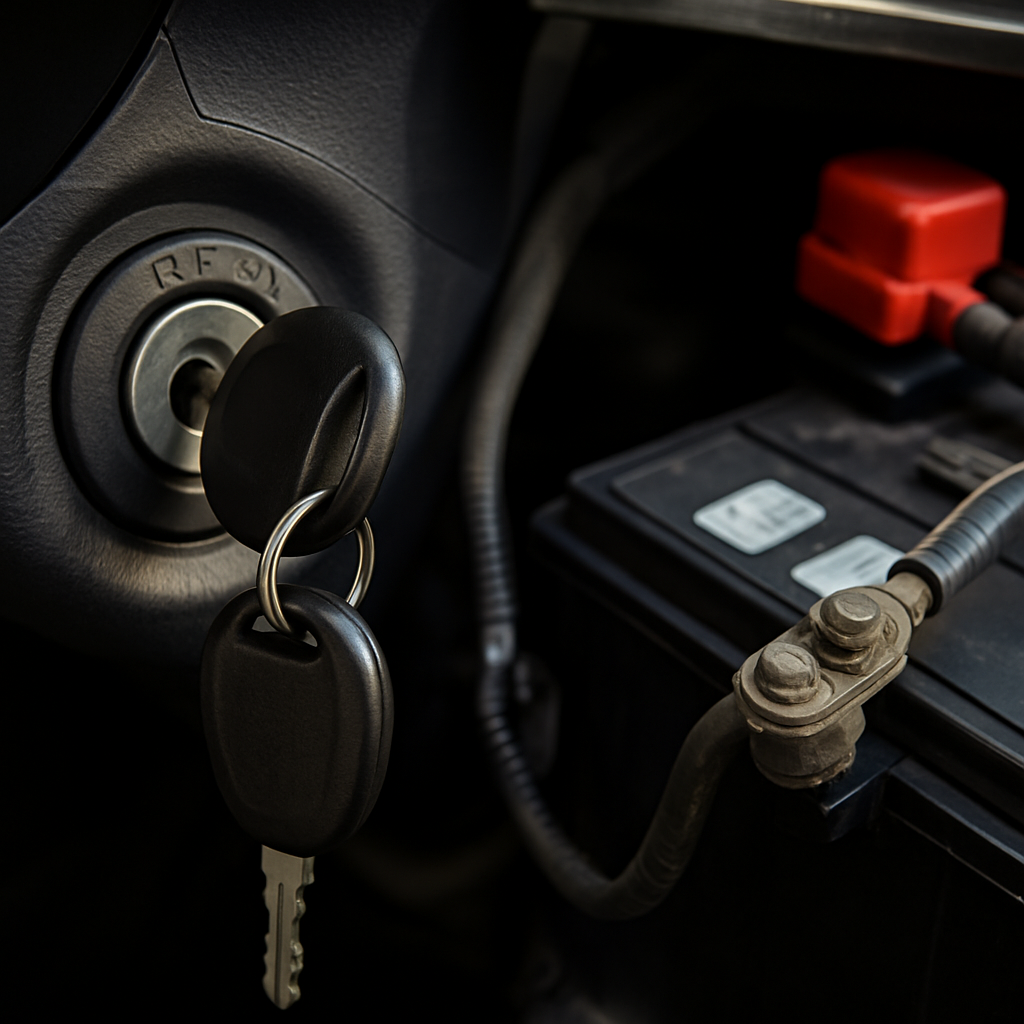
Leaving a physical key in the ignition does not automatically drain the battery. The important question is whether the key and ignition switch were left in an accessory or ignition-on position, or whether lights or other electrical equipment remained powered. Even with the engine off, a car battery supplies certain background systems, but an overnight no-start is not proof that the inserted key alone caused the discharge.
Before blaming the key, check its actual position and look for an obvious load: headlights, interior or door lights, the radio or another accessory. Also consider the battery’s age and condition, recent short journeys, how long the car was parked and the temperature. These factors can all reduce the reserve available for the next start.
Does Leaving the Key in the Ignition Drain the Battery?
It can, but not simply because the key is physically in the ignition barrel. The practical distinction is whether the vehicle has been left in an electrical state that keeps equipment energised.
When a car is parked, its battery normally still supports some low-level functions. As Firestone’s overview of battery drains notes, these can include the clock, radio and alarm system. Modern vehicles may also retain power for computer and convenience functions after the engine is switched off. Those background loads are not automatically the same as a significant parasitic drain.
By contrast, leaving the ignition or accessory system on may leave additional circuits and devices powered. Headlights, interior lights, door lights and accessories are more likely to leave a parked car unable to start later, particularly if the battery was already weak. Whether a particular key position powers a particular circuit varies by vehicle, so it is not sound to treat every car’s OFF position in exactly the same way.
If the key was left in overnight
If you left the key in the ignition overnight and the car is now unresponsive or will not start, battery discharge is a plausible explanation if a light, accessory or other load stayed on. It does not establish that the key’s presence was the cause. The useful first questions are:
- Was the switch fully in OFF, or was it in ACC/accessory or ON?
- Were the headlights, cabin lights or door lights on?
- Does the vehicle have an automatic light shut-off feature, and did it operate?
- Had the car been sitting for a long period, making mostly short trips or showing earlier signs of a weak battery?
A weak or ageing battery may have little margin for an otherwise modest parked electrical load. Hot and cold weather can also weaken battery performance, while frequent short journeys may not give the alternator enough opportunity to restore the charge used during starting and normal driving.
How Long Can the Ignition Stay On Before the Battery Dies?
There is no reliable vehicle-independent answer such as one hour, eight hours or overnight. The time before a car will no longer start depends on the battery’s state of charge and health, the equipment that remains on, the vehicle’s electronics, ambient temperature and the car’s recent use.
For example, an older battery, a battery that has not been fully recharged after repeated short trips or a battery affected by temperature may lose starting reserve much sooner than a healthy, well-charged one. The electrical load also matters: a vehicle left with more systems active will generally use more battery power than one left fully shut down with only normal retained-memory functions operating.
That is why an inserted key in an OFF state should not be treated as equivalent to an ignition-on or accessory-on state, and why a generic time estimate is not a guarantee. The available evidence does not support a dependable number of hours for every car or every key position.
What Drains a Car Battery When the Car Is Off?
A parked vehicle can have normal background electrical consumption, but it can also have a larger unintended draw. Potential contributors supported by the available research include:
- Lights left on: headlights, interior lamps and door lights can discharge a battery, especially where there is no automatic shut-off.
- Accessories or electrical devices that remain energised: an accessory or ignition-on state can keep more equipment powered after the engine stops.
- Extended parking: even normal electronic loads can matter over time, particularly with a weak battery.
- A battery in poor condition: age and reduced capacity can leave insufficient reserve for starting.
- Electrical faults: faulty relays, short circuits and other circuits that do not switch off properly can create a parasitic draw.
- A charging-system-related fault: a faulty alternator diode is one possible contributor to off-engine battery discharge.
UTI’s explanation of parasitic battery drain similarly distinguishes normal power use for electronics such as the engine computer, alarm and clock from conditions in which power continues to be discharged after shutdown because a component or circuit remains energised. That distinction matters: a clock or alarm in a parked car does not, by itself, diagnose a fault.
There can be several contributors at once. A battery with reduced reserve may be exposed by a single evening with an interior light on, while a healthy battery that repeatedly goes flat without an obvious load warrants a broader battery, charging-system and electrical assessment. For a wider look at conditions that can contribute to battery failure or discharge, see Midtronics’ overview of car problems that can kill a battery.
If the Car Will Not Start Afterward: What the Dead Battery May—and May Not—Mean
A no-start after a key was left in the ignition is a sequence of events, not a confirmed diagnosis. It may be consistent with a discharged battery, particularly where a light or accessory was left powered, but it does not prove the battery is faulty or rule out another starting or charging-system issue.
Symptoms that can fit a battery-related problem
Clicking when you try to start the car, or unusually slow or laboured cranking, can point towards a battery-related problem. However, neither symptom identifies the failed part on its own. The battery, starter, charging system or another electrical issue can require proper testing before a repair decision is made.
If you own a Rogue and the symptom is specifically clicking during a start attempt, Premier Motoring’s guide to Nissan Rogue clicking when starting provides a model-specific follow-up.
What to check before assuming the battery needs replacing
Keep the initial checks simple and observational. Confirm the key position, look for lights or accessories that may have been left on and consider whether the vehicle had already been slow to start. Think about whether it has been parked for an extended period, exposed to temperature extremes or used mainly for short journeys.
If there was no obvious load, or the battery repeatedly goes flat, arrange professional testing of the battery, charging system and relevant electrical circuits. This is more useful than assuming the event has been solved merely because the key was found in the ignition. Avoid bypassing fuses, altering wiring or attempting high-current electrical tests without the right equipment and knowledge.
For a different symptom pattern involving sputtering or a no-start after the vehicle has been parked, see what to check when a car will not start after sitting.
Key Fobs and Lawn Mowers Are Separate Questions
Leaving a key fob inside a keyless-entry vehicle is not the same question as leaving a physical key in a conventional ignition. The available evidence supports only the general point that off-engine electronics can draw power; it does not establish whether an in-car fob drains the vehicle battery, drains its own cell or changes vehicle behaviour for every make and model. Check the owner’s manual or manufacturer guidance for the specific vehicle rather than applying a blanket rule.
Likewise, this car-focused guidance should not be extended to a lawn mower. Mower key-switch behaviour, battery systems and charging arrangements vary by equipment design, so the manufacturer’s manual is the appropriate source for that question.
The Practical Bottom Line
Leaving the key inserted is not, by itself, a dependable explanation for a flat battery. A key left in accessory or ignition-on, a lamp left on or another active electrical load can discharge the battery, and a weak battery has less reserve to tolerate it. If the car will not start afterwards, note the switch position and any visible loads, but treat clicking, slow cranking or a dead battery as clues rather than a final diagnosis. Repeated discharge or a no-start with no obvious cause merits professional battery, charging-system and electrical diagnosis.
Pingback: Chrysler Pacifica Interior Lights Won't Turn Off: What to Check First and When to Get Help - Premier Motoring Blog
Pingback: Nissan Altima ‘No Key Detected’ and Won’t Start: Causes, Emergency Start Steps and Next Checks - Premier Motoring Blog