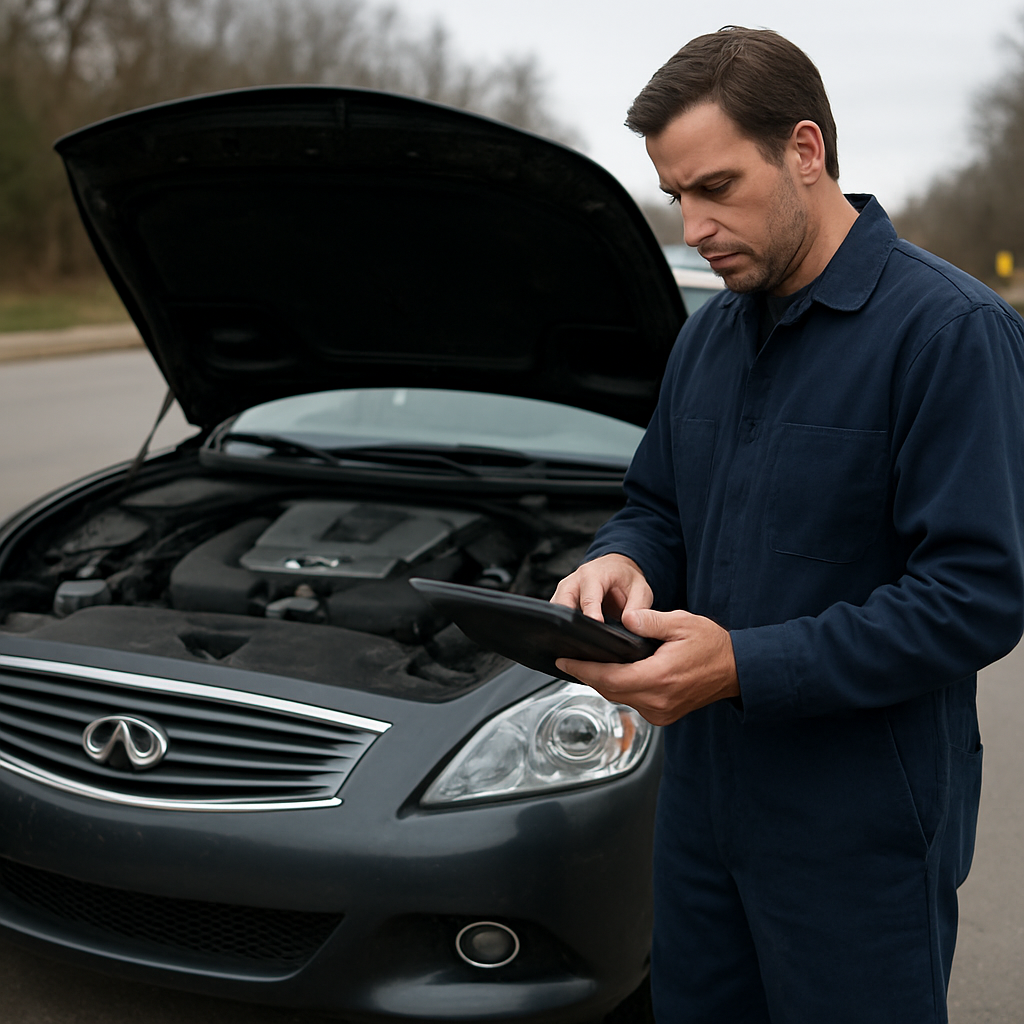
A restart may temporarily change how your Infiniti G37 behaves, but it does not identify or repair the fault that triggered limp mode. The reliable next step is to record the symptoms and warning lights, retrieve and save the diagnostic trouble codes before clearing anything, and have the cause diagnosed. If the car cannot respond predictably or its reduced power prevents safe control, stop in a safe place and arrange professional assistance or recovery.
How to get a G37 out of limp mode safely
If the G37 has lost power, focus first on getting out of traffic safely. Do not continue driving if the car cannot keep up with traffic, responds unpredictably or displays a serious warning. Switching the vehicle off and restarting it may alter the symptom temporarily, but a return to normal operation is not evidence that the underlying fault has been fixed.
- Record what happened. Note when the reduced power began, whether it followed a restart or occurred while slowing down, and whether there was shuddering, bucking, unusual behaviour or any warning lights. These details can help a technician reproduce the fault.
- Retrieve and record diagnostic codes. Have the diagnostic trouble codes read and written down before they are cleared. A fault code is useful diagnostic information, but it does not by itself prove which component has failed.
- Carry out only a basic visual check. With the vehicle parked and switched off, look for an obviously disconnected or damaged intake connection if it is safely accessible. Do not dismantle components or manipulate electronic throttle parts based on a guess.
- Arrange diagnosis if the problem remains or returns. A qualified technician can interpret the codes alongside the symptoms and test the car using service information that applies to its specific year and configuration.
An Edmunds forum discussion includes an owner statement that disconnecting a battery cable cleared limp mode temporarily. This is an anecdotal report, not a verified G37 reset procedure or a repair recommendation. The available evidence does not establish a safe battery-reset or relearn procedure for every G37, so do not disconnect the battery or attempt an electronic-throttle procedure without the applicable Infiniti service information.
For broader information, see our guide to safe steps for getting a car out of limp mode. The important distinction is the same: temporarily clearing or changing a symptom is not the same as repairing its cause.
Why a G37 may have little or no acceleration
Poor acceleration is a symptom, not a diagnosis. Limp mode is one possible reason for reduced power, but the available G37-specific evidence does not establish whether an individual case is caused by throttle bodies, engine management, an intake issue, a misfire, the transmission or another fault. The cause cannot be confirmed from reduced acceleration alone.
Owner-forum reports provide limited leads rather than verified diagnoses. In one G37 Reddit discussion, a commenter mentions throttle-body flaps that may be stiff or very dirty. An Edmunds discussion describes shuddering and bucking above 2,500 rpm alongside a limp-mode concern. Neither report establishes how common these issues are, nor does either confirm the cause of another G37’s problem.
Do not replace a sensor, throttle body or transmission component simply because the car is slow to accelerate. Likewise, do not treat a code or forum suggestion as proof that a particular part has failed. Record the exact symptoms and diagnostic codes first; interpreting them and carrying out confirmatory testing may require a qualified technician. The available evidence also does not support a universal diagnosis based on G37 model year, engine or transmission type.
What if the Service Engine Soon light is on?
Do not treat switching off the Service Engine Soon light as proof that the fault has been repaired. The available sources do not establish a G37-specific warning-light reset method or a verified cause for the light on a particular vehicle. Have the diagnostic codes retrieved and recorded before anyone clears them, then diagnose the underlying condition.
A warning light that goes out after a restart or reset may still return if the fault remains. Preserving the stored codes and the conditions in which the light appeared gives a repairer a better starting point than repeatedly clearing the system.
Is limp mode expensive to fix?
There is no supported typical or numerical repair cost for a G37 limp-mode issue in the available evidence. Limp mode does not identify the failed component or the work required, so a reliable price cannot be inferred from the symptom alone. After diagnosis, ask the repairer for an itemised estimate that explains the proposed work and parts before authorising repairs.
When should you stop driving?
Do not assume the G37 is safe to drive merely because restarting it temporarily restores power. If reduced acceleration prevents safe control or safe progress with traffic, the vehicle behaves unpredictably, or a serious warning is present, stop in a safe place and arrange professional assistance or recovery. If the cause is unclear or the condition returns, have the car assessed rather than relying on repeated resets.