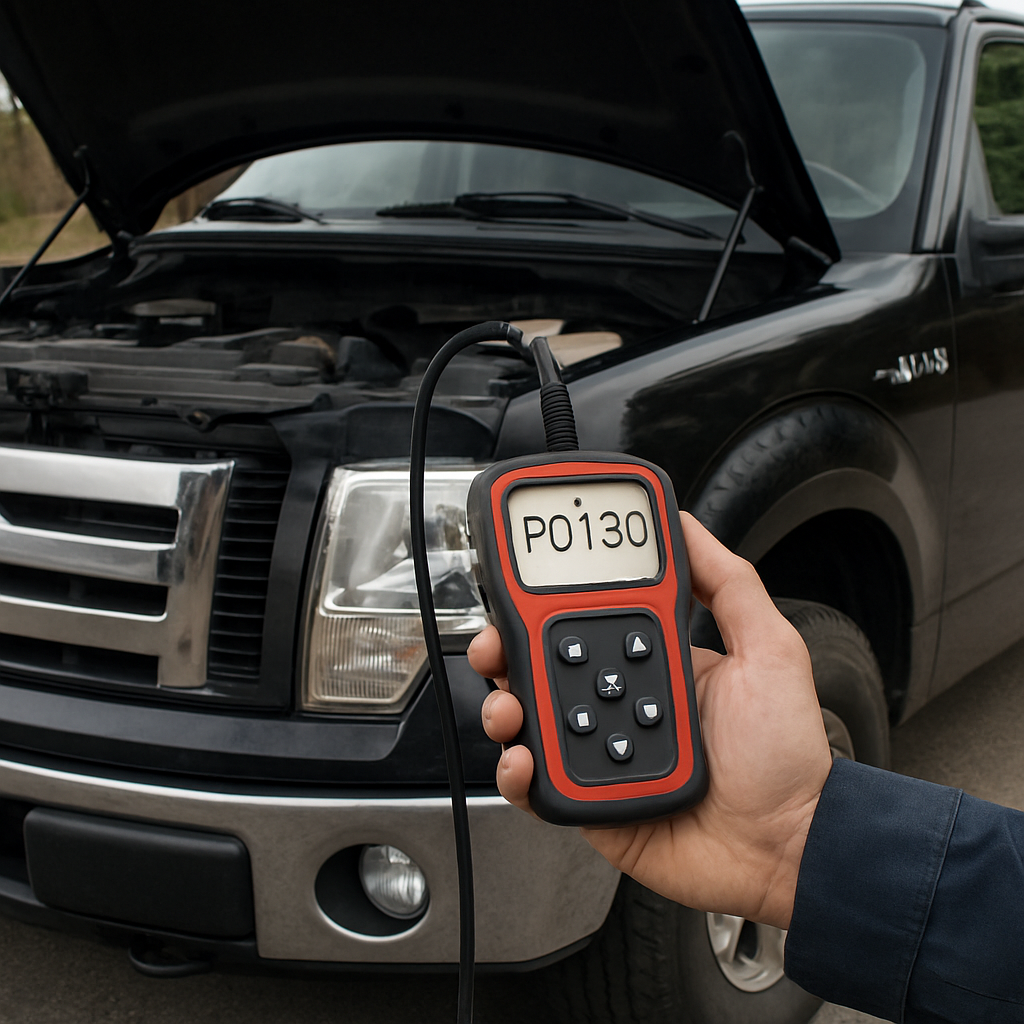
On a 2010 Ford F-150, treat a P0130 code as a diagnostic clue rather than proof that an oxygen sensor has failed. The supplied material repeatedly associates P0130 with oxygen-sensor terminology, including Bank 1 Sensor 1, but the only full-text source available is an Audi-owner forum discussion rather than Ford service information. It therefore cannot confirm the precise Ford definition, sensor location, circuit criteria or test procedure for every F-150 engine configuration.
What P0130 Indicates
The available source discusses P0130 in connection with an oxygen sensor and Bank 1 Sensor 1. That wording may help explain why the code is commonly investigated as an oxygen-sensor-related fault, but it is not a verified Ford-specific diagnosis for a 2010 F-150.
A diagnostic trouble code is not a parts-replacement instruction. Even where a code is associated with a sensor circuit, it does not by itself establish whether the sensor, its wiring, its connector, another related system or a vehicle-specific condition is responsible. The correct interpretation depends on the truck’s exact engine and configuration, together with the results of a complete diagnostic assessment.
Do Not Assume the Oxygen Sensor Needs Replacing
The Audi-owner P0130 discussion illustrates why replacing a sensor on the strength of the code alone can be inconclusive. In that separate case, the owner reported replacing the oxygen sensor twice while the code continued to return. That anecdote does not identify the cause on the Audi and does not establish a cause or repair for a Ford F-150. It does, however, reinforce the need to diagnose the fault rather than guess at a component.
The same discussion refers to exhaust and catalytic-converter modifications on that Audi. Those vehicle-specific details should not be carried across to a 2010 F-150 diagnosis. They also do not support fitting sensor spacers, modifying emissions equipment, suppressing the code or merely clearing it as a repair. A stored code should be addressed by finding and correcting the underlying issue.
Practical Next Steps for a 2010 F-150
- Have the truck scanned fully and confirm that P0130 is present, including any additional stored or pending codes.
- Use diagnostic information that matches the F-150’s exact engine and configuration; do not rely on a generic code description alone.
- Ask a qualified technician to assess the code before authorising replacement parts. The supplied material does not provide Ford-specific wiring details, pinouts, test values or a diagnostic flowchart, so these should not be assumed.
- If the truck has concerning running symptoms, arrange qualified assessment promptly. The available evidence does not establish a P0130-specific safe-driving judgement, distance limit or time limit for this Ford.
Keep Other Trouble Codes Separate
P0130 is distinct from other F-150 diagnostic codes. If a scan also reports P0420, see our guide to P0420 on a 2014 Ford F-150; it covers a different code and model year and does not diagnose P0130. For a separate P0430 code, consult the separate P0430 guide for Ford F-150 owners. One code should not be treated as proof of the cause of another.
Bottom line: P0130 points the diagnosis towards an oxygen-sensor-related area, but the supplied research does not verify a Ford-specific cause, repair or sensor location for a 2010 F-150. Confirm the code with a complete scan and have it assessed using service information for the truck’s exact engine.
Sources and Further Reading
- Code P0130 Subaru O2 Sensor Circuit Malfunction Bank 1 … — further reading identified in search results