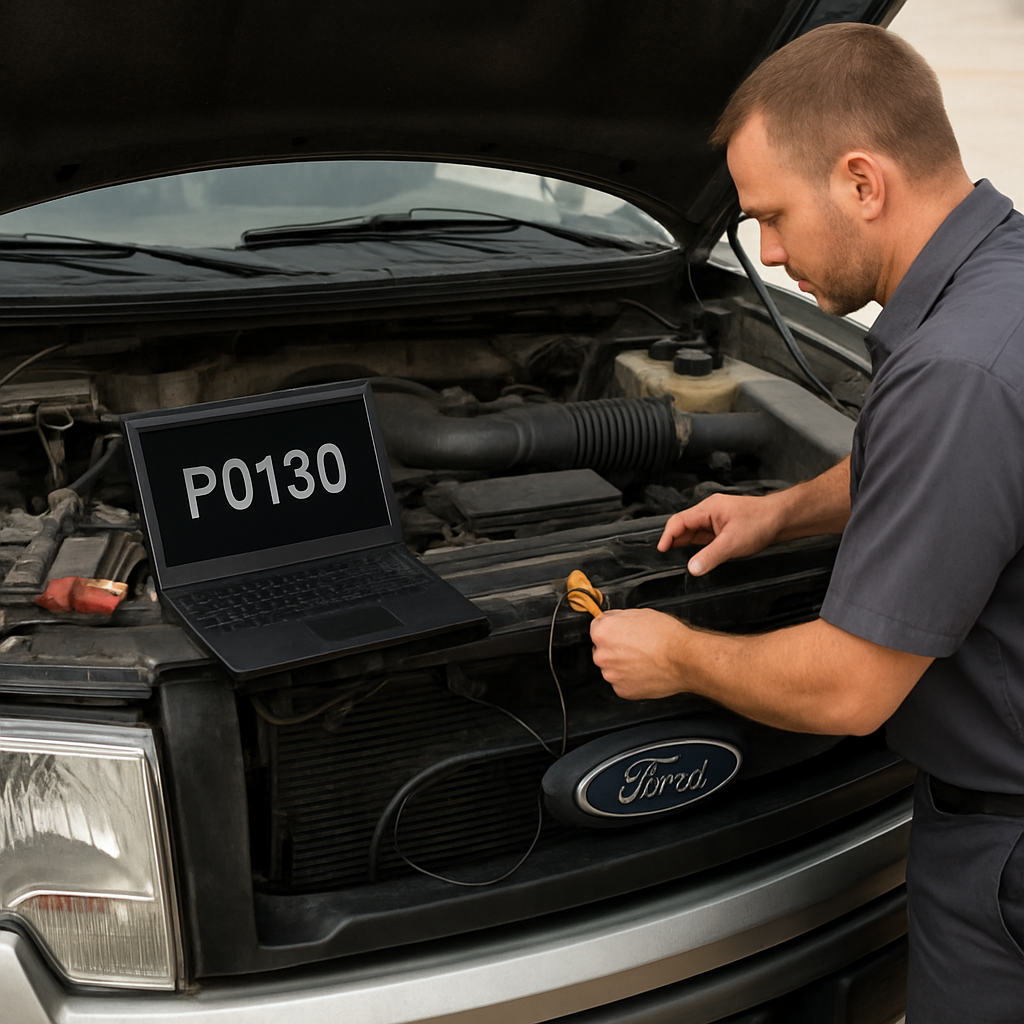
P0130 is a generic OBD-II fault code for a malfunction in the Bank 1 Sensor 1 oxygen-sensor circuit. The oxygen sensor produces a signal related to oxygen content in the exhaust, and the engine control module monitors that signal in closed loop to help regulate fuelling. The code identifies an issue with the monitored circuit or signal; it does not, by itself, prove that the sensor has failed or that the catalytic converter is faulty.
The available information explains P0130 in general OBD-II terms. It does not provide 2010 Ford F-150-specific engine identification, sensor location, wiring diagrams, pinouts, diagnostic thresholds or service procedures. Ford service information should be used for vehicle-specific tests and specifications rather than applying details from another make or model.
What P0130 means on a 2010 Ford F-150
“Bank 1 Sensor 1” identifies the oxygen-sensor circuit that the control module is monitoring. During closed-loop operation, the control module uses the sensor’s changing signal as an indication of exhaust oxygen content and adjusts fuelling accordingly. P0130 means that the monitored circuit or signal has not behaved as expected; it is not a direct instruction to replace a particular component.
The general P0130 diagnostic-code explanation describes the sensor signal and outlines checks that can help separate a sensor fault from wiring, engine or exhaust-related conditions. This general guidance is useful, but it is not a substitute for Ford’s specifications for the truck.
Possible causes: sensor, wiring, or a misleading exhaust reading
A faulty oxygen sensor is a common possible cause of P0130, particularly where a sensor is old. It is not, however, the only explanation. A circuit fault or a condition affecting the exhaust reading can produce a similar code, so replacing the sensor without further checks may not resolve the problem.
- Oxygen-sensor fault: The sensor may fail to switch between rich and lean indications or may respond sluggishly.
- Wiring or connector fault: Damage, a poor connection, or an intermittent open or short can interrupt the sensor signal. A signal that drops out when the harness or connector is moved can point towards this type of fault.
- Supply or ground problem: The sensor may not operate correctly if an applicable reference or heater supply, or its ground circuit, is missing or incorrect.
- Exhaust leak: A leak may allow extra oxygen into the exhaust near the sensor and make its reading misleading.
- Unmetered intake air: An unmetered vacuum leak can contribute to a lean exhaust reading. The general source notes that such leaks are usually accompanied by lean-related codes, although this is not guaranteed in every case.
These possibilities need to be distinguished during diagnosis. A sensor that does not respond properly may be defective; a signal that cuts out intermittently may indicate wiring or a connection issue; and a sensor that responds to a changing mixture may be reporting a genuine engine-airflow or exhaust condition. P0130 alone does not establish catalytic-converter failure.
Symptoms and what the code does—and does not—tell you
The malfunction indicator lamp may be the only noticeable sign. General P0130 diagnostic information also notes that an intermittent fault may produce no other apparent symptoms. The absence of noticeable symptoms does not identify the cause or confirm that the underlying fault has gone away.
The code alone does not establish how the truck will drive or whether it is safe to continue using. It should be diagnosed rather than treated as either proof of a failed sensor or evidence that no attention is needed.
How to approach diagnosis before replacing parts
- Read the sensor signal with a scan tool. A technician can observe Bank 1 Sensor 1 live data and assess whether the signal switches between rich and lean indications as expected. A steady or sluggish signal needs further investigation; it does not automatically confirm a failed sensor.
- Inspect the connector and harness. Check for visible damage, loose connections and signs of chafing or heat damage. With suitable equipment, a technician can monitor the signal while carefully moving the harness and connector. A dropout during this check can help identify an intermittent wiring fault.
- Check whether the sensor responds to mixture changes. A controlled rich/lean response test can help distinguish a sensor that reacts correctly from one that does not. This is technician-level diagnostic work and should follow the appropriate service procedure rather than being improvised as an owner test.
- Consider engine and exhaust conditions. If the sensor responds appropriately during controlled testing, an exhaust leak or an unmetered vacuum leak may be affecting the reading and should be investigated where relevant.
- Test the electrical circuits using Ford-specific information. If signal behaviour remains abnormal, a technician may check the applicable sensor reference or supply, heater supply and ground circuits, along with the wiring for opens or shorts. Generic examples sometimes refer to a 5 V reference and a 12 V heater supply, but these are not confirmed 2010 F-150 specifications. The correct values, test points and procedure must be verified using Ford service information.
Confirm the cause before replacing the sensor or repairing wiring. The aim is to establish whether the fault lies in the sensor’s response, an intermittent or damaged circuit, or an engine or exhaust condition affecting what the sensor detects. A stored code is the starting point for diagnosis, not a final component verdict.
Sources and Further Reading
- P0130
- P0130 Code : r/AskAMechanic — further reading identified in search results
- Code P0130 Subaru O2 Sensor Circuit Malfunction Bank 1 … — further reading identified in search results