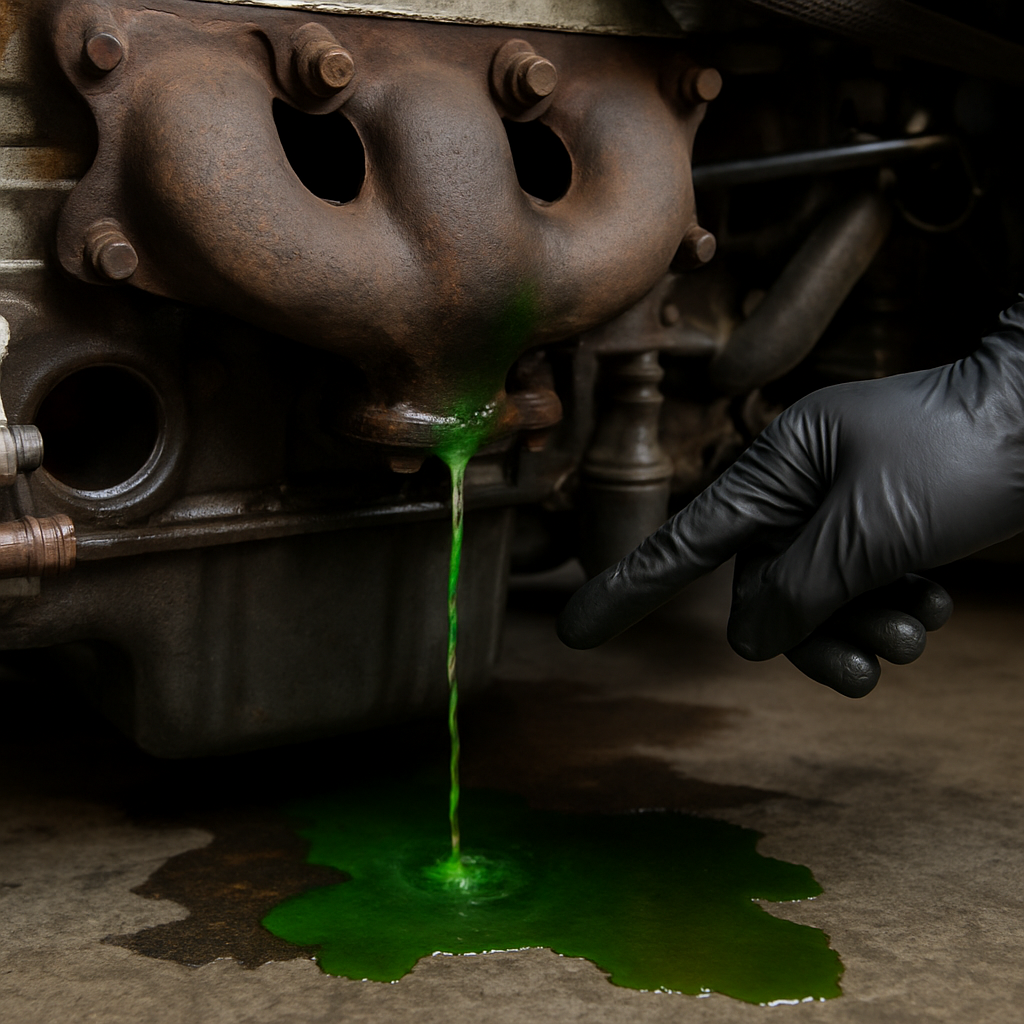
If coolant is visible below, or appears to be landing on, the exhaust-manifold area, the location alone does not identify the failed part. It does, however, deserve prompt, vehicle-specific attention because coolant contact with exhaust hardware has been documented as a fire-hazard condition in at least one recall application. Do not assume the exhaust manifold itself is leaking, and do not assume that every coolant leak in this area is a hose failure, a safety recall or an identical level of risk.
The available evidence supports one important example: a Volvo XC90 recall record concerning cracked engine-coolant hoses describes coolant leaking onto the exhaust and a resulting fire-hazard concern on affected vehicles. That is a documented defect for the vehicles covered by that recall; it is not evidence that the same hose problem applies to a Toyota, Ford, Chevrolet, Silverado, Jeep or any other unspecified vehicle.
Coolant Below the Exhaust Manifold: Treat the Location as a Safety Clue, Not a Diagnosis
Coolant often becomes visible where it runs, drips or collects rather than at its point of origin. A wet patch below an exhaust manifold therefore cannot, by itself, confirm a hose, a gasket, a plug, a head, a block, a drain fitting, a fastener-related issue or another cooling-system component. It also cannot establish whether the exhaust manifold is involved at all.
This distinction matters because online discussions frequently turn the visible location into a diagnosis. A vehicle may need inspection of the cooling system and the surrounding engine area, but the correct path requires vehicle-specific inspection or service information. The make, model, model year, engine and VIN are important because cooling-system layouts and manufacturer campaigns vary between vehicles and, in some cases, between engine versions of the same model.
For now, the sensible safety framing is limited but clear:
- Treat coolant seen on or near hot exhaust components as a concern that should not be dismissed as a cosmetic drip.
- Do not use the apparent position of the wet area to select a replacement part or authorise a repair.
- Do not treat an ordinary coolant leak as proof that a safety recall exists.
- Obtain vehicle-specific inspection or service information before deciding on a repair path or making a general drivability decision.
The supplied evidence does not support a blanket statement that every vehicle with this symptom is safe to drive, nor does it support a blanket instruction that every such vehicle must not be driven. The urgency and manufacturer guidance depend on the particular vehicle, the actual source of the coolant and whether an applicable campaign exists.
What the Documented Recall Example Does—and Does Not—Show
The Volvo example is useful because it establishes that coolant reaching exhaust components can be safety-relevant in a defined circumstance: the recall record identifies cracked engine-coolant hoses and describes a fire-hazard risk when coolant leaks onto the exhaust. It is not a universal explanation for coolant found below an exhaust manifold.
| What can be concluded from the evidence | What cannot be concluded from the evidence |
|---|---|
| Coolant leaking onto exhaust components was identified as a fire-hazard condition in the specified Volvo recall application. | Every coolant-on-exhaust observation has the same cause or the same degree of risk. |
| Recall status should be checked by VIN rather than guessed from a symptom or model name. | An unspecified Toyota, Ford, Chevrolet or Silverado has a related recall or known defect. |
| The wet area below a manifold is an observation, not proof of origin. | A particular hose, gasket, fastener or engine casting has failed. |
| Manufacturer information may provide defect and remedy details for an affected VIN. | General internet advice can substitute for the vehicle’s service information. |
Check recall applicability by VIN
A safety recall is vehicle-specific. The recall material supplied for this article explains that a recall notice identifies the stated defect, when repair arrangements are available and whether the manufacturer considers the unrepaired vehicle safe to drive. Use the VIN to establish whether a relevant open recall applies to the vehicle in question; do not infer eligibility from a similar-looking leak or from another owner’s experience.
A normal diagnostic or repair concern is not automatically a recall. Equally, a technical service bulletin or other manufacturer communication should not be treated as proof of recall eligibility. They are different types of manufacturer information, and neither should be used to diagnose an unspecified coolant leak from its location alone.
Why the Visible Leak Point Cannot Identify the Source
Searches for coolant leaking externally from below the exhaust manifold commonly lead to questions about manifold bolts, studs, intake-manifold gaskets, head gaskets, freeze plugs, block drains, cracked heads and cracked blocks. Those are distinct possibilities that require different vehicle and engine information. The research available here does not verify any of them as a general cause of this symptom.
That means it would be inaccurate to publish a ranked “most likely causes” list or to call any one of those components the answer for every vehicle. It would also be inaccurate to rule them in or out from the position of the coolant alone.
If coolant appears to be coming from an exhaust-manifold bolt or stud
Apparent seepage at an exhaust-manifold bolt or stud is a separate, engine-specific question. The supplied material does not establish whether any particular fastener intersects a coolant passage, whether a previous repair has affected the area, or what procedure applies to a given engine. Do not loosen, tighten, reseal or replace a manifold fastener merely because coolant is visible nearby. Correct action requires the factory information and inspection process for the exact engine.
Do not assume an intake-manifold gasket is involved
An intake-manifold gasket is not a universal explanation for coolant seen under an exhaust manifold. Whether that component is relevant depends on the engine’s design, and the supplied evidence contains no engine-specific information linking it to this symptom. It should not be described as a likely cause or treated as a repair recommendation without confirmed vehicle-specific findings.
A visible position does not confirm or exclude a head-gasket issue
The same limitation applies to questions about an external head-gasket coolant leak. The supplied research package does not provide an authoritative diagnostic reference, test procedure or vehicle-specific evidence that would support a factual answer for an unspecified engine. The observed location cannot confirm a head-gasket problem, but it also cannot rule one out.
Questions That Need Separate, Vehicle-Specific Diagnosis
Several closely related searches are not interchangeable with an externally visible coolant leak below an exhaust manifold. Keeping them separate avoids turning a symptom into a diagnosis.
- Coolant in the exhaust but not in the oil: the supplied evidence does not explain the significance, causes, testing or severity of that particular symptom combination. It calls for vehicle-specific professional diagnosis rather than an assumption about internal engine damage.
- “Where is the most common place for coolant to leak?” no prevalence evidence was supplied to rank coolant-leak locations. A general list would create false certainty and would not identify the source on a specific vehicle.
- “Can I drive with a leaking exhaust manifold gasket?” this is an exhaust-leak question, not confirmation of a coolant leak. The available research does not provide exhaust-manifold-gasket safety, emissions or drivability criteria, so it should not be answered by applying the Volvo coolant-on-exhaust recall example.
Toyota, Ford, Chevrolet and Silverado Searches Need More Than a Make Name
There is no supported Toyota-, Ford-, Chevrolet- or Silverado-specific cause, repair, recall, bulletin or component layout in the supplied research. A make name is not enough: a useful diagnosis needs the exact model, year and engine, plus the VIN when checking manufacturer campaigns.
For that reason, this article cannot responsibly say that coolant below the exhaust manifold on a Toyota, Ford, Chevy or Silverado points to a particular hose, gasket, plug or repair. Applying a generic online fix across those vehicles could lead to the wrong conclusion. The correct next step remains vehicle-specific inspection or service information.
If Coolant Is Disappearing but No External Source Is Found
Coolant loss without an externally visible source is a different symptom pattern from coolant that can be seen below the exhaust-manifold area. It should not be assumed to have the same cause. For a model-specific example of that separate situation, see Premier Motoring’s guide to losing coolant with no visible leak in a 2014 Buick Encore. That article is specific to that vehicle and is not evidence that it diagnoses an externally visible leak on another model.
What a Useful Diagnosis Should Establish
Before a repair is chosen, the important unanswered question is not simply “what is below the exhaust manifold?” It is where the coolant is actually originating on this particular vehicle. A qualified inspection or the correct manufacturer service information should distinguish the observed wet area from the confirmed leak source and should account for the exact engine configuration.
If a diagnosis eventually identifies a water-pump issue on a Jeep Grand Cherokee, Premier Motoring also has model-specific Jeep Grand Cherokee water-pump symptoms and replacement advice. That is conditional follow-up reading only; it does not establish the water pump as the source of coolant seen near an exhaust manifold.
In short, coolant below the exhaust manifold is a meaningful safety clue, especially because a documented recall shows that coolant on exhaust components can be hazardous on affected vehicles. But it is not a component diagnosis. Confirm recall status by VIN, preserve the distinction between a recall and an ordinary repair concern, and rely on vehicle-specific inspection or service information before treating any hose, bolt, gasket or engine component as the cause.
Pingback: Dodge Grand Caravan P0420 Code: Meaning, Causes, Fixes and Repair Cost - Premier Motoring Blog
Pingback: 2015 Hyundai Elantra Overheating: Common Causes and What to Check - Premier Motoring Blog