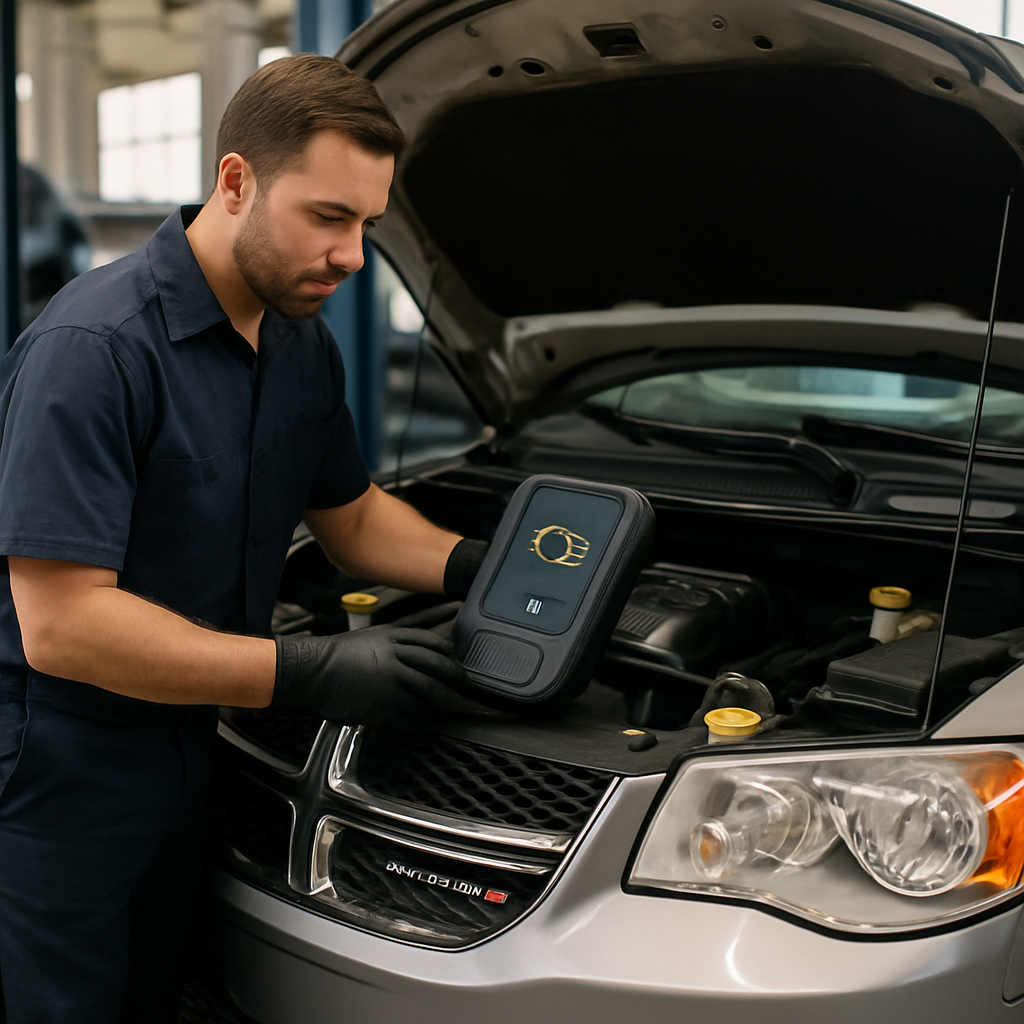
A P0420 code on a Dodge Grand Caravan means “Catalyst System Efficiency Below Threshold (Bank 1)”. In plain terms, the powertrain control module (PCM) has decided that the catalyst-efficiency monitor for one engine bank did not perform as expected. It often raises suspicion of a worn catalytic converter, but it does not prove that the converter itself must be replaced. An exhaust leak, an oxygen-sensor fault confirmed by testing, an engine misfire, incorrect fuel control or contamination from an engine problem can produce the same code or damage a converter over time.
The sensible next step is diagnosis rather than parts-swapping: read all stored and pending codes, note any symptoms, and deal with misfire or engine-running faults before authorising expensive exhaust work. P0420 can also cause an emissions-inspection failure, even where the Grand Caravan otherwise seems to drive normally.
What P0420 Means on a Dodge Grand Caravan
P0420 is a generic OBD-II diagnostic trouble code. Its formal description is “Catalyst System Efficiency Below Threshold (Bank 1)”. The catalytic converter is intended to reduce harmful pollutants in the exhaust. To assess whether it is doing that effectively, the PCM uses oxygen-sensor information from before and after the converter.
At a useful high level, the upstream sensor reports oxygen content in the exhaust before it reaches the converter, while the downstream sensor reports what leaves it. A working converter smooths changes in exhaust oxygen content. If the downstream sensor behaviour becomes too similar to the upstream signal under the conditions required for the monitor, the PCM may judge that the catalyst is no longer storing oxygen as effectively as expected and set P0420. This is the basic diagnostic logic described in Rick’s explanation of P0420 catalyst-efficiency monitoring.
That distinction matters: P0420 reports a monitor result, not a diagnosis of a confirmed failed part. It can accompany an illuminated check-engine light and can prevent the vehicle from passing an emissions test. Some owners also notice reduced fuel economy, but a P0420 code does not guarantee a particular drivability symptom.
“Bank 1” identifies the applicable engine bank; it is not a price category and does not, by itself, identify a particular sensor or converter location. Grand Caravan engine and exhaust layouts vary by model year and engine. Confirming the physical bank, sensor positions, wiring and correct replacement part requires service information for the specific vehicle or a technician with access to it.
Do Not Replace the Catalytic Converter Until These Causes Are Checked
A degraded catalytic converter is a possible outcome, and in a properly diagnosed case it may indeed need replacement. But replacing it first, without checking why the monitor failed, can waste money and leave the replacement converter exposed to the same damaging condition.
Possible causes of P0420
- A catalyst that has lost efficiency: the converter may no longer store and process exhaust oxygen as the PCM expects.
- Exhaust leaks: a leak can admit outside air and distort the exhaust-oxygen reading used by the monitor. It may be a much less costly repair than converter replacement.
- A faulty oxygen sensor or sensor-related issue: sensor operation must be tested, rather than assuming P0420 proves either that a sensor is bad or that it is good.
- Misfires and ignition faults: unburned fuel can overheat and damage the catalyst. A misfire code, rough running or flashing warning light should take priority over a catalyst-efficiency code.
- Rich or lean fuel control, intake or fuel-system problems: abnormal mixture control can affect exhaust readings and place an unhealthy load on the converter.
- Oil burning or internal coolant leakage: contamination can degrade a catalyst. These conditions need investigation in their own right, not merely a new converter.
- Physical damage or incorrect exhaust-component fitment: impact damage and unsuitable replacement parts can also require investigation.
The important pattern is cause and effect. A misfire or excessive fuelling can load the converter with fuel and overheat its substrate; fuel-control faults can affect the monitor; contamination can shorten converter life. As this structured P0420 diagnostic guide emphasises, fuel control, misfire information, exhaust integrity and contamination risks should be assessed before condemning the converter. Installing a converter without fixing the underlying engine fault can lead to another P0420 or a repeat converter failure.
If coolant is visible near exhaust components, do not assume it is the reason for P0420 or try to diagnose an internal leak by guesswork. Premier Motoring’s guide to safe first steps when coolant is found near the exhaust explains the limits of an owner inspection and when further diagnosis is appropriate.
A sensible diagnostic order
- Scan for every stored and pending code. Record freeze-frame information if the scan tool provides it, and note whether the check-engine light is steady or flashing. Do not focus on P0420 while ignoring related misfire, fuel-trim, oxygen-sensor or engine-temperature codes.
- Address engine-running faults first. Misfires, ignition faults and obvious rich- or lean-running issues should be diagnosed and repaired before catalyst replacement is considered.
- Inspect exhaust-system condition. A technician can check for leaks, loose joints, damaged pipes and converter impact damage. Exhaust leaks are an often-overlooked possible explanation for catalyst-monitor faults.
- Assess sensor and fuel-control data. Interpreting upstream and downstream sensor behaviour and fuel-trim data needs the correct scan data and vehicle-specific service information. A code reader alone cannot reliably condemn an oxygen sensor or a converter.
- Evaluate the converter only after those checks. If related faults, leaks, sensor performance and fuel control do not explain the result, diagnosis can more credibly support a failed catalyst or an applicable fitment issue.
Reading codes, recording warning-light behaviour and describing symptoms are reasonable owner-level first steps. Waveform interpretation, fuel-trim analysis, exhaust-leak diagnosis and exhaust-system replacement are better left to someone with appropriate diagnostic capability and information for the exact Grand Caravan.
Can You Drive a Dodge Grand Caravan With P0420?
An isolated P0420 may leave a Dodge Grand Caravan driving normally, and the code alone is not generally treated as an immediate drivability emergency. However, it should be diagnosed promptly rather than treated as a permanent warning light. The vehicle may produce higher emissions, fuel economy may suffer, and an unresolved engine fault can cause additional catalytic-converter damage.
Do not interpret that as a blanket declaration that every Grand Caravan with P0420 is safe for normal use. Risk depends on the cause and any accompanying faults. Arrange prompt professional assessment and avoid relying on the vehicle for routine driving if P0420 appears with any of the following:
- a misfire, rough running or a flashing check-engine light;
- stalling or repeated difficulty keeping the engine running;
- clear or worsening loss of power;
- overheating, smoke, or another serious engine symptom; or
- other warning lights or diagnostic codes that indicate an engine problem.
Those signs do not prove that P0420 has caused a blocked converter. They do mean the underlying problem may be more urgent than a catalyst-monitor result alone. For broader advice on how to judge when a check-engine light needs prompt attention, the same principle applies: assess the light alongside how the engine is behaving, rather than relying on one code in isolation.
Even if the van feels normal, P0420 can keep it from passing an emissions inspection until the underlying fault is repaired and the relevant monitor has had the conditions needed to complete.
How P0420 Is Fixed and What Repair May Cost
There is no single repair for a P0420 code. The correct repair is the one that fixes the confirmed cause, followed by verification that the code does not return once the required drive-cycle or monitor conditions have been met. Clearing the code may turn off the light temporarily, but it is not a repair, and fitting an untested part simply to clear the light is not sound diagnosis.
The usual repair sequence follows the diagnostic order:
- Correct confirmed misfire, ignition, intake, fuel-system or fuel-control faults.
- Repair exhaust leaks or damaged exhaust components.
- Replace an oxygen sensor only if testing supports a sensor fault.
- Replace the catalytic converter only when diagnosis supports converter failure and any root cause that could damage the replacement has been addressed.
This is why the questions “How do you fix P0420?” and “How much does it cost to repair P0420 Bank 1?” do not have one fixed answer. Bank 1 and the code label do not establish the repair price; the confirmed fault does.
Broad repair-cost context
The following figures are broad general 2026 context from a published P0420 repair-cost overview. They are not verified Dodge Grand Caravan quotes.
| Possible work | General indicated cost | What the figure does and does not mean |
|---|---|---|
| Diagnostic assessment | About $100 to $180 | A diagnosis fee can help distinguish a leak, sensor or engine fault from an actually failed converter. |
| Exhaust-leak repair | About $100 to $400 | Cost depends on the leak location, corrosion, damaged components and labour required. |
| Downstream oxygen-sensor replacement | About $150 to $500 | Appropriate only where testing supports a sensor-related fault. |
| Catalytic-converter replacement | About $1,300 to $3,500 | A broad general range, not an installed price for any particular Grand Caravan. |
Actual cost for a Grand Caravan can change substantially with model year, engine, emissions-certification configuration, the exact failed component, parts choice, local labour rates, location and any related engine repair. The supplied evidence does not establish Grand Caravan-specific labour times, converter layout, compliant part fitment, warranty coverage, recall status or an exact installed price.
Before approving major exhaust work, request a written diagnosis that identifies related codes, exhaust-leak findings, relevant oxygen-sensor or fuel-control test results, and any misfire, oil-consumption or coolant-contamination concern. That record is more useful than a recommendation based solely on the presence of P0420.
What to Do Next
- Read and record all codes; do not erase them before noting whether there are related faults.
- Note whether the engine is smooth, whether fuel economy has changed and whether there is loss of power, smoke, overheating or a flashing warning light.
- Prioritise a misfire or serious engine symptom over the P0420 label itself.
- Book diagnosis that checks engine operation, exhaust integrity, sensor data and converter condition in that order.
- Approve an oxygen sensor or catalytic converter only when testing and inspection support that repair.
For a Dodge Grand Caravan, P0420 is best treated as a useful warning that the emissions system needs investigation—not as an automatic instruction to buy a catalytic converter.