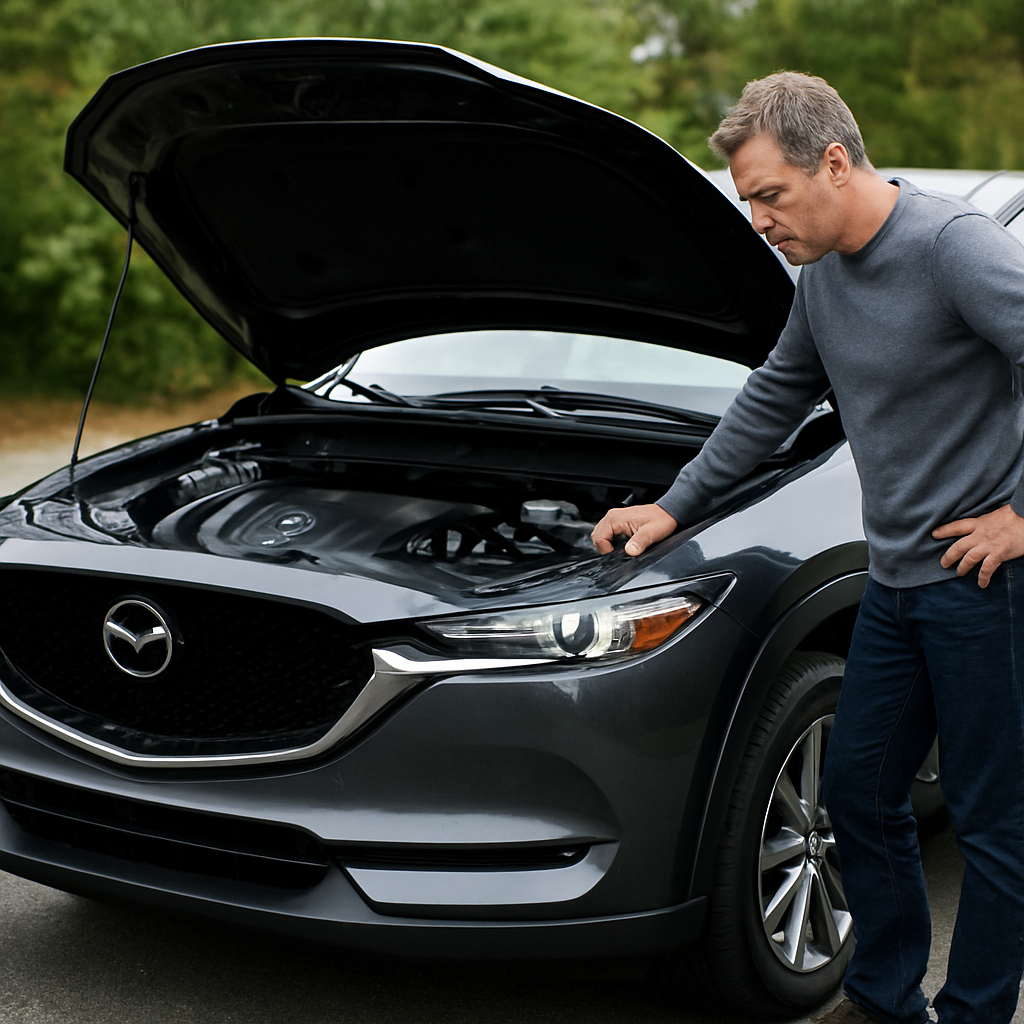
The most frequently reported individual Mazda CX-5 problem in a complaint summary drawing on CarComplaints submissions is daytime-running-light (DRL) failure. The same reporting identifies engine issues as the largest overall complaint category. These are different findings: one is a specific reported issue, while the other combines several engine-related complaints. Neither establishes how likely a particular CX-5 is to develop a fault.
Consumer complaint submissions are not adjusted for the number of vehicles of each model year on the road, so they are not failure rates. They can highlight reported concerns, but cannot confirm what is wrong with an individual vehicle or predict its condition.
What is the most common problem with the Mazda CX-5?
In its review of CarComplaints data, SlashGear’s summary of common Mazda CX-5 problems identifies DRL failures as the most frequently reported individual issue across model years with submitted complaints. It also says that engine problems are the largest complaint category overall.
The engine category covers different reported concerns rather than one confirmed defect affecting every CX-5. The issues named include acceleration complaints, inconsistent engine-warning-light reports and cracked cylinder heads. A warning light or loss-of-performance symptom does not, by itself, identify a failed component. For general guidance on what to check if a CX-5 suddenly loses acceleration, see our general symptom guide; it is not a diagnosis of a CX-5-specific fault.
Windscreen cracking is another significant issue mentioned in the complaint summary, but it is not identified as the leading individual problem. Reports about lights, engines or windscreens should be treated as prompts to inspect a particular vehicle, not as proof that all CX-5s share the same fault.
Common diesel CX-5 problems, including the 2.2 diesel
Diesel CX-5s have potential concerns that differ from those of petrol models. The repair-focused overview from FixMyCar describes diesel models as more prone to DPF blockage or incomplete regeneration, fuel mixing with engine oil, leaking injector seals and soot build-up in the intake that may affect performance.
Short journeys matter because they can make it harder for the diesel particulate filter (DPF) to complete its regeneration cycle. A DPF-related warning therefore warrants investigation, but the warning alone does not confirm that the filter is blocked. FixMyCar also describes unburnt fuel entering the engine oil during regeneration on diesel models; this can dilute the oil and raise its level, particularly where the vehicle is used mainly for short trips.
These are reported concerns for CX-5 diesel models generally. The reporting does not establish that every issue affects every 2.2 diesel engine, market or model year in the same way. If a diesel CX-5 has persistent warnings, an abnormal oil level or a noticeable change in performance, arrange assessment by a qualified technician rather than assuming that a particular component has failed. Do not ignore a serious warning or an abnormal oil condition.
What to know about CX-5 problems by model year
The cited reporting does not provide a reliable ranking of the most common fault for each of the model years below. This table separates limited model-year context from broader generation-level reports.
| Model year | What the evidence supports |
|---|---|
| 2016 | The all-years complaint summary identifies DRL failures as the most frequently reported individual issue, but it does not provide a 2016-specific rate or establish that DRLs are the most common fault on the 2016 model alone. |
| 2020 | No reliable 2020-specific fault ranking is available in the cited reporting. FixMyCar describes diesel DPF and regeneration concerns for the 2017–2025 generation, plus occasional electrical or infotainment glitches across both generations; these are not confirmed as 2020-specific problems. |
| 2021 | No reliable 2021-specific ranking is available. The generation-level diesel reports and cross-generation electrical or infotainment reports are useful inspection context, not proof of a fault on every 2021 vehicle. |
| 2022 | The sources do not establish a leading 2022-specific problem. Diesel-related reports for the generation and occasional electrical or infotainment reports across generations should not be treated as a diagnosis for an individual car. |
| 2023 | No 2023-specific fault ranking is supported. The available diesel-generation and cross-generation reports are broader than this model year and may not apply to every engine or trim. |
For any of these years, check the individual vehicle’s service and repair history, test that its lights and infotainment work correctly, and note any warning indications during an inspection. Check recall status using the vehicle identification number (VIN) through an official recall lookup, as a general model-year report cannot establish whether a recall applies to a particular car.
Is the 2016 Mazda CX-5 reliable?
FixMyCar characterises the CX-5 generally as dependable, but the cited reporting does not provide a 2016-specific reliability score, failure rate or comparison with rival vehicles. The all-years DRL complaint finding is not a measure of the 2016 model’s overall reliability and does not mean every 2016 CX-5 has a lighting fault.
For a used 2016 example, assess the actual car rather than relying on a broad reputation. Review its maintenance and repair records, check the lights and infotainment, and have warning indications investigated as part of a pre-purchase inspection where appropriate.
What repair-focused sources say about CX-5 problems
FixMyCar’s overview is repair-focused reporting, not a formal survey of mechanics or evidence of universal professional consensus. Its broad assessment is that the CX-5 is generally dependable, while diesel models are more prone than petrol models to the DPF, oil-dilution, injector-seal and intake-soot concerns described above. It also notes occasional electrical or infotainment glitches across both generations.
These reports can help owners decide what to ask about during an inspection, but they do not confirm a fault on a specific vehicle. A technician must assess the vehicle and its symptoms before identifying the cause.
Are there Mazda CX-5 years to avoid—or especially reliable years?
The complaint summary offers limited context for engine complaints: it places the 2014 CX-5 highest in that category, with the 2018 close behind, and describes significant engine complaints for the 2019 model. These are concentrations in the cited complaint data, not population-adjusted failure rates. They do not prove that every vehicle from those years is problematic or that those years are definitively the worst to buy.
The available reporting is not sufficient to identify the most reliable CX-5 years or certify any year as one to avoid. It cannot support a best-to-worst ranking. When comparing used examples, prioritise the individual vehicle’s condition, service history and repair history, and arrange a qualified pre-purchase inspection where appropriate. Verify any potentially applicable recall by VIN through an official source.
What about 2026 CX-5 problems and popularity?
The cited sources do not establish problems specific to the 2026 Mazda CX-5, so earlier-generation reports should not be presented as a 2026 fault list. They also provide no sales, registration or market-share data that would establish whether the CX-5 is popular. Complaint reports alone cannot answer either question reliably.