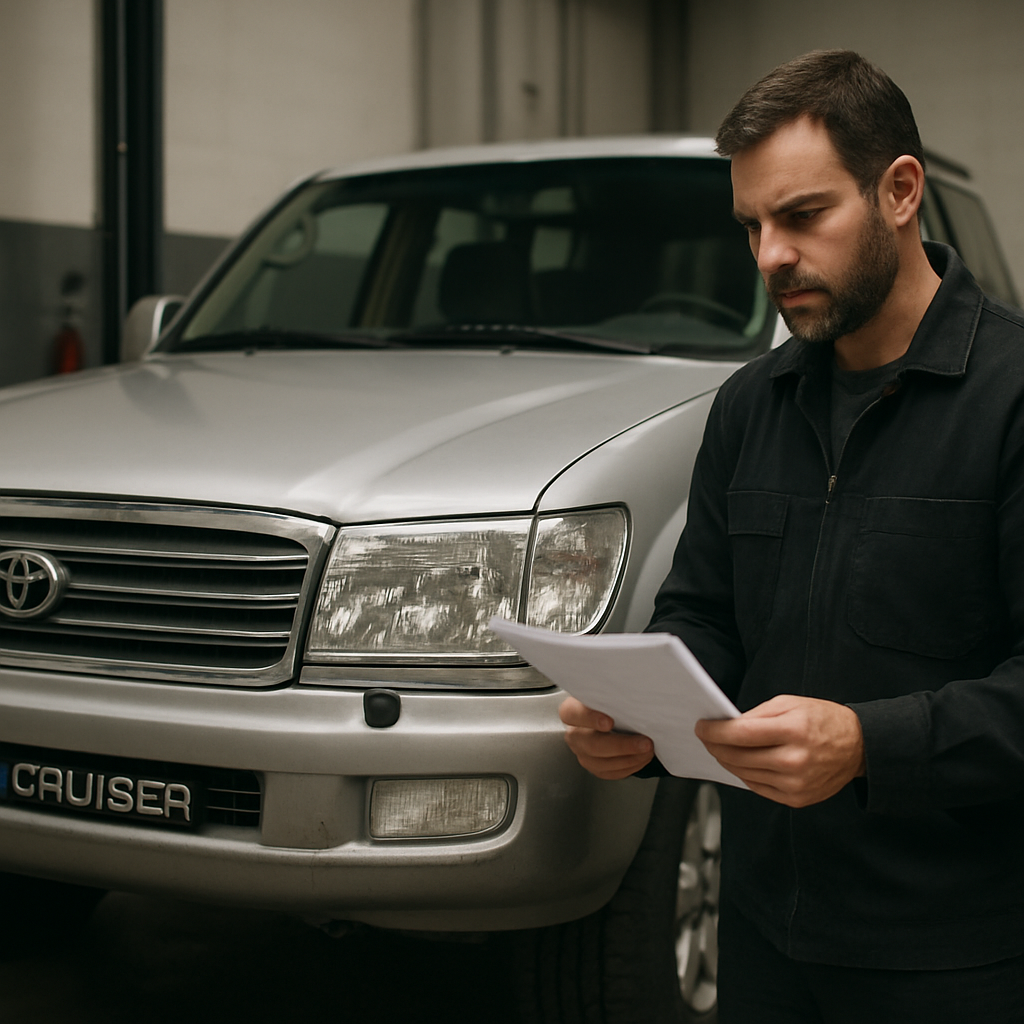
A used Toyota Land Cruiser can be a sensible purchase, but the nameplate’s durability reputation is not a substitute for checking the individual vehicle. Before committing, establish the exact model year, trim and specification; obtain the VIN; review maintenance and repair records; confirm outstanding safety recalls; and arrange an independent pre-purchase inspection. The evidence available here does not support declaring every used Land Cruiser broadly reliable or unreliable, naming universal best or worst years, or offering a complete common-fault or repair-cost guide.
That caution matters because a used Toyota Land Cruiser is not one mechanically uniform proposition. An older V8 example and a current turbocharged hybrid are materially different vehicles, with different powertrains, fuel-use expectations and driving characteristics. Treat a Land Cruiser’s reputation as a reason to investigate a promising example carefully—not as proof that it is fault-free.
Should You Buy a Used Toyota Land Cruiser?
Buy one only if the particular vehicle stands up to records, recall checks and inspection. A favourable review of a 2018 Land Cruiser described it as likely to be among the most durable vehicles on sale, but that was an assessment of the reviewed vehicle, not fleet-wide reliability data or a guarantee about a high-mileage used example. Age, use, maintenance quality, corrosion exposure, accident history, modifications and incomplete repairs can all matter more than the badge on the grille.
Start by asking the seller for the VIN and documentation before travelling or leaving a deposit. The VIN allows you to verify the actual year and equipment, investigate recalls, and match service invoices to the vehicle. A seller’s description such as “Land Cruiser V8” or “fully serviced” is not a replacement for documents that identify what was done, when it was done and at what mileage.
The most useful decision is therefore not “Are Land Cruisers reliable?” but “Does this exact Land Cruiser have credible history, no unresolved safety issue, and inspection results that fit its asking price and my intended use?” If the seller will not supply the VIN, will not permit an inspection, or cannot explain important gaps in the history, it is reasonable to walk away.
What this guide can and cannot establish
The supplied evidence supports a focused buying process, a limited comparison between a 2018 V8 vehicle and the current hybrid vehicle, and VIN-specific recall and warning-light checks. It does not establish a generation-by-generation failure rate, a model-year ranking, used prices or depreciation, repair-cost ranges, towing or payload limits, tyre specifications, or a complete list of recurring faults. Check the documentation and labels for the exact vehicle rather than applying an online generalisation to it.
Know Which Land Cruiser You Are Considering: Older V8 vs. Current Hybrid
Do not transfer specifications, economy figures or driving impressions from one Land Cruiser era to another. The sources provide a useful but deliberately limited contrast between the 2018 vehicle reviewed by CNBC and the current vehicle covered by Car and Driver and Consumer Reports; it is not a complete history of every Land Cruiser generation or every market.
| Vehicle described in the source | Supported specification or observation | What it means for a used buyer |
|---|---|---|
| 2018 Land Cruiser reviewed by CNBC | 5.7-litre V8; 381 horsepower; seating for eight; EPA expectation of 15 mpg. | An older V8 example has a notably different engine and fuel-use proposition from the current hybrid. These details should not be assumed to apply to every older Land Cruiser or market. |
| Current Land Cruiser covered by Car and Driver and Consumer Reports | 326-hp 2.4-litre turbocharged four-cylinder hybrid; eight-speed automatic; four-wheel drive. | A current-model hybrid should be assessed as a different powertrain and ownership proposition, including its hybrid-system condition and applicable records. |
| Current Land Cruiser in Consumer Reports’ road test | Full-time four-wheel drive and electronically controlled locking rear and centre differentials were described. | Useful capability hardware may be relevant to an individual vehicle, but verify the exact trim and equipment rather than assuming it is fitted to every Land Cruiser. |
The 2018 Land Cruiser review specifically described a large, eight-seat vehicle with a 5.7-litre V8 producing 381 horsepower. Those are attributes of the vehicle reviewed, not blanket specifications for all older examples. The review also characterised its construction as heavy-duty and durable, while noting an old-school feel and poor fuel economy.
By contrast, Car and Driver’s current Land Cruiser coverage describes a 326-hp 2.4-litre turbocharged four-cylinder hybrid powertrain, paired with an eight-speed automatic transmission and four-wheel drive. Consumer Reports’ road test additionally describes full-time four-wheel drive and electronically controlled locking rear and centre differentials on the vehicle it tested.
These are not small year-to-year changes. A buyer choosing between an older V8 and a newer hybrid is choosing between substantially different engines and drivetrains, rather than simply selecting a newer or older version of the same mechanical package. For a current hybrid, do not attempt DIY diagnosis or repair of high-voltage or hybrid components: the supplied material establishes that it is a hybrid, but does not provide safe owner-level procedures.
Road-test impressions are not fault diagnoses
Consumer Reports recorded an 8.5-second 0-to-60 mph result for the current Land Cruiser it tested and reported engine noise plus vibration through the steering wheel and chassis when accelerating. Those are that publication’s road-test observations. They are not evidence of a diagnosed defect, proof that every Land Cruiser behaves the same way, or a basis for concluding that the hybrid is less reliable than an older V8.
They are, however, useful prompts for a test drive. Drive the actual vehicle from cold and once fully warmed, through gentle and firmer acceleration, urban speeds and legal road speeds where possible. Note any behaviour that concerns you, then ask the inspecting technician to assess it in context. A noise, vibration or warning lamp is an observation; it becomes a repair decision only after appropriate diagnosis.
Fuel Economy and Daily-Use Trade-Offs
Fuel use is a meaningful ownership consideration, but published figures need to remain attached to the exact vehicle and test method. They are not a lifetime fuel-cost forecast for an individual used SUV. Fuel prices, distance driven, driving conditions, maintenance, load and local specification all vary.
- For the current Land Cruiser, Car and Driver lists EPA estimates of 22 mpg city, 25 mpg highway and 23 mpg combined. Its 75-mph highway test returned 21 mpg for a First Edition.
- Consumer Reports reported 20 mpg overall in its testing of the current Land Cruiser. It contrasted that result with 14 mpg overall in its tests of the previous-generation vehicle. These are publication test results, not EPA figures and not promises for every used example.
- CNBC reported an EPA expectation of 15 mpg for the 2018 V8 vehicle it reviewed.
The practical takeaway is straightforward: an older V8 and a current hybrid have different fuel-economy expectations, but neither set of figures tells you exactly what a particular vehicle will return in your use. Compare the VIN, model year and trim you are considering with its applicable official label and manufacturer documentation, especially if equipment or market specification differs from the U.S.-specification vehicles discussed in these sources.
Do not turn these figures into a precise total-cost calculation without current, local inputs for fuel, insurance, tax, finance, servicing and repairs. None of those inputs is established by the evidence here.
Check Recalls by VIN Before You Buy
Recall verification should be a non-negotiable step. A safety recall is a manufacturer action addressing a safety-related issue; it is not routine maintenance, and it does not mean every vehicle of that model has developed the fault. Conversely, a completed recall remedy is valuable documentation, but it does not guarantee that the vehicle has no unrelated wear, damage or mechanical issue.
Use the exact VIN to check applicability and completion status through Toyota and/or the official NHTSA recall lookup. Do not rely on a generic model-year webpage, a seller’s verbal assurance, social-media posts, owner-forum discussions or search-result snippets. A generic page cannot determine whether the particular vehicle in front of you is affected, whether the work was completed, or whether another campaign applies.
A Toyota dealership’s 2026 Land Cruiser recall page reports categories including fuel-pump, seat-belt-sensor, airbag, accessory-installation and label-related actions for that model year, and describes potential consequences such as an engine stall or reduced front-passenger airbag protection. Treat that as attributed, model-year-specific information—not independently verified proof of a recall count, not confirmation that any particular VIN is affected, and not evidence that the same issues apply to older Land Cruisers.
Recall, manufacturer communication and maintenance are different
- Safety recall: a manufacturer action addressing a safety-related issue for affected vehicles. Confirm it by VIN and retain proof of completion.
- Manufacturer communication or technical service bulletin: information for dealers or service personnel. It is not automatically a safety recall and does not automatically mean your vehicle has a fault.
- Maintenance: routine upkeep or replacement of wear items. It is not a recall remedy.
- Repair: correction of an identified defect, damage or failed component on that individual vehicle.
An owner-forum discussion offers a practical navigation tip that NHTSA vehicle pages include a manufacturer-communications section, but it is forum guidance rather than an official database. Use it only to help find the appropriate official information; do not treat a forum post as confirmation of campaign applicability.
Unresolved recall work can matter for safety and for the vehicle’s documentation when you later sell or trade it. But do not reduce a potential safety issue to a bargaining point. A fuel smell, suspected or visible fuel leak, airbag warning, seat-belt warning or other safety-system warning merits prompt professional assessment and recall-status confirmation where relevant.
What to Check During the Inspection and Test Drive
An independent pre-purchase inspection should be part of the purchase process, not an optional extra after you have agreed to buy. The technician should be qualified to assess the exact vehicle and powertrain, and should review visible condition, warning lights, diagnostic information, service documentation and recall status alongside the road test.
Toyota’s 2026 Warranty & Maintenance Guide says Toyota dealership technicians receive Toyota-specific training and current service information. That supports the value of informed inspection, particularly for a current hybrid, but it does not mean a dealership is the only acceptable choice. An independent specialist with appropriate knowledge can also be suitable.
A practical buying workflow
- Get the VIN before committing. Match it to the vehicle, identify the exact year and verify the specification and equipment being advertised.
- Read the history, not just the service-book stamp. Request maintenance invoices, repair invoices, inspection reports and evidence of recall completion. Look for dates, mileages and a coherent sequence of work.
- Check outstanding recalls by VIN. Confirm both applicability and remedy status with Toyota and/or NHTSA. Ask for paperwork if the seller says recall work is complete.
- Inspect the actual vehicle in daylight. Look for condition concerns, signs of poorly explained repairs or modifications, and discrepancies between the vehicle and the advertisement. The inspection should also consider the vehicle’s applicable labels and documentation rather than assumed towing, payload or tyre figures.
- Test-drive before negotiating. Check that the vehicle behaves consistently and that any concern is recorded for the inspecting technician rather than guessed at.
- Arrange the independent inspection before final payment. Use its findings, together with the records and recall result, to decide whether to proceed—not merely to seek a discount.
Do not confuse a warning lamp, code and confirmed failure
A warning lamp is an alert that needs investigation. A stored diagnostic trouble code is information recorded by a system. A scan or health-check report is a snapshot that may contain current, pending or historical information. None of those items alone identifies a failed component with certainty. A confirmed failure requires interpretation in the context of the vehicle’s symptoms, history and inspection.
Therefore, do not accept “the scan is clean” as conclusive proof of condition. Ask what type of scan or health check was performed, when it was performed, whether the report is available, and whether any findings were current, pending or historical. Have meaningful results interpreted by the inspection technician. Equally, do not assume that a code automatically means a particular part needs replacement.
The diagnostic snippets that commonly surface in searches—whether they mention sensors, engine codes, brake codes or generic Toyota reports—do not establish Land Cruiser-specific faults for the vehicle you are considering. They should not be used to diagnose a used Land Cruiser without vehicle-specific evidence.
Brake and ABS warnings deserve special caution
An illuminated ABS warning is not a diagnosis. Kelley Blue Book’s Land Cruiser warning-light information says an ABS light can indicate an anti-lock braking-system issue and lists possibilities ranging from a speed-sensor problem or low brake fluid to brake failure. Those possibilities show why the lamp cannot be diagnosed from the dashboard alone.
Do not assume the vehicle is safe to drive with an ABS or other brake warning illuminated. Have it professionally assessed promptly, and do not treat the warning as routine negotiation detail. The same approach applies to airbag and seat-belt warnings, a fuel smell or any suspected fuel leak: pause the purchase process, seek prompt professional assessment and confirm relevant recall status by VIN.
How to Use the Results Before You Make an Offer
Once the VIN check, records review, test drive and inspection are complete, separate the findings into categories. Documented routine wear is different from an unresolved warning light. An open recall is different from an unverified rumour about a recall. A stored code is different from a technician-confirmed failed part. This distinction makes the decision clearer and avoids either dismissing a genuine safety concern or paying for speculative repairs.
- Proceed with care when the VIN checks out, recall status is documented, records are credible and the inspection findings are acceptable for the vehicle’s age and condition.
- Seek clarification or a further assessment when records are incomplete, scan results are unexplained, or the test drive raises a concern that has not been diagnosed.
- Pause or walk away when the seller refuses a VIN check or independent inspection, cannot substantiate key claims, or there is an unresolved safety-related warning or suspected fuel issue.
A used Toyota Land Cruiser may appeal because of its capability, long-standing reputation and—depending on the exact model—either V8 character or a newer hybrid powertrain. The disciplined approach is the same in each case: buy the verified condition of the individual vehicle, not an assumption about the badge or model year.