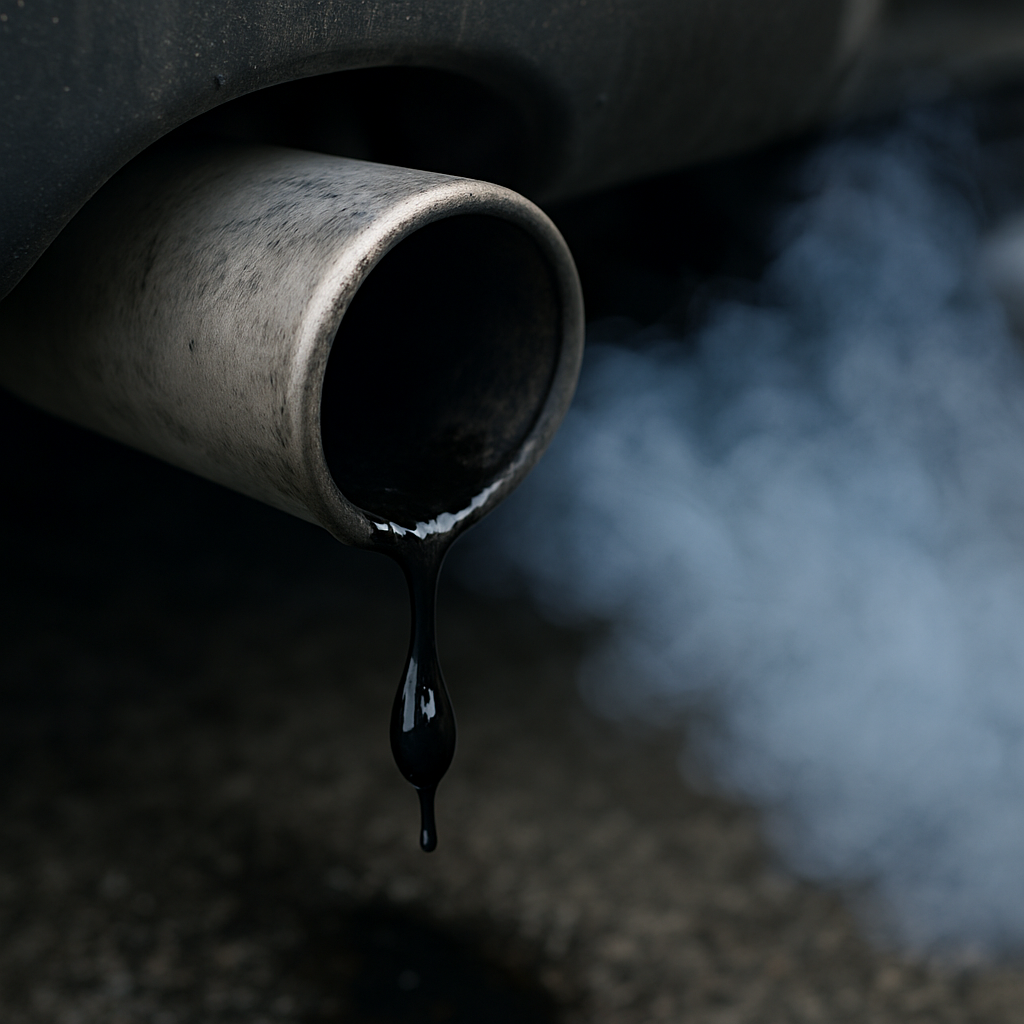
If oil is genuinely coming out of the exhaust pipe, it is not normal. It can indicate that engine oil is entering the combustion or exhaust path, where it may burn and leave oily residue at the tailpipe. The available evidence associates this condition with blue smoke and lists valve stem seals, the PCV system, piston oil-control rings and a turbocharger as possible sources. Those possibilities are not a diagnosis: the residue, smoke and location of the fluid must be assessed before deciding which component has failed.
First, do not assume that every wet patch or dark deposit at a tailpipe is engine oil. Condensation, soot and an unidentified fluid can be present around an exhaust outlet, while an external engine-oil leak can leave oil on exhaust-side components without travelling through the exhaust stream. Literal oily liquid from the tailpipe deserves prompt diagnosis, especially if the engine is running badly.
What Oil Coming From the Exhaust Pipe Usually Means
Engine oil reaching the exhaust stream is different from a routine external seep on the outside of the engine. According to CarParts’ overview of engine oil coming from the exhaust, oil-related exhaust contamination is associated with blue smoke rather than black or white smoke. Smoke colour is a useful observation to report, but it is not a complete diagnosis and cannot identify a failed part by itself.
If oil is literally dripping from the pipe, the same source notes that the vehicle may be running so poorly that it is barely driveable. That does not mean every vehicle with an oily-looking tailpipe will be undriveable, but it does mean a visible liquid discharge should not be dismissed as a cosmetic exhaust problem.
| What you notice | What it can indicate | What it does not prove |
|---|---|---|
| Blue smoke from the tailpipe | An observation associated with engine oil entering the exhaust path | Whether the source is a valve seal, PCV fault, piston oil-control ring or turbocharger |
| Oily residue or liquid at the tailpipe | Possible oil contamination of the exhaust stream, particularly if accompanied by blue smoke or poor running | That the residue is definitely engine oil, or that a particular internal engine part has failed |
| Dark dry deposit around the outlet | Soot may be present at an exhaust outlet | That oil is coming out of the exhaust pipe |
| Fluid on an exhaust-side heat shield or nearby metalwork | Possible external fluid leak near hot exhaust hardware | That oil has travelled through the engine and out of the tailpipe |
Possible causes of oil entering the exhaust path
The supplied evidence supports the following as possible causes. A proper inspection is needed to distinguish between them.
- Worn or failed valve stem seals: these are one potential route for oil to reach an area where it can be burned and enter the exhaust stream.
- A damaged or malfunctioning PCV system: a PCV-system problem is another possible contributor. The PCV system should be assessed as part of diagnosis rather than assumed to be the answer.
- Piston oil-control-ring problems: oil-control-ring faults are among the possible internal-engine causes identified by the source.
- A worn turbocharger: turbocharger wear is also listed as a possible cause. This does not make it a diesel-specific diagnosis, nor does tailpipe residue confirm that a turbocharger is at fault.
These causes can produce overlapping symptoms. Blue smoke does not confirm worn rings; oil at the exhaust outlet does not confirm valve seals; and a head-gasket diagnosis should not be made from tailpipe oil or smoke alone. Likewise, milky-looking engine oil is a different symptom that needs its own evidence-based diagnosis; it should not be used here to confirm or rule out a head-gasket fault.
For owners of a turbocharged Chevy Cruze who also have the relevant fault-code context, Premier Motoring has separate Chevy Cruze turbo-underboost code guidance. An underboost code and oil from an exhaust are still separate diagnostic questions unless testing establishes a connection.
What to Do Next: Checks, Diagnosis, Repairs, and Whether to Drive
Where oil is actually leaking from the exhaust, continued driving is not recommended. CarParts warns that driving with oil in the exhaust can cause significant engine damage. Treat this as guidance for confirmed or strongly suspected oil exiting the exhaust pipe, not as a blanket statement that every small external engine-oil seep makes every vehicle immediately undriveable.
- Stop continued use when practical and assess how the engine is running. If there is visible liquid at the tailpipe, ongoing blue smoke or notably poor running, arrange diagnosis rather than trying to drive until the residue disappears.
- Check the engine-oil level using the vehicle manufacturer’s procedure. Do not rely on a universal hot-or-cold rule, because the correct method is vehicle-specific. Our guide on how to check the engine-oil level accurately explains why following the applicable procedure matters.
- Record useful observations for the repairer. Note whether the discharge appears to be liquid or residue, whether blue smoke is present, whether the engine runs poorly, and whether the fluid is instead visible on the outside of the engine or exhaust hardware. These observations guide inspection but do not identify the failed component on their own.
- Arrange professional diagnosis of the relevant systems. This may include assessment of the PCV system, valve seals, piston oil-control rings and, where fitted, the turbocharger. These are not suitable targets for guesswork based solely on tailpipe appearance.
- Repair the cause, not just the visible symptom. Wiping the exhaust tip or attempting to clear residue does not correct the route by which oil entered the exhaust. The supported general repair principle is to clean the PCV valve where appropriate and repair or replace inoperative components once the fault has been identified.
If a low-oil-pressure warning also appears, treat that warning as a separate escalation issue rather than assuming it was caused by the tailpipe symptom. See Premier Motoring’s guide on what to do if an oil-pressure warning also appears.
Repair scope and cost cannot be estimated responsibly from tailpipe oil alone. The appropriate work depends on the confirmed failed component, the engine design, the vehicle, parts availability, labour requirements and local pricing. It may be a PCV-related repair, or it may require substantially deeper engine or turbocharger work; the symptom alone cannot establish which.
Oil on the Exhaust Manifold Is a Different Problem From Oil Exiting the Tailpipe
Oil visibly present on or around an exhaust manifold, heat shield or nearby metalwork is not automatically oil travelling through the exhaust stream. It may be an external engine-oil leak that has reached an exhaust-side area, and the source needs to be traced before attaching a diagnosis or driving recommendation to it.
The distinction matters because fluid location alone is not identification. A RepairPal example concerning a Porsche Cayman notes an engine-oil leak visible on a metal plate close to an exhaust pipe. That is a useful illustration of proximity, not proof that every fluid near an exhaust pipe comes from the same component or that it will exit the tailpipe. Read the narrow example here: engine oil leakage from a valve-cover-gasket area on a Porsche Cayman.
Do not diagnose a valve-cover gasket, head gasket, cylinder-head fault or cracked manifold merely from where fluid appears. An inspection must establish whether the fluid is engine oil at all, whether it is external, and where it originates. Similarly, an external seep near the exhaust does not automatically carry the same drivability implication as confirmed oil emerging from the tailpipe.
Other fluids can also appear in this area. For example, coolant found below the exhaust manifold is a separate diagnosis; it should not be identified as engine oil simply because it is near exhaust hardware.
Ford F-150 owners investigating an external oil-leak source can also use our model-specific Ford F-150 oil-leak source and repair guidance. It is a follow-up for that model’s external-leak investigation, not evidence that all tailpipe-oil symptoms share one cause.
If the Problem Is an Exhaust Leak Rather Than Oil From the Tailpipe
An exhaust leak is a separate condition from oil contamination in the exhaust stream. It may involve noise, escaping exhaust gases or a damaged connection, but it should not be treated as a synonym for oil coming from the tailpipe.
At the exhaust manifold, repeated heating and cooling can distort or warp the metal and contribute to gasket leaks; a manifold can also crack. As outlined in this guide to exhaust-manifold leak repair, possible repair paths depend on the confirmed fault. Defective gaskets or seals may be replaced, damaged mating surfaces may need professional resurfacing, and a cracked manifold may require repair or replacement.
Is it worth fixing an exhaust leak? There is no universal financial answer. The decision depends on what has actually failed, the vehicle’s overall condition and the repair required. The available material supports several repair paths, but it does not establish a single cost threshold or say that every exhaust leak has the same urgency. Manifold removal, resurfacing and crack repair are professional-level work in the supplied guidance, so this is not an appropriate fault to turn into a generic DIY removal procedure.
Vehicle Types That Need Their Own Guidance
This article addresses the supplied car-oriented evidence. It should not be used as a vehicle-specific repair guide for a diesel engine, motorcycle, four-stroke dirt bike, lawn mower, tractor or other small engine. Although turbocharger wear is one general possible cause of oil entering an exhaust stream, the available evidence does not provide a diesel-specific decision process. Nor does it support model-specific oil-level, overfill, transport, storage or repair advice for motorcycles, off-road machines or lawn equipment.
For those vehicles, consult the applicable manufacturer documentation or a qualified technician familiar with that engine type. Online anecdotes, including discussion threads, cannot establish whether a residue is engine oil or confirm which component has failed.
The Practical Bottom Line
True oil coming out of an exhaust pipe is not a normal condition and should be treated as a possible sign that oil is reaching the combustion or exhaust path. Blue smoke, poor running and literal liquid from the tailpipe make professional assessment more important, but none of those observations alone confirms valve seals, the PCV system, oil-control rings, a turbocharger or a head gasket.
Check the oil level using the correct vehicle procedure, avoid continued driving when oil is leaking from the exhaust, and have the underlying system diagnosed. If the fluid is on the outside of an exhaust manifold or nearby heat shield instead, keep the diagnosis separate: trace the external leak rather than assuming the engine is pushing oil out through the tailpipe.