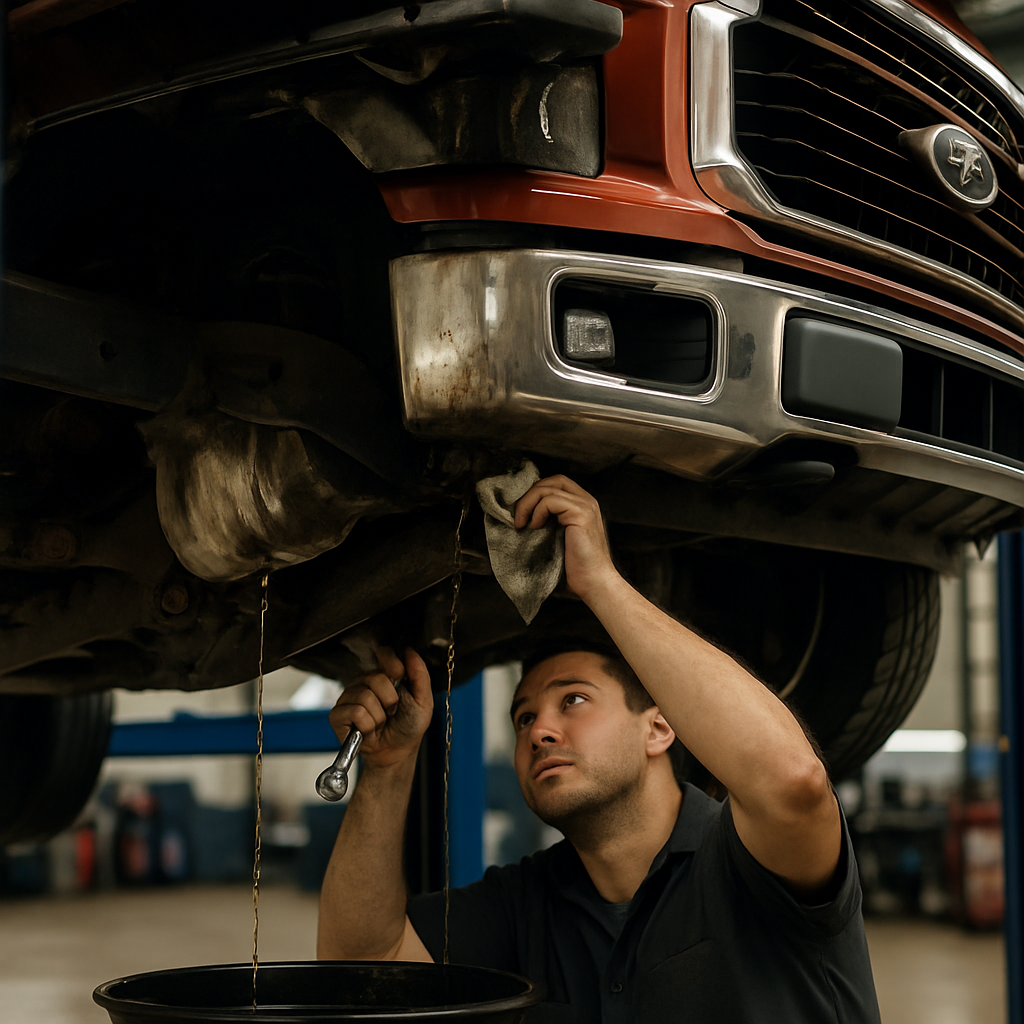
A Ford F-150 oil leak needs its source confirmed and the engine-oil level monitored; the right repair depends on where fresh oil begins, how quickly the level is falling, whether oil is reaching hot components, and the truck’s year and engine. RepairPal lists oil-system component failures and leaking engine gaskets as broad common reasons an F-150 may leak oil, but a wet underside does not identify the failed part by itself. A valve-cover area, oil-pan area, filter/service area, seal, or another oil-system component can require very different work.
Do not buy a gasket, pan, or seal simply because that is where the drip appears. Oil can travel across the engine, transmission bellhousing, splash shields, and chassis before it reaches the lowest point and falls to the ground. A diagnosis that finds fresh oil at its origin is more valuable than a parts guess.
My Ford F-150 Is Leaking Oil: What to Do First
Start by treating the sighting as an apparent engine-oil leak, not as a confirmed component failure. Check the engine-oil level on level ground and under the normal checking conditions specified for your truck. Record the reading rather than relying on memory, then watch whether it changes. If the oil is low, do not assume a small patch on the drive is the whole story.
Before arranging an inspection, note the following:
- Whether there are fresh drips after parking, and roughly how much is appearing.
- The apparent area of the truck where oil is first visible.
- Any change in the oil-level reading over time.
- Any oil-pressure warning or other warning message.
- Smoke, a burning-oil smell, or visible oil near hot engine or exhaust components.
- A check-engine light, rough running, or misfire that occurs at the same time.
These observations help a workshop narrow the search; they do not prove that the closest gasket or component has failed.
When to stop driving and seek help
Do not treat rapid oil loss, an oil-pressure warning, substantial dripping, smoke or a burning-oil smell, or oil on hot components as a routine DIY observation. Stop using the truck when continued operation could leave the engine inadequately lubricated or create a fire risk, and arrange qualified assistance. There is no universal answer to whether an F-150 with an oil leak is safe to drive: the answer depends on leak rate, remaining oil level, source, and where the oil is going.
A slow seep with a stable level may still need a booked diagnosis, but it is not the same situation as an active leak onto hot parts or a falling level. Waiting for the source to become obvious can turn a straightforward inspection into a harder, messier diagnosis.
Where a Ford F-150 Oil Leak May Be Coming From
At a high level, the possibilities fall into two useful groups: a leaking engine gasket or seal, and a failure involving an oil-system component. That distinction matters because a repair should address the confirmed source, not merely clean the location where oil collected.
Valve-cover areas and the oil-pan-gasket area are reasonable places to inspect, but neither is automatically the answer on every F-150. A 2017 repair-shop example describes leakage from valve covers and an oil-pan gasket; it also describes cleaning and, where needed, using UV dye to locate the leak. That is a useful illustration of the process, not evidence that those are universal failure points for every year, engine, or configuration. See the shop’s discussion of 2017 F-150 oil-leak diagnosis for that example.
A sensible diagnosis sequence
- Verify the fluid. Confirm that the wet fluid is engine oil rather than another automotive fluid or residue from a previous service.
- Inspect accessible areas. A technician can inspect visible service/filter areas, gasket boundaries, and oil-system components for signs of fresh oil.
- Clean the suspected area. Removing old oil helps separate historical staining from an active leak.
- Recheck for fresh oil. The aim is to trace the first fresh appearance of oil, rather than work backwards from the lowest drip.
- Use UV dye if appropriate. UV dye is a leak-location method a workshop may choose when ordinary inspection does not establish the origin. It is not proof in advance that the pan or valve cover is at fault.
This diagnosis-first approach is particularly important if more than one area is wet. An older seep and a newer active leak can coexist, and oil from above may contaminate a lower gasket without that lower gasket being the origin.
Oil around ignition components is a separate diagnostic clue
Oil around coils or other ignition components should not automatically be translated into “the valve-cover gasket has failed.” An individual consultation involving a 2006 5.4L associates a valve-cover-area leak with coil and misfire concerns, but it does not establish a pattern for all F-150 engines. If oil is present around ignition hardware, or the truck also has a check-engine light or rough running, have both concerns diagnosed. For context on the code rather than a presumed cause, read our guide to what a P0300 random/multiple-cylinder misfire means.
Is an F-150 Oil Leak Worth Fixing, and What Will Repair Cost?
In most cases, the better question is not simply whether an engine-oil leak is worth fixing, but what has actually failed and what happens if it is left alone. A repair becomes more pressing when the level is falling, oil is reaching hot parts, the leak is substantial, or the confirmed fault risks related damage. For a minor seep, the decision may also involve the truck’s overall condition and value, the expected ownership period, and the diagnosis and repair estimate.
Before authorising work, ask the workshop to establish whether the repair is for a gasket or seal, an oil-system component, or more than one source. That prevents a quote for one visible area from being mistaken for a complete solution when fresh oil is coming from elsewhere.
Why there is no reliable one-price answer
The available research does not provide a dependable F-150-wide price for an engine-oil leak or for replacing an oil-pan gasket. It would be misleading to turn forum or dealer anecdotes into a market benchmark. Access, engine layout, the actual failed component, condition of surrounding parts, local labour rates, and whether other work is required all affect the bill. Valve-cover and oil-pan work can differ materially in access and labour even on the same model line.
For both “how expensive is an engine oil leak repair?” and “how much does an F-150 oil-pan-gasket replacement cost?”, the responsible answer is: obtain a written, source-specific estimate after diagnosis. It should separate:
- Diagnostic charge.
- Parts required for the confirmed repair.
- Labour.
- Engine oil and filter replacement if the work requires it.
- Taxes and shop supplies.
- Any related repair found during diagnosis.
Ask the adviser to state the confirmed source in writing and to explain whether the estimate addresses one leak or every active source found. The available evidence does not support a universal labour time, parts list, torque specification, sealant instruction, or do-it-yourself replacement procedure by year and engine.
Do not mistake a temporary change for a repair
An apparent reduction in dripping does not establish that a leak has fixed itself. This article does not treat high-mileage oil or sealing additives as a supported repair plan. If the level had been dropping, continue to monitor it and obtain a diagnosis rather than relying on a temporary change in symptoms.
2013, 2016, 2017, and 2018 F-150 Oil Leaks: Why Year and Engine Matter
“F-150” covers different engines and configurations. A repair instruction or leak pattern from one truck should not be carried across to every 2013, 2016, 2017, or 2018 model. Identify the model year and engine before choosing parts, approving a repair, or following service information.
| Model year | What the available evidence supports | What not to assume |
|---|---|---|
| 2013 | Use a diagnosis-first approach: verify the fluid, identify the engine, locate fresh oil, and use correct Ford service information or a qualified workshop. | The available research does not establish an authoritative 2013 engine-specific leak pattern, repair procedure, or price. |
| 2016 | Confirm the engine and source before selecting parts or repair steps. | The available research does not establish an authoritative 2016 engine-specific leak pattern, repair procedure, or price. |
| 2017 | One repair-shop example used cleaning and possible UV dye and identified leaks from valve covers and the oil-pan gasket. | That example is not a defect rate, a complete repair specification, or proof that every 2017 F-150 leaks from those areas. |
| 2018 | Distinguish a visible external leak from oil consumption, especially on a 5.0L truck. | Do not apply a 5.0L oil-consumption bulletin to every 2018 F-150 or assume low oil proves an external leak. |
The research does not support blanket claims that any of these years has a cracked plastic pan, a particular design defect, a failed pressure sender, a restricted PCV system, a front crankshaft seal failure, or a head leak. Those may be possibilities on an individual vehicle, but they require evidence from its inspection and applicable service information.
Low Oil With No Drips Is Not the Same as an External Oil Leak
An engine can use oil without leaving a visible external leak. That distinction is important for 2018 owners because a Ford/NHTSA technical service bulletin applies to some 2018–2020 F-150 trucks fitted with the 5.0L engine. The bulletin describes excessive oil consumption of more than 1 quart per 3,000 miles with no visible oil leaks. It attributes the condition to oil being drawn into the combustion chamber during certain deceleration fuel shut-off events.
The Ford/NHTSA bulletin describes a bulletin-specific service path that includes an engine-leak inspection, engine-oil and filter replacement, PCM reprogramming, and, if needed, replacement of the oil-level indicator. This is not a safety recall, not a diagnosis for every 2018 F-150, and not owner-performed programming advice. It also should not be extended to EcoBoost, 3.3L, 5.4L, or other engines.
If a 2018–2020 5.0L F-150 is losing oil but leaves no external drips, tell the dealer or qualified workshop the measured oil-use history and ask whether the truck meets the bulletin’s criteria. If there is visible fresh oil, the external-leak diagnosis still matters; oil consumption and external leakage are different paths, and in some cases more than one issue could be present.
What to Tell the Workshop
A clear description can reduce guesswork. Provide the model year, engine, mileage, oil-level trend, where the oil is visible, whether the engine was recently serviced, and any smoke, burning smell, warning, or drivability symptom. Ask the workshop to show or describe the source of the fresh oil before approving a major repair.
For a Ford F-150 oil leak repair, the practical goal is straightforward: protect the oil level, identify the true origin, address the confirmed component or gasket, and avoid treating a year-specific example or an internet price as a universal diagnosis. That approach is safer and usually less wasteful than replacing the part closest to the drip.
Pingback: Toyota Certified Pre-Owned: Warranty, Value, and What to Check Before Buying - Premier Motoring Blog
Pingback: Oil Pressure Low—Stop Engine: What It Means, What to Do, and Common Causes - Premier Motoring Blog