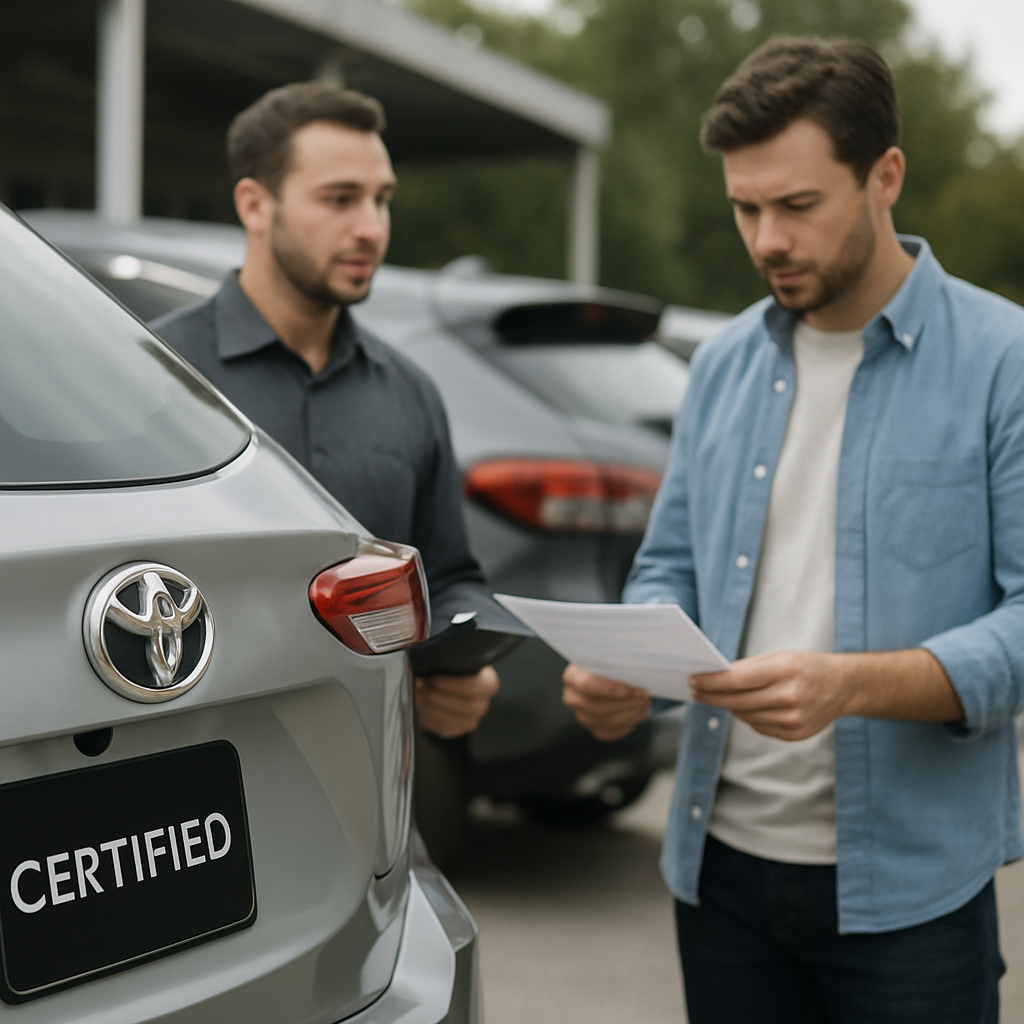
A Toyota Certified Pre-Owned vehicle can be worth considering only after you verify the specific car’s written certification and warranty documents, condition, history, price difference, and VIN-based recall status. The research available for this guide does not establish Toyota’s current universal CPO warranty length, mileage limits, inspection-point count, deductible, roadside-assistance terms, eligibility rules, or transferability provisions. Treat those as vehicle-specific terms to confirm in writing before you sign—not benefits to assume from a listing.
In practical terms, compare the advertised CPO Toyota with similar non-certified examples, then decide whether its documented coverage, preparation, and condition justify the actual extra cost. Certification can add useful protection or reassurance, but it is not proof that a used vehicle has no wear, prior repairs, future faults, or unresolved safety work.
Toyota Certified Pre-Owned: What to Verify Before You Buy
“Certified”, “inspected”, “warranty included”, and “dealer-certified” are not interchangeable descriptions. A used Toyota sold by a Toyota dealer is not automatically enrolled in Toyota’s official Certified Pre-Owned programme. Equally, a sales advert using the word “certified” is not, on its own, evidence of official programme enrolment.
Ask the selling dealer to identify the programme in writing and to provide the coverage documents that apply to the exact vehicle. The documents should identify the seller, the vehicle identification number (VIN), and the terms that apply to that sale. If the dealer cannot provide clear paperwork, assess the car as an ordinary used vehicle rather than assigning unproven value to a CPO label.
Read the coverage document, not just the advert
Before agreeing to buy, obtain the exact CPO warranty booklet, contract, or coverage summary for that Toyota and read the terms alongside the buyer’s order. Confirm the following points for the individual vehicle:
- VIN applicability: the VIN on the coverage document must match the vehicle being sold.
- Covered components: establish what systems and parts are included, rather than relying on a broad phrase such as “powertrain warranty”.
- Exclusions and conditions: check exclusions, wear items, maintenance-related limits, and any conditions that could affect a claim.
- Deductible: confirm whether a deductible applies and, if so, when it is charged.
- Duration and mileage: identify the start point, end point, and any mileage limitation in the actual contract.
- Transferability: ask whether coverage can transfer to a later owner and what process or limits apply.
- Roadside assistance: establish whether it is included, its duration, and what services or distance limits apply.
- Claims process: find out where repairs may be performed, whether prior authorisation is required, and whom to contact if a covered issue arises.
Do not assume that a remaining original manufacturer warranty, a dealer warranty, and CPO coverage are the same thing. They may overlap, differ in scope, or have different conditions. The paperwork is what determines the relevant protection.
Is Toyota Certified Pre-Owned Worth the Extra Cost?
There is no responsible universal answer without current, local comparable pricing and the exact coverage terms. Rather than accepting a stated CPO premium as automatically justified, compare like for like: the same model year where possible, similar trim, mileage, drivetrain, condition, location, and history.
| Compare | What to look for | Why it matters |
|---|---|---|
| Price | The certified car’s asking or agreed price against comparable non-certified vehicles | Shows the real amount being paid for certification, preparation, and dealer convenience. |
| Written CPO terms | Included systems, exclusions, deductible, claim rules, and end date or mileage | Lets you judge the value of actual coverage instead of a marketing label. |
| Condition and reconditioning | Tyres, brakes, paintwork, interior condition, keys, and documented work completed | A better-presented car may have value, but promised work should be documented. |
| History | Available service records, accident or title disclosures applicable in your jurisdiction, and evidence of repairs | History can affect condition, resale prospects, and the questions an inspector should investigate. |
| Remaining original coverage | Any manufacturer coverage that may still apply to that VIN | Helps prevent paying twice, based on assumptions, for protection that may already exist or may not apply. |
| Recalls | Current VIN-specific safety-recall status and repair availability | Open safety work is separate from normal maintenance and warranty coverage. |
A CPO example may be the better purchase if its written benefits, condition, and price compare favourably with alternatives. A non-certified Toyota may be the stronger value if it has equivalent condition and history, a lower price, and the certified vehicle’s paperwork does not add meaningful protection for your needs. Neither conclusion can be reached from the badge alone.
Documents to Get Before You Agree to Buy
Request the information early enough to review it before leaving a deposit or signing final paperwork. Availability and legal disclosure requirements vary by jurisdiction, so this is a practical request list rather than a claim that every item is required nationwide.
- The full VIN: use it to match the physical vehicle, sales paperwork, coverage documents, and recall results.
- The listing and buyer’s order: retain the advert or written description, and make sure promised certification, equipment, price, and included items appear in the purchase documents.
- Written CPO warranty or coverage paperwork: obtain the programme terms that apply to this vehicle, not a generic verbal description.
- Condition and reconditioning records, if available: ask what was inspected, repaired, replaced, or deferred, and whether any work remains outstanding.
- Service history, if available: review dates, mileage, and the nature of recorded maintenance or repairs.
- Recall-completion evidence, where available: useful supporting information, but still check the current status by VIN.
- Applicable title and history disclosures: ask for the disclosures required where the transaction takes place and read them carefully.
- Keys, manuals, and accessories promised in the sale: have every promised item listed rather than relying on a verbal assurance.
Match the VIN character for character across the vehicle, listing, buyer’s order, warranty or CPO documents, and recall lookup. A generic document for the same Toyota model is not confirmation that it applies to the car in front of you.
What service records and condition records can—and cannot—tell you
Records can make useful questions more specific. For example, they may show that a component was serviced, that maintenance was recorded at a particular mileage, or that cosmetic work was carried out. They do not, by themselves, prove present condition or guarantee that no future repair will be needed.
The same caution applies to online service information. Toyota’s Technical Information System (TIS) is described in this guide to finding Toyota technical service bulletins as Toyota’s technical-information library, while NHTSA manufacturer communications can provide a free discovery route. Manufacturer communications are broader than TSBs, however, and a generic bulletin search is not a diagnosis. Read any bulletin for its exact model year, system, symptom, component, and applicability; its existence does not show that an individual vehicle has the issue or that it has received the described repair.
Check the VIN for Open Safety Recalls Before Purchase
Make a VIN-specific recall check a separate buying step. Do not rely solely on a model-year search, a dealer statement, a completed-looking inspection report, or an assumption that CPO status means all recall work has been done. Ask the dealer or manufacturer to confirm the current status of the exact VIN and whether a remedy is available.
A safety recall concerns a safety-related defect or equipment issue. It is different from routine maintenance, a CPO warranty repair, a service campaign, or a technical service bulletin. The Automobile Club of Southern California notes that safety-recall repairs are paid by the manufacturer regardless of warranty considerations; see its recall and service-bulletin guidance. Even so, confirm the current campaign status and repair availability with the dealer or manufacturer for the specific VIN, as the practical next step can depend on the campaign and the vehicle.
Recall, service campaign, TSB, and maintenance: keep the terms separate
| Term | What it means for a buyer | What not to assume |
|---|---|---|
| Safety recall | A safety-related defect or equipment issue addressed through a manufacturer recall process. | Do not assume it applies to every vehicle of a model, or that the remedy is already completed on the car you are considering. |
| Technical service bulletin (TSB) | Service information intended to help diagnose or repair a defined condition under specified circumstances. | A TSB is not automatically a recall, and it does not prove the individual car has the condition. |
| Manufacturer communication | A broader category of manufacturer notices that can include information beyond TSBs. | Do not treat every communication as a TSB, safety defect, or free repair authorisation. |
| Service campaign | Manufacturer-directed work that is distinct from an ordinary maintenance item and may have its own terms. | Do not assume it is a safety recall or that it is covered by CPO warranty terms. |
| Routine maintenance | Normal upkeep and replacement of service items as required by the vehicle’s maintenance needs. | Do not describe maintenance as a recall repair or assume it is included in all warranties. |
Use TIS and manufacturer-communication material to research questions raised by records or an inspection, not to diagnose a vehicle remotely. A VIN is valuable for recalls, campaigns, and confirming vehicle details, but it is not the sole way to locate potentially relevant service information; the symptom, component, model year, and repair context matter too.
Why an Independent Pre-Purchase Inspection Still Helps
Certification should not replace your own assessment. Consider arranging an independent pre-purchase inspection, particularly where the vehicle is expensive, has limited records, shows inconsistent wear, has had significant repair work, or carries a large difference in price compared with non-certified alternatives.
An inspector can assess the actual car’s observable condition and identify questions to take back to the seller. The aim is verification, not an assumption that the dealer’s inspection was inadequate. No inspection can guarantee a fault-free future, but an independent review can help distinguish documented condition from an untested sales claim.
Ask the inspector to focus on matters relevant to the particular Toyota and its records, including evidence of prior repairs, uneven wear, warning messages, fluid leaks, operation of fitted equipment, and signs of condition that merit further investigation. If a concern is identified, request a written explanation of what the dealer will repair, whether the work will be completed before delivery, and whether it is reflected in the sale documents.
A Practical Toyota CPO Buying Process
- Identify the exact car. Obtain the VIN, full listing, mileage, trim, and price. Do not compare vehicles that differ materially in age, equipment, or condition as though they were equivalent.
- Verify the certification claim. Ask whether the car is enrolled in Toyota’s official CPO programme and request vehicle-specific written evidence.
- Read the coverage terms. Check covered components, exclusions, deductible, duration, mileage limits, transferability, roadside assistance, and claims procedure in the applicable document.
- Match every VIN. Compare the VIN on the vehicle, advert, buyer’s order, CPO paperwork, and recall result before finalising the deal.
- Review available records. Request service history, reconditioning or condition records, applicable disclosures, and recall-completion evidence where available.
- Check open recalls separately. Confirm VIN-specific safety-recall status and remedy availability with the dealer or manufacturer.
- Compare alternatives. Price the certified car against comparable non-certified examples, then judge whether the documented benefits justify the difference.
- Inspect before commitment. Test drive the vehicle and consider an independent pre-purchase inspection before signing, especially if records are incomplete or the purchase is a substantial commitment.
- Put promises in writing. Ensure agreed repairs, included keys or accessories, certification status, and coverage representations are included in the paperwork you receive.
Questions to Ask the Dealer
- Is this exact VIN enrolled in Toyota’s official Certified Pre-Owned programme?
- May I have the complete written CPO coverage document that applies to this vehicle?
- What is covered, excluded, and subject to a deductible?
- When does coverage start and end, and is it transferable?
- What roadside-assistance and claims terms apply?
- Can you provide available reconditioning, condition, and service records?
- Are there any open safety recalls for this VIN, and if so, is the remedy available and completed before delivery?
- May I arrange an independent pre-purchase inspection?
- Which keys, manuals, accessories, and repairs are included in the agreed sale price?
The Bottom Line
A Toyota Certified Pre-Owned badge may be useful, but the purchase decision should rest on evidence tied to the individual vehicle: valid written CPO terms, a matching VIN, documented condition and history, a current recall check, and a price comparison against credible alternatives. Do not buy on an assumed warranty length, inspection standard, or price premium that is not shown in the paperwork. Verify first, compare carefully, and treat an independent inspection as a sensible additional safeguard rather than a substitute for reading the contract.