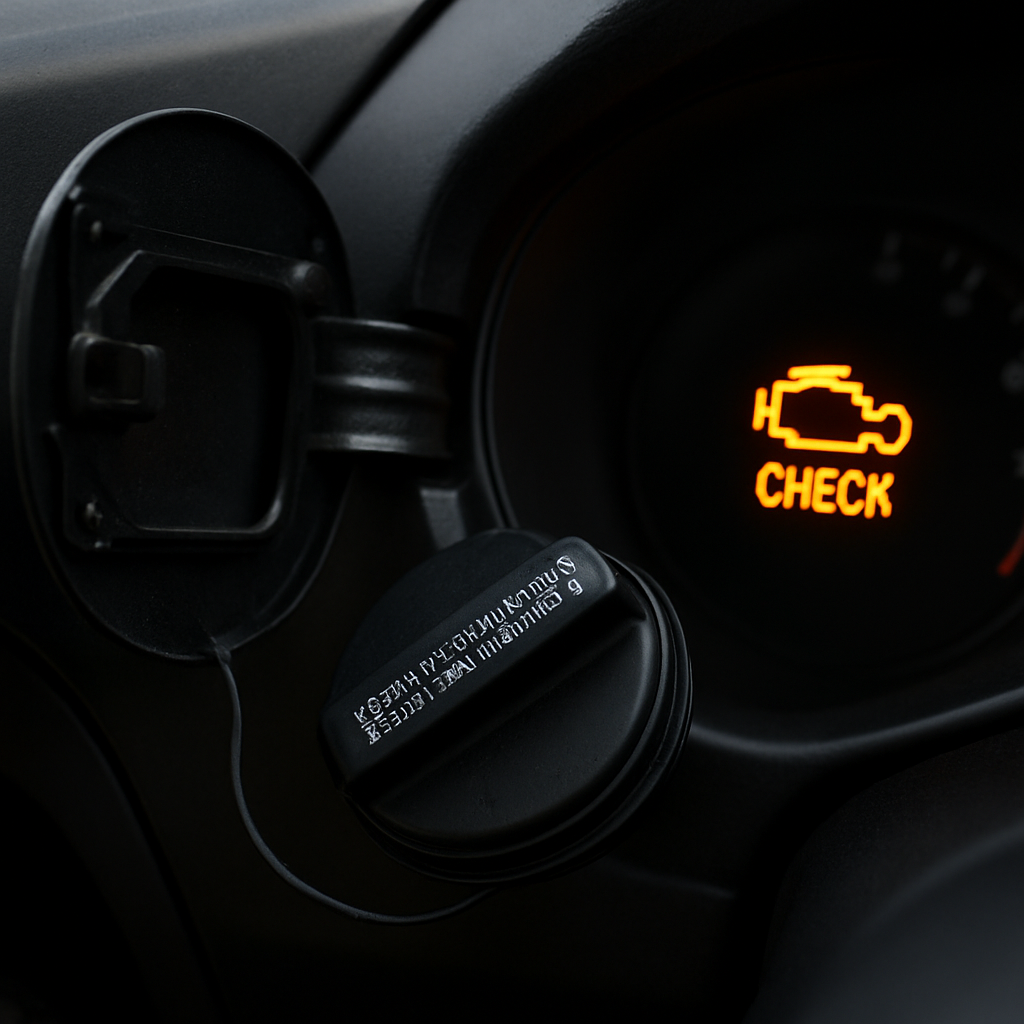
Yes, a loose, damaged, or missing fuel cap can trigger a Check Engine Light. The cap helps seal the fuel tank as part of the evaporative-emissions (EVAP) system, which is designed to contain fuel vapours. If the seal is not holding, the vehicle may detect an EVAP-system fault. However, a Check Engine Light does not confirm that the gas cap is the cause: other EVAP faults can produce a similar warning.
If the light appeared after refuelling, checking the fuel cap is a sensible first step. It is a quick owner-level check, but it should not replace diagnosis if the warning persists, returns, or is accompanied by a smell of petrol.
Can a Loose Gas Cap Cause a Check-Engine Light?
A fuel cap is more than a cover for the filler neck. On vehicles with a conventional removable cap, it is part of the system that seals the tank and limits the escape of fuel vapours. A cap that is not fully fitted, has a damaged seal, or is missing can leave the system unable to maintain the conditions the vehicle expects during EVAP monitoring. The vehicle can then store an EVAP-related diagnostic trouble code and illuminate the Check Engine Light.
As Ferber’s Tire & Auto Service explains, the cap also helps keep dirt and debris out of the fuel tank while helping to contain vapours. Repeated removal and refitting can eventually wear the cap seal, so a cap may look present and still fail to seal properly.
That said, the timing alone is not a diagnosis. A light that comes on after filling up gives you a reason to inspect the cap first; it does not prove that refuelling or the cap caused the fault. A cracked EVAP hose, a purge-valve fault, or another EVAP-system problem can cause a similar result.
How to check and refit the fuel cap
- Park safely and switch off the vehicle.
- Open the fuel-filler door and remove the cap, if your vehicle has a removable fuel cap.
- Look at the cap, its seal, and the filler-neck sealing area for obvious dirt, damage, or contamination.
- Refit the cap squarely, without cross-threading it.
- Turn it until it reaches its normal ratcheting or clicking stop, if that is how the cap is designed to operate.
Do not rely on a universal number of clicks or turns. Cap designs differ, and the useful test is whether the cap seats normally and reaches its intended stop. A cap that will not tighten normally, is visibly damaged, or has a cracked or weakened seal deserves closer attention.
If you can smell petrol, do not treat the issue as merely a dashboard-light reset problem. Arrange prompt inspection, since the odour may indicate that vapours are escaping and the cap is not necessarily the only possible cause.
When Will the Light Come On or Go Back Off?
Two timing questions are often confused: when the vehicle first decides there is an EVAP-system problem, and when it decides the fault is no longer present after the cap has been secured.
There is no universal delay between leaving a gas cap loose and seeing the Check Engine Light. EVAP monitoring strategy varies by vehicle, model year, and operating conditions, so the light might not appear immediately after refuelling. Do not use an immediate warning, or the lack of one, as proof that the cap is or is not responsible.
Likewise, the warning may not go out as soon as you refit the cap. Commercial guidance from Loosoo’s fuel-cap article notes that a light may clear after driving cycles if the underlying problem has been resolved. That is a possibility, not a guaranteed mileage, deadline, or confirmation that the cap was the fault.
It is better not to repeatedly disconnect the battery or clear a stored code simply to hide the light. A cleared warning can return if the EVAP fault remains. If the cap is installed correctly and the light stays on or comes back after normal use, retrieve the stored diagnostic trouble code or arrange professional diagnosis.
When to Replace the Gas Cap and What It May Cost
A cap that was simply left loose does not automatically need replacement. Refit it correctly first. Replacement becomes more reasonable when the cap is missing, cannot tighten as intended, is visibly damaged, or has an obviously compromised seal.
Parts pricing is highly variable. One aftermarket seller, Loosoo, advertises its own fuel caps at about $15 to $25 in its published guidance. This is an example of an advertised aftermarket part price, not a market-wide average, an OEM price, or a fitted-repair quote.
The supplied information does not establish verified prices for original-equipment caps, vehicle-specific parts, labour, tax, diagnostic charges, or regional shop rates. Before buying a replacement, verify fitment for the particular vehicle. Fuel caps are not universally interchangeable, and fitting a new cap does not prove that it caused the warning.
| Cap condition | Practical next step |
|---|---|
| Cap was left loose but now seats and tightens normally | Refit it correctly, then monitor whether the warning clears or returns during normal use. |
| Seal looks cracked, weakened, or otherwise damaged | Consider a correctly matched replacement cap and continue to monitor the warning. |
| Cap is missing or cannot tighten normally | Obtain a vehicle-compatible replacement and arrange diagnosis if the light persists or returns. |
| Cap appears sound, but the warning remains or returns | Read the stored code or seek a qualified EVAP-system diagnosis. |
Does the Same Gas-Cap Check Apply to Toyota, Chevy, and Ford Vehicles?
For a Toyota, Chevrolet, or Ford gasoline vehicle with a conventional removable fuel cap, the same basic owner check is reasonable: make sure the cap is fitted squarely, reaches its normal stop, and has no obvious damage or compromised seal.
That is general guidance, not make-specific diagnosis. Cap design, capless-fuel systems, EVAP monitoring, dashboard messages, and repair instructions can differ by model year and configuration. Some vehicles from these brands do not use a conventional removable cap. Follow the owner’s manual and the wording of the vehicle’s own dashboard message rather than assuming that all Toyota, Chevy, or Ford vehicles behave the same way.
For Toyota owners seeing both TRAC OFF and a Check Engine Light, that is a separate diagnostic situation. See Premier Motoring’s Toyota TRAC OFF and Check Engine Light guidance for the appropriate next steps; the presence of both warnings does not by itself establish that a loose fuel cap is responsible.
If the Check-Engine Light Stays On After You Check the Cap
A persistent or recurring warning after the cap has been correctly fitted, or after a correctly matched replacement has been installed, means the cap should not be treated as the confirmed cause. The EVAP system has other possible fault points, including leaks such as a cracked hose and a faulty purge valve.
A scan tool can retrieve the stored diagnostic trouble codes and provide a more useful starting point. The scan-tool seller VDIAGTOOL gives P0440 and P0442 as examples of codes that may appear with an EVAP-system issue. Those examples can point towards an EVAP fault, but they do not conclusively prove that the fuel cap has failed or identify the exact leak location.
If you have access to a code reader, record the code or codes before making assumptions. Premier Motoring’s guide to how to interpret automotive diagnostic trouble codes explains why a code is a diagnostic direction rather than a parts-replacement instruction.
Obtain code-based diagnosis or professional inspection when any of the following applies:
- The cap cannot seal or tighten correctly.
- The Check Engine Light remains on after the cap has been secured.
- The warning returns after it has been cleared or after normal driving.
- You notice a petrol smell.
- A scan retrieves an EVAP-related code, but the cap appears to be in good condition.
This article addresses the fuel-cap and EVAP possibility only. A Check Engine Light can have many causes, so a suspected loose gas cap should not be used to dismiss a warning that continues or returns.
The Sensible First Step
A loose gas cap can cause a Check Engine Light, particularly when the warning follows refuelling, but it is only one possible explanation. Safely refit the cap, check its visible condition and seal, and give the vehicle’s normal monitoring system time to reassess the fault. If the light does not clear, returns, the cap will not tighten, or there is a petrol odour, move on to stored-code retrieval or qualified diagnosis rather than assuming the cap has solved the problem.
Pingback: Ford F-150 Oil Leak Repair: How to Find the Source, Fix It, and Judge the Cost - Premier Motoring Blog
Pingback: Volkswagen Jetta Check Engine Light: What to Do, Diagnosis Limits, and Recall Checks - Premier Motoring Blog
Pingback: 2007 Toyota Camry Check Engine Light: Causes, What to Check, and When Diagnosis Is Needed - Premier Motoring Blog
Pingback: Check Engine Light After an Oil Change: Causes, What to Check, and When to Stop Driving - Premier Motoring Blog
Pingback: Chevy Equinox Check Engine Light: Meaning, Causes, Codes and What to Do - Premier Motoring Blog