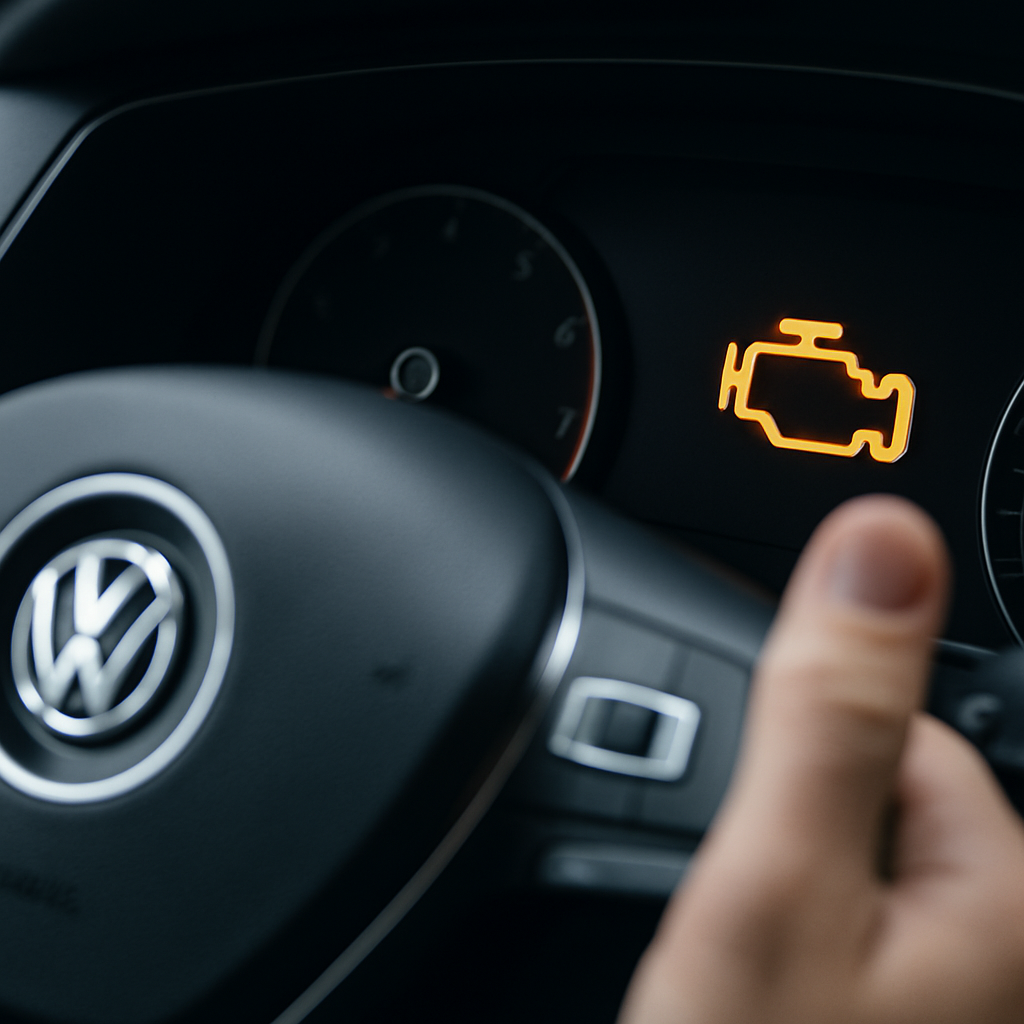
A check engine light on a Volkswagen Jetta is not, by itself, a diagnosis. The information available here cannot identify a single most common cause across all Jetta model years, engines and fuel types, and it cannot confirm that a particular component has failed. The practical first step is to obtain and keep the exact diagnostic trouble code or codes, their descriptions, and the circumstances in which the light appeared before approving a repair or attempting to clear anything.
This matters because a warning lamp, a stored code, a suspected system and a confirmed failed part are four different things. A code scan can point a technician towards the relevant system, but it does not automatically prove which part needs replacing.
Your Volkswagen Jetta Check Engine Light Is On: Start With the Code, Not a Parts Guess
Start by recording the information that makes a vehicle-specific diagnosis possible:
- the Jetta’s model year;
- engine and fuel type;
- the exact diagnostic trouble code(s) and code description(s);
- when the lamp came on, including whether it followed refuelling, maintenance, a long journey or another event;
- any changes in starting, idle quality, acceleration, fuel smell, fuel use, temperature indication or other dashboard warnings; and
- recent repair and maintenance history.
Some parts retailers may offer engine-code scanning at some branches. For example, a local parts-store listing notes that code scanning is available at most locations for one retailer, so it is sensible to call ahead and confirm the service at the branch you plan to use. A retail scan is useful for retrieving stored information, but it is not a complete diagnosis and should not be treated as a guaranteed identification of the failed part.
Keep a photo or written record of the codes before anyone clears them. It gives a repair facility a starting point and prevents a warning light from becoming the only remaining clue. It is also worth keeping the code description rather than relying on an abbreviated verbal summary.
What not to assume
- Do not assume one component is bad simply because the check engine light is illuminated.
- Do not assume a code scan is the same as a confirmed repair diagnosis.
- Do not assume clearing or resetting a code has repaired the underlying condition.
- Do not assume another Jetta owner’s code, symptoms or successful repair applies to a Jetta with a different year, engine or history.
There are many owner discussions online that attach a Jetta warning light to individual repairs. Those accounts can show why people look for a scan first, but they are not evidence that a particular component is a common cause across the full Jetta range. A model-year- and code-specific assessment is still needed.
For general background on one possible warning-light pathway, see our guide to a loose gas cap and the check-engine light. It is related reading only; it does not establish that a loose cap is the cause of a particular Jetta’s warning.
Why the Light Can Be On When the Jetta Seems to Drive Normally
A Jetta that feels normal has not provided enough information to identify the fault or establish that it is harmless. The absence of an obvious drivability problem does not replace retrieving the stored codes, documenting symptoms and considering the exact vehicle’s history.
In practical terms, normal-feeling operation may simply mean that the driver has not noticed a change, that the condition is intermittent, or that further testing is needed to understand the stored information. This article does not have Volkswagen model-specific diagnostic procedures or code definitions that would allow a reliable component diagnosis from the lamp alone.
If another Volkswagen warning symbol is illuminated, identify the exact symbol rather than calling every engine-related warning a check engine light. An EPC light, for example, is a distinct Volkswagen dashboard warning. Our explanation of what Volkswagen’s EPC light means may help distinguish the symbol, but its VW Rabbit-specific discussion should not be used as a Jetta diagnosis or reset instruction.
What Is the Most Common Cause of a Check Engine Light on a Jetta?
The supplied evidence does not establish a statistically most common cause for every Volkswagen Jetta. That would require reliable failure-frequency information separated by model year, engine, fuel type and diagnostic code. It is therefore not responsible to rank components or publish a universal Jetta parts list from the warning light alone.
The better answer is procedural: obtain the code, retain it, and have the code interpreted alongside the vehicle’s specification, symptoms and appropriate testing. A code can identify a fault area or monitoring condition; it is not automatically proof of a root cause or a failed replacement part.
Will a VW Check Engine Light Reset Itself?
Do not rely on a promise that a Volkswagen check engine light will reset itself after a particular number of journeys, miles or drive cycles. The supplied research does not include Volkswagen model-year-specific information on self-clearing conditions, readiness monitors or approved reset procedures.
Equally, do not treat clearing a code as a repair. Whether a lamp goes out, stays out or returns depends on vehicle-specific diagnostic information that is not available from the lamp alone. Preserve the codes first, then decide on the next step using the applicable owner’s documentation and qualified diagnostic advice. This article does not recommend battery disconnection, scan-tool clearing or a self-reset timetable because the evidence supplied does not support a Jetta-specific procedure.
Can You Drive Four Hours With the Check Engine Light On?
A four-hour driving clearance cannot be made from the check engine light’s status alone. The available sources do not provide a Jetta-specific severity matrix, a code-specific driving assessment or a safe distance threshold. Do not interpret a steady lamp, a flashing lamp or apparently normal operation as universal permission to continue a long trip.
Check the owner’s manual for the exact model year, consider every warning and symptom present, retrieve the stored codes and check the VIN for open recalls. Seek prompt help from a qualified repair facility rather than continuing when there are additional serious symptoms or a manufacturer warning. If there is a suspected fuel leak, treat it as safety-sensitive and follow manufacturer or dealer instructions rather than attempting fuel-system work yourself.
| What you know | What it does and does not tell you | Useful next action |
|---|---|---|
| The check engine lamp is on | It indicates that diagnostic information should be retrieved; it does not identify a failed part. | Record the code(s), vehicle details and symptoms. |
| A code has been read | It provides a diagnostic starting point, not necessarily a confirmed root cause. | Keep the code description and obtain vehicle-specific diagnosis where needed. |
| The Jetta seems to run normally | It does not establish why the lamp is on or that the condition is minor. | Do not dismiss the warning; assess the codes and exact vehicle. |
| The light was cleared or went out | It does not prove a repair has been completed. | Use model-specific diagnostic guidance before drawing conclusions. |
Also Check Your Jetta’s VIN for Open Safety Recalls
Checking recalls is a separate action from diagnosing the check engine light. A warning lamp does not prove that a safety recall applies, and an open recall does not prove that it caused the lamp. Recall eligibility is campaign- and VIN-specific.
RepairPal’s Jetta recall guidance says owners can use a VIN or licence plate in a recall checker. It also states that safety-related recalls are repaired by Volkswagen without charge, including when the warranty has expired or the owner is not the original owner. That applies to safety recalls; it should not be confused with ordinary diagnostic or maintenance work.
The same guidance notes that the VIN may be found at the lower edge of the windscreen, on the driver’s door frame or in the engine bay. The exact location can vary, so confirm it against the vehicle’s own documentation if necessary.
Limited fuel-system recall context
Reuters reporting supplied with this research describes recalls involving certain 2015–2020 Volkswagen Golf, Jetta and GTI vehicles in connection with a defective suction jet pump that could cause a fuel leak. The reporting describes the component in the fuel-tank/evaporative-emissions context. See the Reuters report on the recall query and subsequent action and separate Reuters coverage of the U.S. recall announcement.
This is context, not proof that any individual Jetta is affected or that the recall is responsible for a check engine light. Do not infer inclusion from model name or year alone: verify the exact VIN, follow the recall notice and dealer instructions, and do not attempt a do-it-yourself fuel-system repair where a fuel leak is suspected.
A Sensible Next-Step Checklist
- Confirm that the illuminated symbol is the check engine light and note any other dashboard warnings.
- Record the model year, engine, fuel type, symptoms and recent work.
- Retrieve and retain all diagnostic trouble codes and descriptions; confirm local code-scanning availability if using a parts retailer.
- Do not buy a part solely on the basis of the lamp or a code description.
- Do not rely on a reset, a cleared code or a light that goes out as proof that the issue has been repaired.
- Use the VIN or licence plate to check for open safety recalls, separately from ordinary diagnosis.
- For a planned long drive, obtain code-, symptom- and vehicle-specific guidance from the owner’s manual and a qualified repair facility rather than relying on a generic time or distance rule.
The useful outcome of a check engine light is not a guessed repair. It is a clear record of the code, the vehicle configuration and the symptoms, followed by diagnosis that can distinguish a stored warning from the actual cause.
Pingback: “Forward Driving Aids Temporarily Disabled – Front Sensor Blocked”: Meaning, Causes and What to Do - Premier Motoring Blog
Pingback: Check Engine Light After an Oil Change: Causes, What to Check, and When to Stop Driving - Premier Motoring Blog