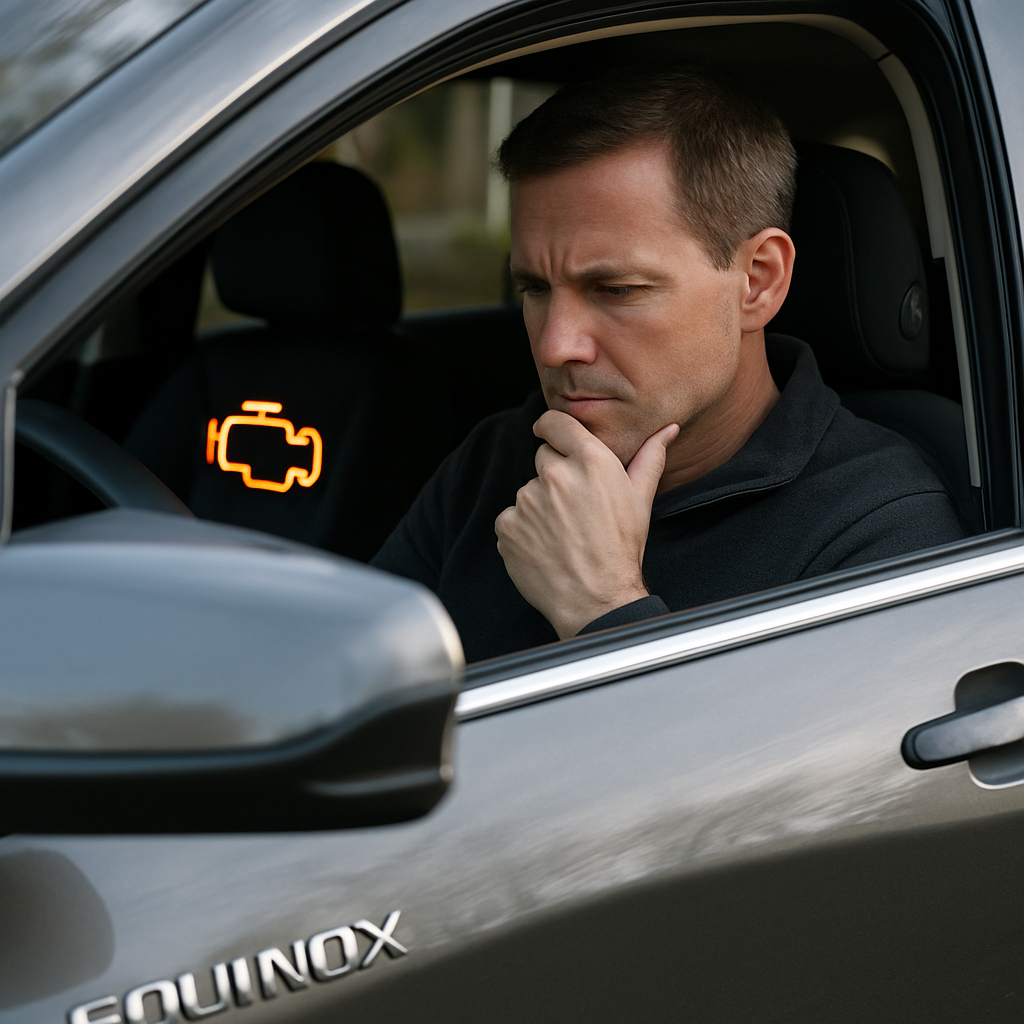
A check engine light on a Chevy Equinox means its onboard diagnostic system has detected a fault in an engine, emissions, powertrain-related, or electronic-control system and stored a diagnostic trouble code (DTC). It is a warning system, not a diagnosis: the lamp alone cannot identify the failed part. The useful next step is to read the stored code with an OBD-II scanner or have a qualified diagnostic service do so before approving replacement parts.
An Equinox may seem to run normally even when the light is on. That does not prove the fault is harmless, resolved, or unrelated to future drivability and emissions performance. A loose fuel cap can be one possible explanation, but so can sensor-input, ignition, fuel-system, air-measurement, or exhaust-emissions faults. Start with the light’s behavior, note any symptoms, and obtain the code.
What a Check Engine Light Means on a Chevy Equinox
The check engine light, also called the malfunction indicator lamp, comes on when the vehicle’s electronic control module detects a fault or condition requiring attention and records a fault code. As the overview from Hare Chevrolet explains, the stored code is intended to identify the affected system or condition for diagnosis.
That distinction matters. A code may point toward an air-fuel, ignition, emissions, or sensor-related problem, but it does not by itself prove that a particular oxygen sensor, ignition coil, catalytic converter, or other component has failed. Wiring, connectors, air leaks, fuel delivery, mechanical condition, and other factors can produce overlapping symptoms and related codes. Proper diagnosis uses the exact DTC alongside the vehicle’s symptoms and appropriate inspection or testing.
Do not ignore a steady lamp simply because the Equinox feels fine. A fault may be intermittent, may primarily affect emissions control, or may not yet have created an obvious change in how the vehicle drives. Equally, a steady check engine light does not automatically mean the vehicle requires a tow. It does mean the fault should be investigated in a timely manner.
Steady vs. Flashing Check Engine Light: When to Stop Driving
| Light behavior | What it indicates | Sensible response |
|---|---|---|
| Steady or continuously illuminated | A stored fault requiring diagnosis; it does not identify a component on its own. | Arrange an OBD-II code read and diagnosis soon, particularly if the light persists or symptoms develop. |
| Flashing | The available sources treat this as a potentially serious condition, often associated with a possible misfire. | Do not continue normal driving. Reduce engine load and arrange prompt professional assessment. |
| Flashing, then steady or off | The change in lamp behavior is not confirmation that the cause has been repaired. | Read the stored codes and note whether the warning or symptoms recur. |
A flashing light deserves a more cautious response than a steady one. The available Equinox sources associate flashing with conditions such as a possible engine misfire and warn that continuing to drive can allow damage to escalate, including damage involving the catalytic converter, ignition-related parts, or spark plugs. The exact failure cannot be determined from the flashing lamp alone, but it should not be treated as ordinary driving.
If the light flashed and then stopped, do not assume the issue fixed itself. An intermittent fault can still leave useful stored information, and a repeat event matters. Seek prompt diagnosis if there is a rough idle, a noticeable misfire, reduced acceleration, difficulty starting, poor fuel economy, engine knock, or a continuing or recurring warning light. The available research does not establish a safe distance to drive or an exact roadside procedure for an intermittently flashing Equinox light, so it would be unwise to rely on either.
If a scan returns P0300, or a technician confirms a misfire, see our guide to what a P0300 random/multiple-cylinder misfire code means. It should be used after the code is retrieved, not as evidence that every flashing Equinox light is P0300.
Common Possible Causes of an Equinox Check Engine Light
There is no defensible universal answer to the question, “What is the most common reason?” for every Chevy Equinox. Causes vary by year, engine, condition, code, and symptoms. The sources identify the following as possible trigger groups, not a parts-shopping list:
- Fuel-filler or evaporative-emissions sealing issue: a loose, missing, damaged, or improperly sealed fuel cap can trigger a warning, especially if the light appeared after refueling.
- Sensor-input issue: oxygen-sensor and other sensor faults can provide inaccurate information to the engine control system.
- Air-measurement issue: a dirty or defective mass airflow (MAF) sensor is one possible cause.
- Ignition issue: spark plugs and ignition coils can be involved when there are misfires, rough running, or starting problems.
- Fuel-system issue: a fueling fault can also set the lamp and affect performance.
- Exhaust-emissions issue: catalytic-converter concerns and related emissions-system faults are possible causes.
- Mechanical condition: more serious problems, including low compression, can be associated with poor running, misfires, reduced acceleration, and the warning light.
This Equinox diagnostic overview similarly lists oxygen and MAF sensors, spark plugs, coils, fuel-related issues, catalytic-converter concerns, and compression problems as possible causes. The important word is “possible”: replacing one of those parts without diagnosis can be expensive and may not cure the fault.
A sensible first check after refueling
If the warning appeared shortly after filling up and your Equinox has a conventional removable cap, inspect it for damage, ensure it is present, and refit it securely. This is a low-risk owner check, not a complete diagnosis. A correctly sealed cap may allow the system to retest after the underlying sealing issue is resolved, but there is no guaranteed timing for the lamp to go out.
For more detail on that limited scenario, read our guide to a loose gas cap and check engine light. If the cap is sound, the lamp remains on, or other symptoms are present, retrieve the code rather than treating the cap as the answer.
This guidance should not be extended to a capless fuel-filler system. The available research supports conventional fuel-cap checks but does not establish which Equinox years use a capless design, how such a system should be inspected, or whether a capless-filler fault is the cause of a particular check engine light. Have the exact vehicle diagnosed rather than improvising a repair.
Poor-quality fuel is mentioned by one available source as a possible contributor, but it should not be presumed to be the cause or used to justify improvised fuel-system repairs. Also, a dirty or clogged oil filter is typically not a direct cause of a check engine light according to the available Equinox source. Do not confuse a check engine light with a separate oil-pressure warning.
Check Engine Light Codes: Read the Code Before Trying to Fix It
An OBD-II scan is the practical starting point because it retrieves the DTC recorded by the control module. Before clearing anything, record:
- the exact code or codes;
- whether your scan tool labels a code current or pending, if it provides that information;
- whether the light was steady, flashing, or intermittent;
- when it happened, such as after refueling or immediately after service; and
- any symptoms, including rough idle, hesitation, starting difficulty, poor fuel economy, or reduced acceleration.
This information gives a technician a better starting point and can prevent an intermittent issue from being obscured by clearing the memory first. A code directs diagnosis toward a system or operating condition; it is not a command to replace a named part. The appropriate sequence is:
- Retrieve and record the code.
- Use the code, symptoms, and inspection or testing to diagnose the underlying fault.
- Carry out the repair indicated by that diagnosis.
- Verify whether the lamp stays off or returns.
The available research does not provide a reliable, Equinox-specific code chart or authoritative model-specific procedures for individual codes. For that reason, this article does not treat generic internet code lists as proof of the required repair. The exact year, engine, and DTC are essential when seeking model-specific service information or parts advice.
Can You Reset the Equinox Check Engine Light Yourself?
Yes. An OBD-II scanner can clear DTCs and extinguish the check engine light. But that is not the same as fixing the condition that caused it. The Equinox guidance from WheelsJoint makes the same essential distinction: a scanner can clear codes, while diagnosis is needed to determine why the light came on.
Always save the code information first. Clearing it too early can remove evidence that is useful when the fault is intermittent. If the light returns, the cause remains or has recurred; repeatedly resetting it is not a repair strategy.
After a genuine repair, the lamp may switch off once the vehicle has completed subsequent monitoring. A fuel-cap sealing issue, for example, may clear after the system retests. Do not rely on a promised number of trips, drive cycles, or hours, because the available sources do not establish one dependable Equinox-wide timeframe.
Battery disconnection, ignition-cycling, and accelerator-pedal reset methods are not recommended here as preferred solutions. The available material does not provide Equinox-specific owner-manual guidance or sufficient qualification about their side effects. Scanner-based retrieval and, only after diagnosis, clearing are the more useful approach.
Does the Advice Change for a 2012, 2013, 2014, 2015 or 2016 Equinox?
The fundamental process is the same across these searched model years: observe whether the lamp is steady or flashing, read the stored code, diagnose the root cause, repair what testing identifies, and verify the result. The available 2012, 2013, 2015, and 2016 material supports broad points such as fuel-cap checks, code retrieval, possible sensor or emissions-related faults, and the urgency of a flashing lamp.
It does not establish a year-specific list of common Equinox faults, engine configurations, failure rates, recalls, technical service bulletins, or code procedures for 2013, 2014, or 2016 models. Do not assume that a generic cause listed for one model year is a documented problem for every Equinox of that year. When arranging diagnosis or ordering parts, provide the exact model year, engine, stored DTC, lamp behavior, and symptoms.
What About “Engine Power Reduced”?
“Engine Power Reduced” is a separate message from the ordinary check engine light. The available research package does not provide enough evidence to explain its Equinox applicability, associated codes, causes, fail-safe behavior, or driving instructions responsibly. It should not be equated automatically with a normal check engine light.
What can be said safely is that reduced acceleration, particularly alongside a warning light or other drivability symptoms, warrants prompt diagnosis and a code read. Use the exact warning message, year, engine, and DTC when seeking vehicle-specific guidance.
When Professional Diagnosis Is the Better Choice
Arrange professional diagnosis promptly when the lamp flashes, the vehicle runs roughly, misfires, loses acceleration, struggles to start, develops engine knock, or the warning keeps returning after a basic fuel-cap check. Sensor, ignition, fuel-delivery, compression, and emissions-system diagnosis usually requires more than a visual inspection.
If the light began directly after an oil change or related service, that timing is useful diagnostic information but does not prove the service caused it. Our article on a check engine light after an oil change covers that specific scenario. For all other cases, the most efficient path remains the same: capture the fault code, diagnose the actual cause, and repair that cause rather than merely clearing the warning.