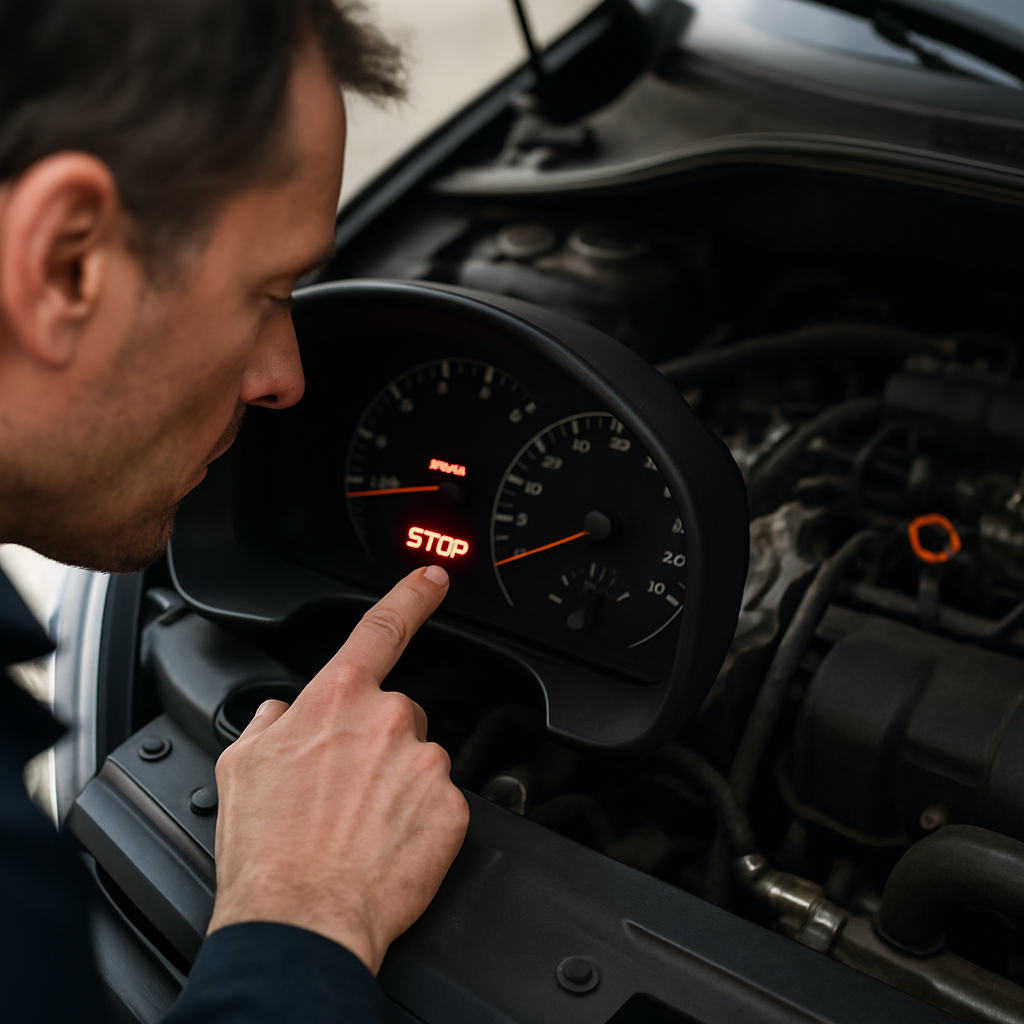
An “Oil Pressure Low—Stop Engine” message is an oil-pressure warning, not simply a routine oil-change reminder. It can mean the engine is not receiving sufficient lubrication pressure, although a faulty sensor, switch, or wiring circuit can also produce an inaccurate warning. Treat it as urgent until the cause has been established: pull over safely as soon as practical, switch the engine off, and avoid continuing to drive or repeatedly running the engine.
If pressure really is low, oil may not circulate adequately through critical engine components. That can raise friction and heat, accelerate wear, and potentially cause severe engine damage. The warning does not prove damage has already occurred or identify the failed component, but it is not a warning to dismiss because the car still seems to run normally.
Oil Pressure Low—Stop Engine: What the Warning Means and What to Do Now
Many vehicles use an oil-can symbol, a red oil light, an audible alert, or wording such as “Oil Pressure Low—Stop Engine.” Exact symbols, colours, and warning logic vary by make and model, so the owner’s manual is the authority for the message in a particular vehicle. In general, a red oil-pressure warning warrants an urgent response. Guidance on low-pressure warnings consistently advises stopping rather than driving on while the cause is unknown; genuinely low pressure can damage an engine quickly.
The crucial distinction is between oil level and oil pressure:
- The dipstick or electronic level display checks the quantity of oil in the engine.
- The warning concerns the lubrication system’s operating pressure or, in some vehicles, the signal used to report that pressure.
A normal oil level therefore does not prove that oil pressure is adequate. Equally, the warning by itself does not prove that the pump, sensor, or any other part has failed.
Safe roadside steps
- Pull over safely and switch off the engine as soon as conditions permit.
- Do not try to diagnose the fault by revving the engine, repeatedly restarting it, or driving until the warning disappears.
- Once the vehicle is parked on level ground and conditions are suitable for the manufacturer’s stated checking procedure, check the oil level.
- If it is safe to do so, look for obvious external oil loss beneath the vehicle or around the engine. Do not crawl underneath an unsupported vehicle or touch hot components.
- If the oil is low, do not assume topping it up has solved the underlying issue. Use only the manufacturer-specified oil and establish why the level fell.
- Do not continue driving if the warning remains, the level is low without an understood cause, or the engine has abnormal noise, overheating, smoke, or reduced performance. Arrange professional assistance or recovery.
A low-pressure warning accompanied by knocking, tapping, other unusual engine noise, overheating, smoke, or a persistent alert is an especially strong reason not to restart or drive the vehicle. As this overview of the low oil-pressure warning notes, the safe default is to pull over and shut the engine off rather than attempt to continue the journey.
Why the Warning Can Appear When the Oil Is Full
“The oil is full, but the oil light is on” is a common and important scenario. A full or normal dipstick reading rules out neither an oil-pressure nor an oil-flow problem, nor a fault in the pressure-reading circuit.
A sensor or oil-pressure switch, its wiring, or possibly the instrument-cluster signal can produce a false or incorrect warning. That is one possibility—not a conclusion. Actual low pressure can also occur with a normal oil level if there is a circulation restriction, incorrect oil specification, a pump or pressure-control problem, or internal engine wear. Available sources identify sensor issues, pump concerns, and restricted filters among the possible explanations for this situation.
Do not conclude that “the problem is not the oil” solely because the dipstick is full. The quantity may be correct while the circulation or pressure is not. The distinction normally requires a qualified technician to confirm actual oil pressure using the correct vehicle-specific procedure and specification before condemning a sensor, pump, or internal engine part. Guidance for warnings with a normal oil level similarly treats both electrical faults and genuine lubrication-system faults as possibilities.
Common Causes: Low Oil, Oil Condition, Sensor Faults, Pump Problems, and Engine Wear
The dashboard warning cannot rank the causes for a particular car. Possible causes include the following categories.
| Diagnostic category | What may be happening | Important limitation |
|---|---|---|
| Low oil level or oil loss | External leaks or oil consumption can allow the level to fall far enough that the system cannot maintain pressure reliably. | Adding oil may be necessary when the level is verified low, but it does not explain where the oil went or prove pressure is restored. |
| Oil condition or incorrect specification | Degraded or contaminated oil, or oil of an incorrect viscosity or specification, may contribute to a pressure problem. | Use the manufacturer’s specified product. A thicker oil is not a universal or evidence-based cure. |
| Restriction or circulation fault | A blocked or restricted oil filter is cited as a possible contributor to a low-pressure warning. | A warning alone cannot confirm the filter is at fault. |
| Pressure generation or control | A failing oil pump or a relief-valve problem can affect oil pressure. | These require diagnosis; do not replace a pump merely because the warning appeared. |
| Internal engine wear | Worn bearings and increased bearing clearances can contribute to low pressure, particularly in a higher-mileage engine. | Internal wear must be confirmed professionally and is not diagnosed by a warning light alone. |
| Signal fault | A faulty pressure sensor/switch, wiring fault, or possible instrument-cluster issue can make the displayed warning unreliable. | A signal fault must not be assumed before actual pressure has been evaluated. |
If you can see signs of an external leak, that may help explain a low oil level, but a leak does not automatically explain the pressure warning. Ford owners dealing with visible oil loss can read our model-specific guide to Ford F-150 oil leak diagnosis and repair; it should not be used as a substitute for a proper oil-pressure diagnosis.
Sources discussing low pressure also identify low oil level, pump faults, restricted filters, and worn bearings as possible causes, while stressing the risk of damage if true low pressure is ignored. See this explanation of the Oil Pressure Low—Stop Engine warning for a general summary of those pressure-system concerns.
Why the Oil Warning May Come On at a Stop or Flicker On and Off
When the vehicle stops, engine speed drops to idle. That lower speed can expose an existing marginal-pressure condition that is less apparent at higher revs. An intermittent warning can also be associated with a sensor, switch, or wiring issue. Neither explanation is safe to assume from the pattern alone.
A light that comes on at traffic lights but goes out when the car moves again is therefore a diagnostic clue, not a safe exception. Do not keep driving in the hope that higher revs will keep the warning off, and do not try to test it by revving the engine. The available evidence does not establish a universal idle-speed trigger, a universal pressure threshold, or a model-independent rule that a flickering oil light is “just a sensor.”
Stop and seek prompt diagnosis, particularly if the alert is persistent or is joined by overheating, knocking, tapping, smoke, rough performance, or reduced power. For owners of the relevant engine only, Premier Motoring also has a model-specific resource on Chevy 5.3 low oil pressure at idle. Its vehicle-specific considerations should not be generalised to other engines.
Signs of a Failing Oil Pump and How Oil Pressure Is Actually Checked
Warning-light illumination, overheating, and knocking or excessive engine noise can be associated with an oil-pump or wider pressure-system problem. They do not confirm that the oil pump has failed. The same symptoms and warning can overlap with low oil level, an incorrect oil specification, a restricted filter, pressure-control faults, internal wear, and faulty sensor circuitry.
A dipstick does not test oil pressure
Checking the dipstick is a sensible owner-level check because it establishes whether the engine has the correct oil quantity. It does not measure operating oil pressure. Actual pressure verification is a vehicle-specific diagnostic task: the technician’s aim is to establish whether pressure is genuinely low before deciding whether attention is needed for the sensor, wiring, pump, relief valve, filter, or internal engine components.
There is no responsible universal pass/fail pressure figure to apply across all makes and engines. Vehicle-specific specifications, test methods, and dashboard logic belong in the relevant owner information and service data. Avoid generic online pressure numbers or a do-it-yourself gauge procedure as a basis for declaring the vehicle safe.
How to Fix an Oil Pressure Low—Stop Engine Warning Safely
There is no single safe quick fix. The correct repair follows the confirmed cause, not the wording on the dashboard.
- Verified low oil: correct the level with the manufacturer-specified oil, then identify the reason for the low level, such as a leak or consumption. Do not treat the top-up as a complete diagnosis.
- Confirmed oil, filter, or specification issue: carry out the appropriate service using the correct oil and filter specification. An oil and filter change is not proof that a pressure problem has been solved unless it is part of the confirmed remedy.
- Confirmed sensor or wiring fault: repair the affected circuit or component only after the pressure issue has been evaluated appropriately.
- Suspected pump, relief-valve, restriction, or internal-wear issue: have a qualified professional diagnose and repair it. These conditions should not be addressed by guessing at parts.
Do not reset or clear the warning to resume driving, install a thicker oil as a blanket fix, or replace only the sensor without establishing whether the engine actually has adequate pressure. If the message began shortly after an oil service, a service-related issue may be relevant, but the oil-pressure warning remains distinct from a check-engine light. Our guide to what to check if a warning appeared after an oil change can help with that separate follow-up.
Repair scope and cost depend on the exact make, model, engine, confirmed fault, and local labour market. Without vehicle-specific service information and diagnosis, no universal repair price, labour time, or pressure specification would be reliable.
Bottom Line
An oil-pressure warning should be treated as an urgent lubrication-system warning even when the oil level appears full or the light goes away at speed. Stop safely, switch off, check the oil level using the vehicle’s procedure, and avoid driving or repeated restarts while the cause is unknown. A normal level can coexist with a real pressure problem or a faulty signal; only proper, vehicle-specific diagnosis can separate them.