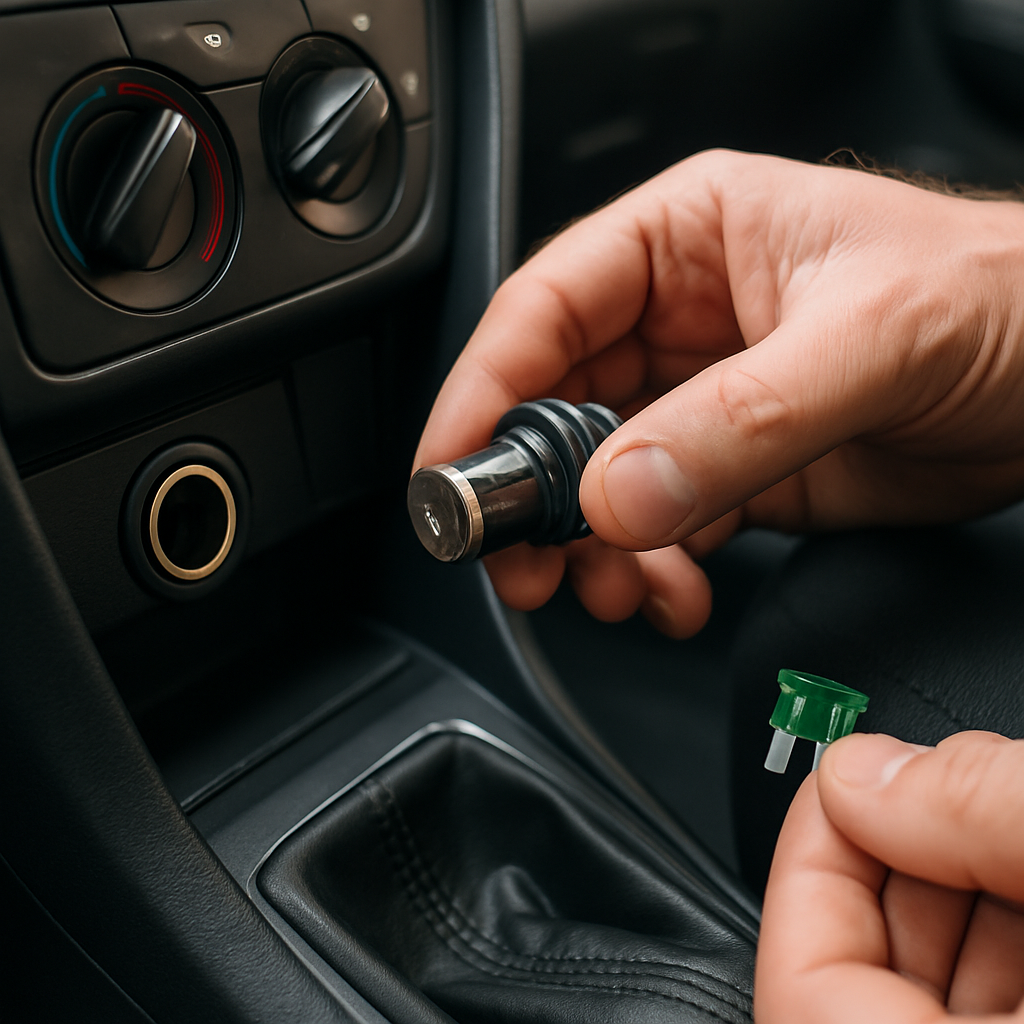
If the cigarette lighter socket is not working in your car, the fault may be a blown fuse, an outlet that only operates with the ignition in a particular position, a failed or contaminated socket, a loose or damaged connection, wiring trouble or, on vehicles fitted with one, a relay issue. The symptom alone cannot confirm which is responsible. Start with the simple checks before removing trim or replacing parts.
Although the name remains common, many cars use this fitting as a 12V power outlet, accessory outlet or power socket rather than for a removable cigarette lighter. That distinction matters: a socket that will not power a phone charger has a different likely fault path from a lighter insert that will not heat or pop out.
Start Here: Why a Cigarette Lighter Socket May Stop Working
Establish exactly what has failed first. A useful process is to check whether one outlet is dead or whether every related outlet has stopped working, try a known-good 12V accessory, and confirm the vehicle is in the power state required for that outlet.
Some outlets are permanently live, while others work only with the ignition in ACC or ON, or with the engine running. That arrangement varies by vehicle, so do not assume that an apparently dead socket is faulty until you have checked the owner’s manual and tried the appropriate ignition position.
| What you find | What it can suggest | Sensible next step |
|---|---|---|
| One outlet does not power a known-good accessory | A socket, local connection or outlet-specific circuit issue remains possible; a fuse can still be involved. | Confirm the operating condition, then identify and check the specified fuse. |
| Several related outlets have stopped working | A shared supply, fuse or relay may be involved, but this does not prove it. | Use the vehicle documentation to identify the relevant circuits before further diagnosis. |
| The outlet works only with the ignition on | This may be normal switching behaviour. | Check the owner’s manual before treating it as a fault. |
| The socket powers accessories, but the lighter insert does not heat or release correctly | The insert’s heating element or pop-out mechanism may be at fault rather than the vehicle’s outlet supply. | Assess the lighter insert separately; do not assume the socket has lost power. |
A blown fuse is a sensible early suspect, and generic 12V-outlet troubleshooting guidance commonly begins there. However, a fuse that looks intact—or even tests good—does not clear the socket, its rear connector, the wiring or every possible upstream component. A troubleshooting overview from JustAnswer’s Chevrolet resource likewise notes that a power-outlet fault can persist despite fuses appearing intact.
Rule out the accessory before diagnosing the car
Try one known-good charger, compressor or other suitable 12V accessory. A failed charger plug or a poor fit can imitate a dead outlet. Do not force an accessory into the socket, and do not use damaged adapters. If the actual complaint is a cigarette lighter insert, test whether another approved 12V accessory receives power instead; that separates a likely insert fault from a socket-supply problem.
How to Find and Check the Cigarette Lighter or 12V Outlet Fuse
There is no universal fuse called “cigarette lighter”, and there is no reliable universal fuse number, location or amperage. The controlling fuse may be labelled for a 12V outlet, accessory power outlet, power socket or cigarette lighter circuit, depending on the vehicle. Use the owner’s manual, the legend on the relevant fuse-box cover or vehicle-specific service information for the exact year, model and market.
Fuse panels may be in an interior area, such as beneath or around the dashboard, and/or in the engine bay. That does not mean every vehicle has both, or that its power-outlet fuse is in either particular location. Identify the specified circuit first rather than pulling fuses at random. For a model-specific example only, 2014 Toyota Camry owners can consult our 2014 Toyota Camry fuse-box location guide; its information should not be transferred to a Volkswagen, Chevrolet or another model.
A safe fuse-check sequence
- Switch the vehicle off and consult the exact vehicle’s documentation to identify the relevant outlet fuse.
- Remove only that specified fuse using the appropriate fuse tool or method described for the vehicle.
- Inspect it for an obvious break. A visual check is only a preliminary check.
- If you are competent and equipped to use a multimeter, test the removed fuse for continuity.
- Replace a failed fuse only with one of the same vehicle-specified rating.
- Retest the outlet under its correct ignition or accessory-power condition.
Generic diagnostic guidance from Outcast Automotive similarly directs owners to locate the vehicle’s applicable fuse and check it, while a 12V-outlet diagnostic video from Carsntoys highlights that a relay can also merit consideration when the fuses are sound.
Never fit a higher-rated fuse, bridge the fuse terminals or repeatedly install replacements without finding out why the original failed. A fuse that blows again points to an unresolved electrical problem and is a reason to stop DIY diagnosis and arrange professional inspection.
If the fuse is good
A good fuse means the investigation is not finished. On a design that uses an outlet relay, the relay and its control circuit may need testing; whether a relay exists, where it is and how it is checked are vehicle-specific. The socket itself, its wiring, its connector and the circuit supply can also remain possible fault areas. At this stage, avoid assuming that a new socket will solve the problem without evidence.
If the Fuse Is Good: Inspecting and Repairing the Socket
With the correct fuse checked, inspect the socket only at an owner-appropriate level. Look for visible debris, a loose-fitting accessory plug, obvious corrosion, physical damage, a loose socket body, heat discolouration or melted plastic. Do not insert coins, wire, screwdrivers or any other conductive object into the outlet. The socket’s central power connection is insulated from its surrounding housing; careless metal probing can create a short-circuit risk.
The electrical construction of a traditional lighter socket helps explain why condition matters: its base connection is insulated from the outer housing, while the surrounding metal provides the other contact path. This overview of how a car cigarette lighter works describes that basic insulated construction. Dirt, physical damage, a damaged insulator or a poor rear connection can therefore be relevant possibilities, but they are not confirmed simply because an outlet has stopped working.
Can you remove a cigarette lighter socket without a tool?
Not safely as a universal procedure. Some sockets shown in generic repair material are retained by tabs and connect to wiring at the rear, but the retention arrangement, trim access and connector design vary considerably between vehicles. A video demonstration of generic socket inspection shows tabs being released so the wiring can be inspected, but it does not establish a tool-free removal method for every car, VW Golf, VW Polo or Chevrolet.
Do not pull or twist the socket aggressively, pry surrounding trim without the applicable procedure, or disconnect wiring by force. Before buying a replacement, confirm the exact vehicle identity and compare the existing socket and connector. A replacement that looks similar at the front may not have the same retention method or rear connection.
What repair may involve
Depending on the diagnosis, a repair might involve cleaning accessible debris or contamination where doing so will not damage the socket, reseating a confirmed loose connection, repairing wiring, or replacing a heat-damaged or failed socket. Those are repair categories, not a diagnosis or a universal DIY procedure. Voltage and continuity testing can help distinguish supply, socket and wiring problems, but it should be left to owners who are competent with automotive electrical testing or to a technician. This article does not provide pinouts, probe locations or expected readings because those details must match the precise vehicle circuit.
Stop work and seek professional diagnosis if you find melted plastic, signs of overheating, a repeatedly blown fuse, damaged wiring, a burnt smell, or if socket removal, trim removal or electrical testing is uncertain. A technician can assess the outlet, its connector, wiring and any applicable relay without guessing from the symptom.
Chevy, VW Golf, VW Polo and Jetta: Get the Exact Fuse and Socket Information
Searches for a Chevrolet, VW Golf, VW Polo or 2017 Jetta cigarette lighter fuse location need a vehicle-specific answer—not a generic fuse number copied from another car. Fuse assignments, panel locations, outlet switching logic, labels, socket locations and retaining arrangements can vary by model year, market and configuration. A video or forum post for a different year or trim may be useful background, but it should not be treated as proof for your vehicle.
Where is the cigarette lighter fuse in a 2017 Jetta?
This research package does not verify the 2017 Jetta fuse location or fuse designation, so it would not be responsible to publish one here. Use the exact 2017 Jetta owner documentation and the fuse-panel legend fitted to the car. If the labels are unclear or the documented fuse tests good, a Volkswagen-capable workshop can identify the circuit using the applicable wiring information.
VW Polo, VW Golf and Chevrolet outlet faults
The same approach applies to a VW Polo cigarette lighter not working, a VW Golf outlet fault and a Chevrolet power-socket fault. First establish whether the outlet is ignition-switched, test a known-good accessory and identify the correctly labelled fuse from the exact handbook or panel legend. For Polo or Golf socket replacement, generic evidence supports only that some sockets use retaining tabs and rear wiring connections. It does not support a Polo- or Golf-specific removal sequence, part number or tool list.
Confirm the exact year, body style, market and, where relevant, trim before purchasing a socket or removing trim. This avoids applying an unrelated procedure or fuse assignment to a superficially similar vehicle. There is also no basis here to claim that any of these named models has a particular common outlet defect.
What If Your Car Does Not Have a Cigarette Lighter Plug?
A newer vehicle may have a 12V auxiliary power port rather than a traditional cigarette-lighter assembly, or it may use other charging arrangements. The similar appearance of a port does not establish that it is designed to accept a cigarette lighter insert.
As CarParts explains in its guide to car cigarette lighters, a cigarette-lighter socket can be used as a power point, but an auxiliary power port is not necessarily intended to operate a lighter. Check the port label and the vehicle documentation, and do not force a lighter insert into an outlet merely because the opening appears similar. If your concern is charging rather than lighting, use only accessories specified as compatible with that port.
A Practical Decision Path
- Confirm the symptom: try a known-good 12V accessory and determine whether one or more outlets are affected.
- Check the operating condition: place the ignition in the state required by the vehicle, as some outlets are switched.
- Check the correct fuse: use the exact owner documentation or fuse-box legend, then inspect and, if competent, continuity-test it.
- Use only the specified replacement: if the fuse has failed, do not increase its rating or bypass it.
- Inspect without probing: look for debris, looseness, melting or other visible damage; do not put conductive objects inside the socket.
- Escalate sensibly: if the fuse is sound but the outlet remains dead, or if a replacement fuse fails, arrange diagnosis of the socket, rear connector, wiring and any applicable relay.
This sequence addresses the most accessible checks without treating a cigarette lighter socket not working in a car as an automatic fuse failure. It also keeps the important boundary clear: a failed lighter insert, a dead 12V accessory outlet and a damaged electrical circuit can produce related complaints, but they are not necessarily the same fault.