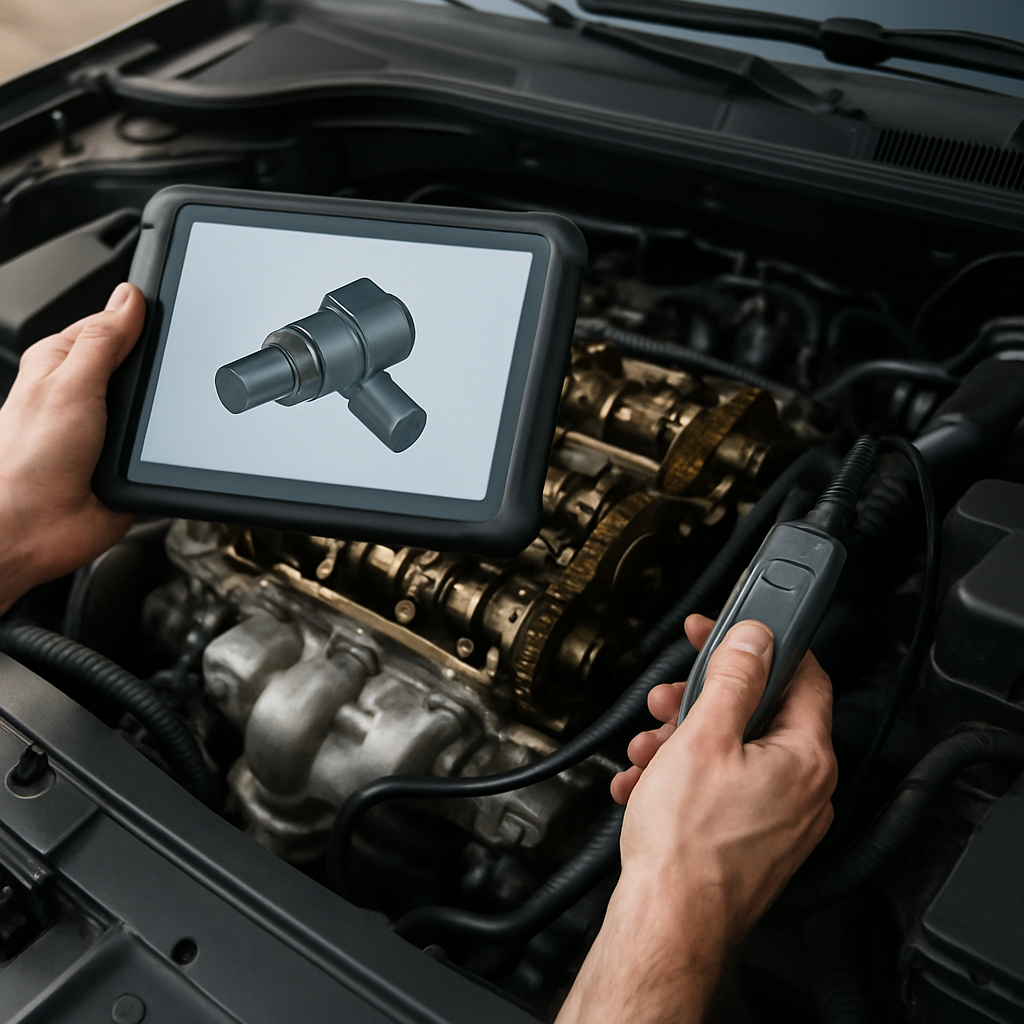
P0011 is the generic OBD-II fault code for “A” Camshaft Position—Timing Over-Advanced or System Performance (Bank 1). Put simply, the engine computer has found that the relevant Bank 1 camshaft timing is more advanced than commanded, has exceeded a calibrated limit, or cannot be brought back into its expected operating range. It identifies a cam-timing-control problem, not a confirmed failed sensor, solenoid, cam phaser or timing chain.
On engines with variable valve timing (VVT), the first sensible checks are the specified engine-oil level and condition, followed by the VVT control circuit and oil-control hardware. A proper diagnosis must still rule out wiring faults, oil-flow or oil-pressure problems, cam/crank signal issues and, where appropriate, base mechanical timing before expensive parts are fitted.
What P0011 Means: “A” Camshaft Timing Over-Advanced on Bank 1
The formal P0011 definition is “A” Camshaft Position—Timing Over-Advanced or System Performance (Bank 1). The PCM or ECU monitors camshaft timing against its command. If the camshaft does not respond as requested, or remains too far advanced for the system’s calibrated criteria, it can store P0011. RepairPal’s P0011 explanation similarly describes the code as setting when the camshaft does not respond as the PCM requests.
Bank 1 means the side of the engine that contains cylinder 1. Do not assume this is always the left- or right-hand side of the vehicle: engine orientation and cylinder numbering differ by design. Confirm the bank and the relevant component in the service information for the exact year, model and engine.
In the supplied P0011 references, “A” is generally used for the intake-cam/VVT side. That is useful shorthand, but the exact component naming and physical location remain engine-specific.
How VVT, Oil and Cam Timing Work Together
VVT allows the control module to alter valve timing as operating conditions change. It commands an oil-control valve—often called a VVT solenoid or oil-control solenoid—which directs engine oil to a cam actuator or cam phaser. The phaser changes the camshaft’s angle relative to its drive gear, advancing or retarding valve timing. CarParts’ overview of VVT operation explains this oil-control-solenoid and actuator relationship.
That chain of control is why P0011 has several possible roots. Oil level, oil condition, oil viscosity where the manufacturer specifies a particular grade, oil pressure, restricted passages, a sticking solenoid, electrical control, a contaminated or faulty phaser, sensor signals and base mechanical timing can all affect the result the ECU sees. The code name does not prove which link has failed.
What Happens When Cam Timing Is Over-Advanced—and Can You Keep Driving?
“Over-advanced” does not mean the engine is simply making a normal VVT adjustment. It means the ECU cannot keep the relevant Bank 1 “A” camshaft position within its expected commanded range, or the system’s performance does not meet the required criteria. The problem may coexist with engine-running concerns, but P0011 alone does not establish a universal symptom pattern, a particular level of damage or a single drivability outcome.
It also cannot, by itself, prove that a vehicle is safe to drive, unsafe to drive, suffering timing-chain failure or about to suffer valve-to-piston contact. Avoid repeatedly clearing the code and assuming that a temporary absence of the warning confirms a repair.
A cautious approach is appropriate. If the engine is running abnormally, or there are signs of an oil-pressure, oil-supply, mechanical-timing or other serious engine problem, do not continue to treat P0011 as a routine warning. Arrange qualified diagnosis. Conversely, the code itself is not proof of catastrophic internal damage; diagnosis is what separates an oil/VVT-control issue from a more involved mechanical fault.
Common P0011 Causes: Start With Oil and VVT Control, Then Rule Out Mechanical Timing
The following are diagnostic possibilities, not a universal ranking for every Toyota, Nissan, Chevrolet, Subaru or other engine. The appropriate order matters because a simple oil or control issue can create the same code as a more expensive fault.
| Potential area | Why it can matter for P0011 | What should be confirmed |
|---|---|---|
| Oil level, condition and specification | VVT systems rely on engine-oil flow to move and control the cam actuator. Low, degraded, contaminated or unsuitable oil can interfere with that control. | Correct level, service condition and the oil specification required for the exact engine. |
| Oil flow or pressure | Restricted passages, screens where fitted, or an oil-pressure-related control problem may prevent the phaser from responding as commanded. | Oil-flow and pressure checks as required by the vehicle’s diagnostic procedure. |
| VVT solenoid / oil-control valve | A sticking, contaminated or faulty valve may misdirect or restrict the oil that controls cam timing. | Commanded operation, electrical supply, circuit integrity and the condition of the applicable valve. |
| Wiring and connectors | An open circuit, short circuit or poor connection can prevent correct VVT-solenoid control. | Harness routing, connector condition and vehicle-specific electrical tests. |
| Cam phaser / actuator | A contaminated, sticking or failed actuator may not move to, or hold, the commanded cam angle. | Diagnosis after oil supply and VVT control have been assessed. |
| Cam/crank position signals | The ECU needs credible position information to monitor cam timing. | Signal evaluation under the manufacturer’s test procedure; a code is not proof that a named sensor has failed. |
| Base mechanical timing | A mechanical-timing problem can place cam timing outside the expected relationship. | Professional verification where preceding checks or accompanying evidence point in that direction. |
The Ford-specific diagnostic reference for a 2011 Fusion lists low or dirty engine oil, a faulty variable camshaft timing solenoid, circuit faults and poor connections among its possible causes, and notes that dirty oil can obstruct small VCT-valve passages. Those examples are useful diagnostic categories, not a finding for every vehicle. The broader 2011 Ford Fusion P0011 reference should therefore not be read as a universal repair guide.
Before assuming a timing chain, tensioner or phaser has failed, establish whether the engine has the correct oil and whether the VVT system can be commanded and controlled correctly. Mechanical timing remains an important possibility, but P0011 does not prove a stretched chain, failed tensioner or failed phaser. For a model-specific example of the checks worth confirming before committing to timing work, see this Premier Motoring guide on what to verify before assuming a timing-chain repair on a Hyundai Elantra; its figures and details should not be applied to other engines.
For more background on the component at the centre of many P0011 investigations, our guide to VVT solenoid symptoms, diagnosis and replacement cost explains why the oil-control valve needs testing rather than automatic replacement.
How P0011 Should Be Diagnosed Before Parts Are Replaced
A sound diagnosis is a sequence, not a parts-shopping list. Procedures, connector details, solenoid locations, specifications and test thresholds vary by engine, so use manufacturer service information for the exact vehicle.
- Record all stored codes and relevant scan data. P0011 may not be the only useful clue. Retain companion codes and scan-tool information before clearing anything.
- Verify engine oil first. Check the level, condition and that the correct manufacturer-required oil has been used. This is an owner-level preliminary check; it is not evidence that an oil change will definitely cure the code.
- Inspect accessible VVT wiring and connectors. Look for obvious harness damage, poor connections or contamination without pulling apart components unnecessarily.
- Evaluate the Bank 1 “A” VVT control system. A suitable scan tool can be used to assess commanded operation or actuation, while electrical supply and solenoid testing may be needed to determine whether the control valve and circuit respond correctly.
- Continue according to the results of those tests. Depending on the engine and findings, the next stage can include VVT-solenoid inspection or testing, camshaft and crankshaft signal evaluation, oil-flow or oil-pressure checks, and verification of base mechanical timing.
The supplied diagnostic training material specifically describes using scan-tool actuation and electrical testing for the relevant Bank 1 intake oil-control valve, while the Auto Veteran overview includes oil condition, wiring, VVT-solenoid, cam/crank-sensor and PCM checks in the diagnostic path. Those principles support a test-first approach, but neither replaces the correct procedure for a particular engine.
Checking the dipstick and confirming the required oil specification are reasonable owner checks. Bidirectional scan-tool controls, circuit testing, oil-pressure diagnosis and mechanical-timing verification require the correct information and tools; they are best left to a qualified technician if you do not have both. Do not publish or follow generic resistance values, pinouts, battery-jump methods, torque settings or timing-mark procedures from another engine.
A P0011 code does not automatically mean the camshaft position sensor needs replacing. Sensor signals may be part of the diagnostic differential, but the component named in a code is not necessarily the failed component. If you are researching sensor work separately, this guide to camshaft position sensor replacement considerations on a 2012 Jeep Wrangler is specific to that application, not a P0011 diagnosis for all vehicles.
If P0011 or the check-engine light appeared shortly after an oil service, recheck the oil level and whether the correct specification was used rather than presuming the timing system has failed. Our article on why a check-engine light can appear after an oil change covers that broader situation. If service is due or oil is implicated, follow the required specification; this guide on how to check or change engine oil correctly can help with the maintenance side.
How to Fix P0011 and What Repair May Cost
The correct repair follows the confirmed cause. It may be as limited as correcting an oil-service issue, repairing a connector or wiring fault, or servicing or replacing the applicable VVT oil-control solenoid. It may also require cam-phaser/actuator work or mechanical-timing repair. Replacing a solenoid because P0011 appeared, without confirming oil supply, electrical control and system response, can leave the root cause untouched.
Cost varies substantially with the vehicle, engine layout, local labour rate, diagnosis time, part access and the difference between an oil/VVT-control issue and internal mechanical-timing work. The following figures are illustrative, source-specific ranges from Foxwell—not quotes, guaranteed totals or figures for every market.
| Work listed by source | Illustrative parts figure | Illustrative labour figure | Important limitation |
|---|---|---|---|
| Engine oil and filter service | $25–$70 | $80–$150 | May be relevant if oil condition, level or specification is implicated; it is not a guaranteed P0011 fix. |
| VVT solenoid / oil-control valve replacement | $30–$100 | $150–$350 | Applies only when testing supports that repair and may differ by vehicle, region and access. |
These numbers come from the supplied Foxwell P0011 cost discussion. The same source stresses checking oil quality, oil pressure and VVT control before assuming a phaser or timing-chain failure, which is the more important takeaway than any broad price estimate.
For diagnosis, the Ford-specific AutoCodes example lists one hour of labour for diagnosing P0011 on a 2011 Ford Fusion, with shop rates shown at $80–$150 per hour. That is an example for the cited vehicle, not a universal diagnostic time or shop rate. The supplied research does not support one reliable universal price for cam-phaser, timing-chain, tensioner or full mechanical-timing repairs. Request an estimate after diagnosis if those possibilities remain.
Does P0011 Mean the Same Thing on Toyota, Nissan, Chevy, or Subaru?
The generic code meaning remains the same: the Bank 1 “A” camshaft timing is over-advanced or the system is not performing within expected limits. What changes by manufacturer and engine is the terminology, component location, calibration threshold, oil requirement, test routine and repair path. For a useful vehicle-specific answer, provide the year, model, engine, subcode if shown, all companion codes, oil-service history and available scan data.
Toyota
On a Toyota, P0011 retains the generic Bank 1 “A” camshaft timing-over-advanced/system-performance meaning. The supplied evidence does not establish a Toyota-specific failed part, VVT location, repair method or cost. Use Toyota service information for the exact model year and engine before identifying a solenoid or attempting a test.
Nissan
On a Nissan, P0011 likewise retains the generic OBD-II interpretation. Do not infer Nissan-specific VVT terminology, component position or a common failure pattern from the generic code alone. The model-, year- and engine-specific service procedure should guide the inspection and testing.
Chevrolet and GMC
A Chevrolet P0011 still calls for diagnosis of Bank 1 “A” cam-timing control. The supplied Foxwell source characterises P0011-00 on Chevy/GMC as commonly associated with oil-pressure logic rather than automatically with timing-chain failure. Treat that as a source-specific generalisation, not a diagnosis for every Chevrolet or GMC engine. Oil supply, VVT operation, electrical control and mechanical timing still need vehicle-appropriate testing.
Subaru Impreza
For a Subaru Impreza, the supported answer is the same generic code definition: Bank 1 “A” cam timing is over-advanced or has a system-performance issue. The available research does not establish Subaru Impreza-specific causes, repair steps, costs or a safe-to-drive conclusion. Those depend on the exact engine, model year and diagnostic findings.
P0011 vs. P0014: Do Not Confuse the “A” and “B” Camshaft Codes
P0011 concerns the Bank 1 “A” camshaft timing-over-advanced/system-performance condition. The supplied CarParts and RepairPal references identify P0014 as “B” Camshaft Position—Timing Over-Advanced or System Performance (Bank 1). They are related cam-timing codes, but they do not automatically identify the same component, share the same root cause or require the same repair. Confirm the engine’s own designation and procedure before drawing an intake/exhaust or component-location conclusion.
P0021 is a distinct Bank 2 code search topic, but the supplied research does not define it or support a reliable comparison, diagnosis or repair recommendation. Do not treat it as interchangeable with P0011; obtain the exact vehicle-specific code definition and service procedure.
Practical Next Steps for a P0011 Code
- Record P0011, every accompanying code and any available scan data before clearing anything.
- Check engine-oil level, condition and the required specification for the exact engine.
- Inspect accessible VVT wiring and connectors, then have the relevant VVT circuit and commanded operation tested if the code persists.
- Do not assume the camshaft position sensor, VVT solenoid, phaser or timing chain is the answer solely because it is a plausible cause.
- Seek prompt qualified diagnosis if the engine is running abnormally or there are concerns about oil supply, oil pressure or mechanical timing.
- Approve major mechanical repairs only after the oil/VVT-control, electrical and applicable timing checks support that conclusion.
P0011 is best approached as a controlled diagnostic problem: establish whether the ECU can control Bank 1 cam timing correctly, then repair the confirmed cause rather than the first part named in an online search.