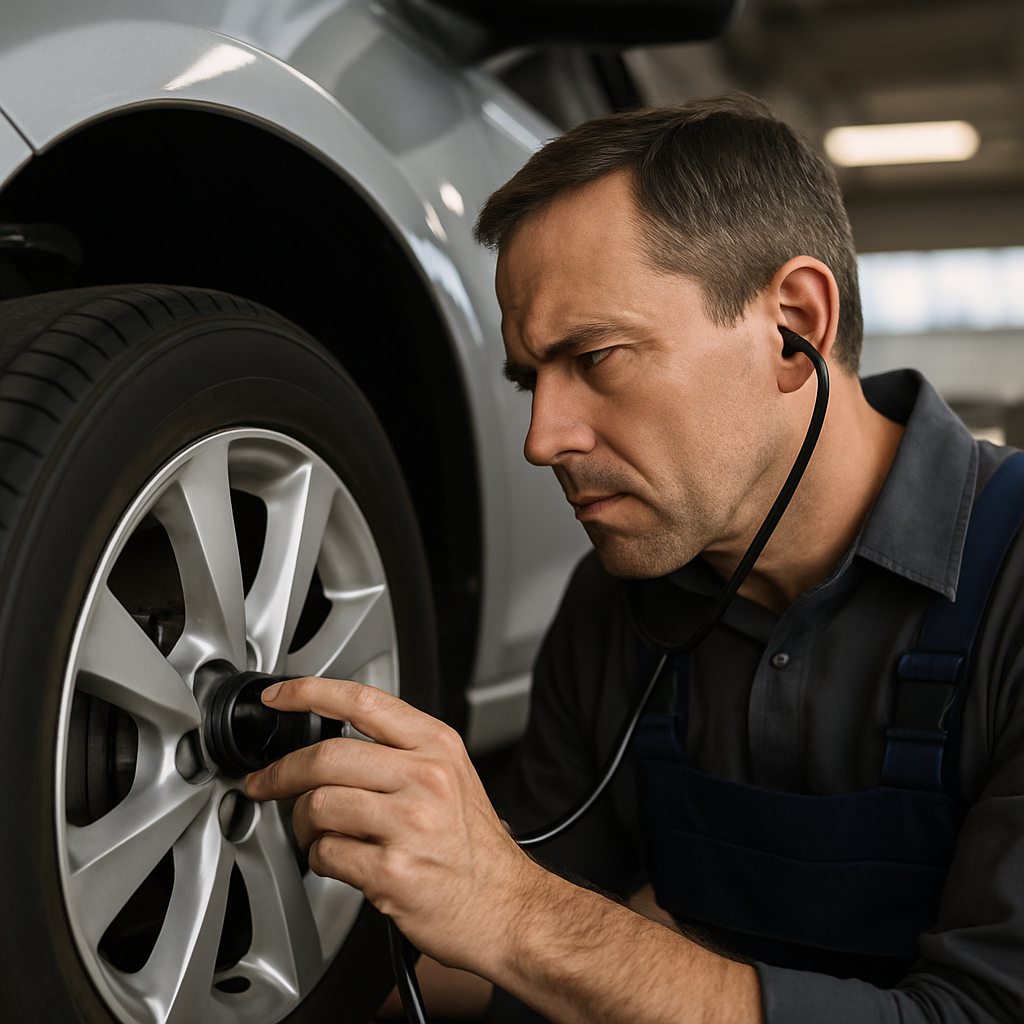
A squeaking noise when accelerating at low speed is often caused by a slipping auxiliary drive belt, brake hardware rubbing, or a dry or worn suspension or steering component. The sound alone cannot confirm the fault, but the conditions that trigger it are useful clues: a squeak that follows engine revs points towards the belt drive, while one that follows road speed, braking, bumps, or steering points towards the wheels, brakes, suspension, or steering. Do not ignore a persistent noise, especially if braking, steering, or handling has changed.
Start by identifying when the squeak happens
Before booking repairs or buying parts, try to narrow down the pattern safely. On a quiet road or driveway, note whether the noise occurs only while pressing the accelerator, whether it remains when coasting, and whether it changes as engine speed rises. Avoid leaning into the engine bay or asking someone to stand near a moving vehicle.
- Squeak rises and falls with engine revs, even when stationary: the auxiliary belt, tensioner, idler pulley, or an accessory pulley is more likely.
- Squeak becomes quicker as the car rolls faster: investigate brakes, tyres, wheel-area components, or bearings.
- Squeak appears over bumps or driveways: suspension bushes, ball joints, strut mounts, or shock absorber mountings deserve attention.
- Squeak occurs when turning at low speed: look at steering and suspension components first, while also considering the power-steering system on vehicles fitted with hydraulic assistance.
- Squeak changes when you touch the brake pedal: the brakes should be inspected promptly.
These are diagnostic pointers, not proof of a failed part. A workshop can use a road test and visual inspection to locate the source rather than replacing components on sound alone.
Common causes of a squeaking noise at low speeds
Auxiliary belt, tensioner, or pulley noise
A glazed, contaminated, loose, or worn auxiliary belt can slip briefly as engine load changes during pull-away. A tired tensioner or a pulley with a worn bearing can produce a similar sound. The RAC notes that squeaking during acceleration can indicate a worn or damaged drive belt and may also involve the pulley system or belt tensioner. Read its guide to unusual vehicle noises for the broader warning signs associated with belts, brakes, steering, and driveline noises.
If the squeak can be reproduced while parked by gently raising engine speed, do not spray belt dressing, lubricant, or water onto the belt as a diagnosis or fix. Contamination can mask the noise and make a proper inspection harder. A technician should inspect belt condition, alignment, and the operation of the tensioner and pulleys.
Brake pads, discs, and hardware
Brake squeal is not limited to hard braking. Pad wear indicators, pad material, corrosion, sticking hardware, or contact between a backing plate and disc can make a sharp squeak at very low speed. If the noise changes immediately with light brake pressure, treat the brake system as the leading suspect. ClickMechanic similarly identifies brake wear or incorrectly fitted brake components as possible sources of low-speed squeaking in its discussion of why cars squeak at low speeds.
Do not apply grease to the friction surfaces of brake pads or discs. Brake inspection and repair are safety-critical work; arrange a professional check if you are not equipped to assess the system correctly.
Dry or worn suspension and steering joints
Rubber bushes can harden or split, and joints can develop wear. Ball joints, anti-roll-bar bushes and links, strut top mounts, and control-arm bushes may squeak as the suspension loads and unloads during a slow pull-away or over uneven ground. A noise accompanied by a clunk, wandering steering, vibration, uneven tyre wear, or altered ride height needs timely inspection.
Wheel bearings and wheel-area contact
A wheel bearing can make noise at low speeds, but it is not sensible to diagnose one from a squeak alone. Bearing noise is commonly reported as a hum, rumble, or growl that varies with vehicle speed, though other sounds are possible. A brake shield touching the disc, a trapped stone, or tyre contact can also create a wheel-speed-related squeak. Do not attempt to judge wheel-bearing play without safely supporting the vehicle; incorrect lifting can cause injury or vehicle damage.
Why does a car squeak when turning right at low speed?
A squeak while turning right can load the left and right sides of the suspension differently, which may expose a dry bush, strut mount, ball joint, or other steering-related component. On a hydraulic power-steering system, a noise that appears only near full steering lock may also warrant a check of the fluid level and the system for leaks. Avoid holding the steering at full lock for longer than necessary.
Turning can also shift a brake pad slightly in its carrier or alter the relationship between a disc and a bent backing plate. Because several parts move at once during a tight, slow turn, the direction of the noise is a useful clue but not a reliable way to identify the exact component.
Is it safe to drive with a squeaking sound?
It depends on the source, which is why a persistent squeak should be assessed rather than dismissed. A brief belt squeak without warning lights or drivability changes may allow a careful trip to a garage, but a belt fault can worsen and affect belt-driven accessories. Do not continue driving if the battery warning light appears, the engine temperature rises, or the steering suddenly becomes heavy.
Stop driving and arrange recovery or urgent professional advice if the squeak is linked to poor braking, a brake warning light, grinding, smoke or a burning smell, severe steering resistance, a loose-feeling wheel, a strong pull to one side, or obvious suspension damage. Brakes, steering, and suspension faults can affect control of the vehicle.
A practical diagnostic route
- Record the conditions. Note cold versus warm operation, wet weather, engine speed, road speed, steering direction, bumps, and brake-pedal input.
- Check for visible warning signs with the engine off. Look for a cracked or frayed belt, fluid leaks, a loose undertray, or obvious damage around the wheels. Do not touch hot or moving components.
- Separate engine speed from road speed. If the car squeaks while stationary as revs change, mention that to the garage. If it only happens while rolling, explain whether braking or turning changes it.
- Have safety-related systems examined first. A brake, steering, suspension, or wheel noise should take priority over a non-critical trim squeak.
- Authorise repairs after confirmation. Ask the workshop to identify the noisy component and any related wear before parts are replaced.
Video or audio recorded from inside the cabin can help a technician, provided it is made by a passenger and does not distract the driver. It is also useful to mention recent brake work, belt replacement, suspension repairs, kerb strikes, or driving through deep water, as these events may help focus the inspection.
What the repair may involve
The repair depends entirely on the confirmed source. A belt-related problem may require a belt, tensioner, pulley, or correction of an oil or coolant leak that has contaminated the belt. Brake repairs may involve pads, hardware, discs, or a backing-plate adjustment. Suspension and steering squeaks can require replacement of a worn joint, bush, link, mount, or shock absorber assembly, followed by wheel alignment where the work affects alignment angles.
Costs vary widely with vehicle design, access, parts quality, labour rates, and whether additional worn parts are found. The most economical approach is usually a proper inspection first, particularly where the noise occurs only under a specific combination of acceleration, low speed, and steering input.
Preventing recurring squeaks
Follow the vehicle’s service schedule, have brakes and suspension checked when tyres are replaced or alignment is performed, and investigate fluid leaks before they contaminate belts or rubber components. A low-speed squeak may be minor, but it is also an early warning that lets you deal with wear before it becomes a braking, steering, charging, or handling problem.
Pingback: Subaru WRX vs WRX STI: Engine, Performance, Reliability, and Ownership - Premier Motoring Blog
Pingback: Creaking Noise When Turning the Steering Wheel: Causes, Checks, and Is It Safe to Drive? - Premier Motoring Blog