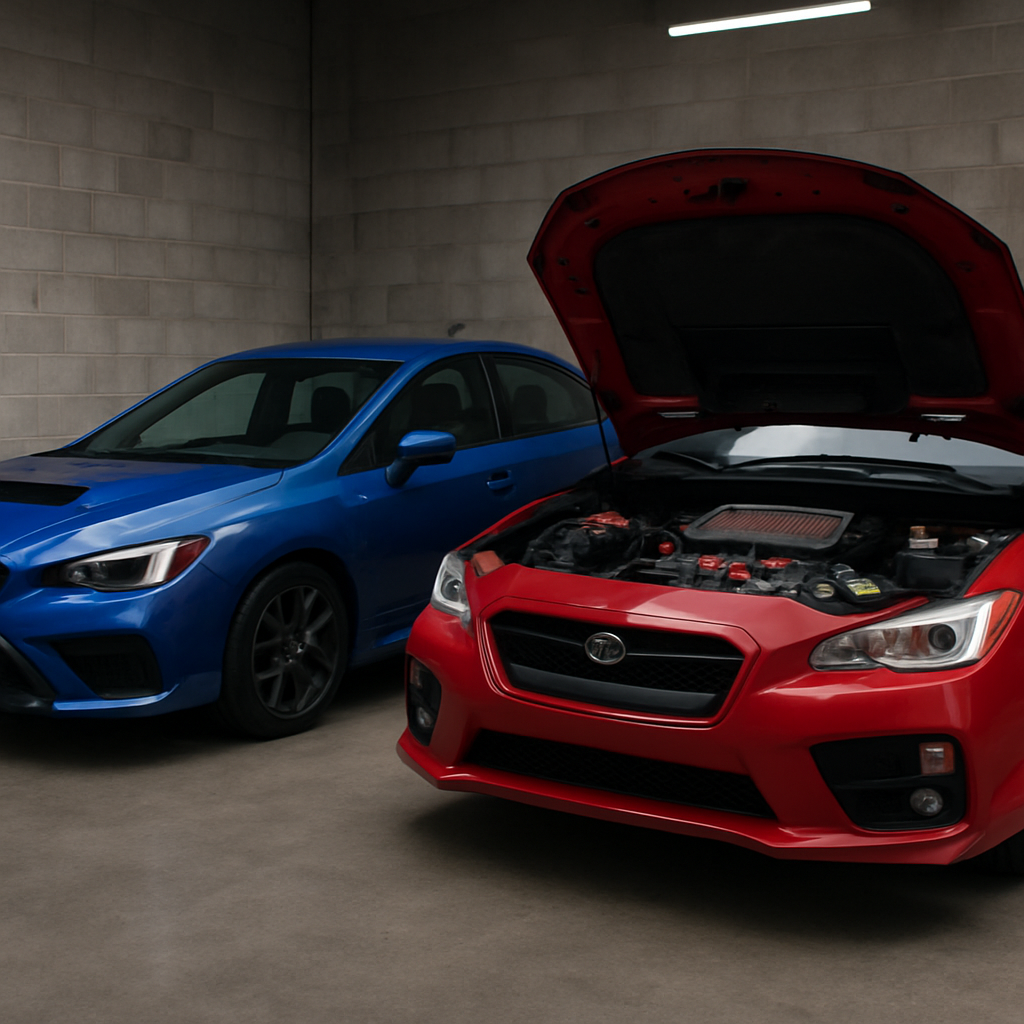
The WRX and WRX STI are not the same car. In the generations where both were sold, the STI was the more focused performance model, with more power and heavier-duty performance hardware, while the WRX was usually the easier and less expensive car to live with. For most road buyers, a well-kept WRX is the sensible choice; an STI makes more sense if you specifically value its manual-only, track-minded character and can accept higher purchase and running costs.
Are the WRX and WRX STI the same?
They share a name, a turbocharged all-wheel-drive layout, and a common performance-car identity, but the STI was Subaru Tecnica International’s higher-performance interpretation of the WRX. It was not simply a WRX with a larger spoiler or an engine tune.
The precise gap depends on model year. A 2015-2021 WRX, for example, differs substantially from a same-era STI in engine family, gearbox, differential hardware, brakes, suspension calibration, and driving character. Earlier generations have their own combinations of engines and equipment, so compare the actual year and trim rather than assuming every WRX or STI has the same specification.
The name also needs a date check. Subaru ended production of the WRX STI after the 2021 model year in many markets, so there is no factory 2022 WRX STI equivalent to compare with the newer WRX. A search for a 2022 WRX versus STI is therefore usually comparing a current-generation WRX with a used, previous-generation STI.
WRX vs STI engine differences and horsepower
For the final US-market pairing, the WRX used Subaru’s 2.0-litre FA20 turbocharged flat-four, while the STI retained the 2.5-litre EJ257 turbocharged flat-four. The STI had the higher headline output: 310 hp versus 268 hp for the 2019 models. That means the answer to “Is WRX horsepower higher than an STI?” is no for this comparison.
Planet Subaru’s WRX and STI comparison describes the STI as the version with the larger engine and greater output. Peak horsepower, however, is only one part of the decision. Turbo response, gearing, kerb weight, tyres, and the driver’s ability to launch a manual car all affect how quick either car feels on the road.
There is also a major transmission distinction in this era: the STI came with a six-speed manual, whereas the WRX was available with a six-speed manual or a continuously variable transmission, depending on market and year. Buyers who need two pedals should verify availability for the specific WRX they are considering; it is not an STI option.
Is an STI really faster than a WRX?
In a straight line, the STI’s extra power can give it an advantage, but it is not automatically much faster in every real-world situation. The WRX can feel eager at ordinary road speeds, and different gearing, weight, tyres, surface conditions, and launch technique can narrow the gap. Comparing one published 0-60 mph figure with another is less useful than looking at tests conducted under the same conditions.
The more meaningful difference is often what happens when the road becomes demanding. The STI’s stronger driveline, performance-oriented all-wheel-drive hardware, larger brakes, and chassis tuning were intended to tolerate harder use and offer more adjustment to an enthusiastic driver. Engineering Explained’s comparison makes the useful counterpoint that a lighter WRX and its gearing can keep its acceleration close to the STI’s in some tests. Neither result makes one car universally faster.
Chassis, brakes, and driveline: where the STI earns its badge
The STI’s appeal is not adequately explained by horsepower. On comparable late models, it brought more substantial braking and driveline components, a six-speed manual transmission, and a more performance-led chassis set-up. Its driver-controlled centre differential was part of that enthusiast-focused package.
A WRX is still an all-wheel-drive turbo performance saloon, rather than an ordinary Impreza with cosmetic additions. The Impreza, WRX, and STI names have overlapped historically, which causes understandable confusion, but they should be treated as distinct models or variants when shopping for parts, insurance, servicing, or used-car history.
The trade-off is comfort. The STI’s firmer, more intense character may be rewarding on a dry, twisting road or occasional track day, but it can be tiring in traffic and on poor surfaces. A standard WRX is often the better all-round daily driver, especially if ride quality, lower tyre and brake costs, or automatic transmission availability matter to you.
WRX vs STI reliability: buy condition, not just the badge
Reliability is highly dependent on age, maintenance, modifications, and previous use. Neither badge tells you whether a used car has been tuned aggressively, driven with low oil, launched repeatedly, or serviced properly. The STI’s EJ engine has a long-established enthusiast following, but that does not make every example a safe purchase; equally, a standard WRX is not automatically trouble-free.
Before buying either model, look for a complete service record and evidence of work carried out by a Subaru specialist where possible. Ask directly about engine mapping, intake and exhaust changes, fuel type, clutch replacement, and accident repairs. Modifications are not automatically bad, but undocumented modifications make it harder to assess what calibration and supporting parts the car has received.
- Arrange a pre-purchase inspection by a workshop familiar with turbocharged Subarus.
- Check for warning lights, uneven idle, smoke, unusual engine noise, clutch slip, gearbox resistance, brake vibration, and signs of fluid leaks.
- Inspect tyre condition and ensure all four tyres are closely matched in size and wear; all-wheel-drive systems are sensitive to mismatched rolling circumference.
- Confirm that servicing, recall work, and any modifications are documented.
Do not diagnose an engine from internet anecdotes or exhaust noise alone. If a candidate has a squeak, rattle, or noise under acceleration, the sound may come from the engine, accessory drive, clutch, brakes, or suspension; our guide to a squeaking noise when accelerating at low speed explains why a methodical inspection matters.
Price and ownership costs
The STI commanded a substantial new-car premium. McLaughlin Subaru’s 2019 comparison listed starting MSRPs of $27,195 for the WRX and $36,595 for the WRX STI, illustrating the size of the gap when both were new. Used values now depend heavily on location, condition, mileage, originality, and service history, so those figures should not be used as current market prices.
Beyond the purchase price, budget for insurance, fuel, tyres, brakes, servicing, and the risk of age-related repairs. An STI may cost more when these items need replacement because it uses more performance-oriented components. A modified car can also be harder to insure and may require specialist knowledge to repair correctly.
Is it better to get a WRX or STI?
Choose the WRX if you want a turbocharged all-wheel-drive performance car that is more likely to suit commuting, mixed-weather driving, and a tighter budget. It is also the practical route if an automatic transmission is a requirement in a generation where the WRX offered one.
Choose the STI if you want the more involving manual performance model and understand that its appeal is as much about its gearbox, drivetrain, brakes, and chassis as its extra power. It is best bought as a carefully inspected, well-documented example rather than simply the cheapest one advertised.
The best Subaru WRX versus WRX STI decision is therefore not a badge contest: match the model year, transmission, condition, and intended use to your budget. A standard, maintained WRX can be the better ownership proposition, while a clean, unmodified STI can be the more special enthusiast car.
Pingback: Single-Piston vs Dual-Piston Calipers: Braking Differences Explained - Premier Motoring Blog