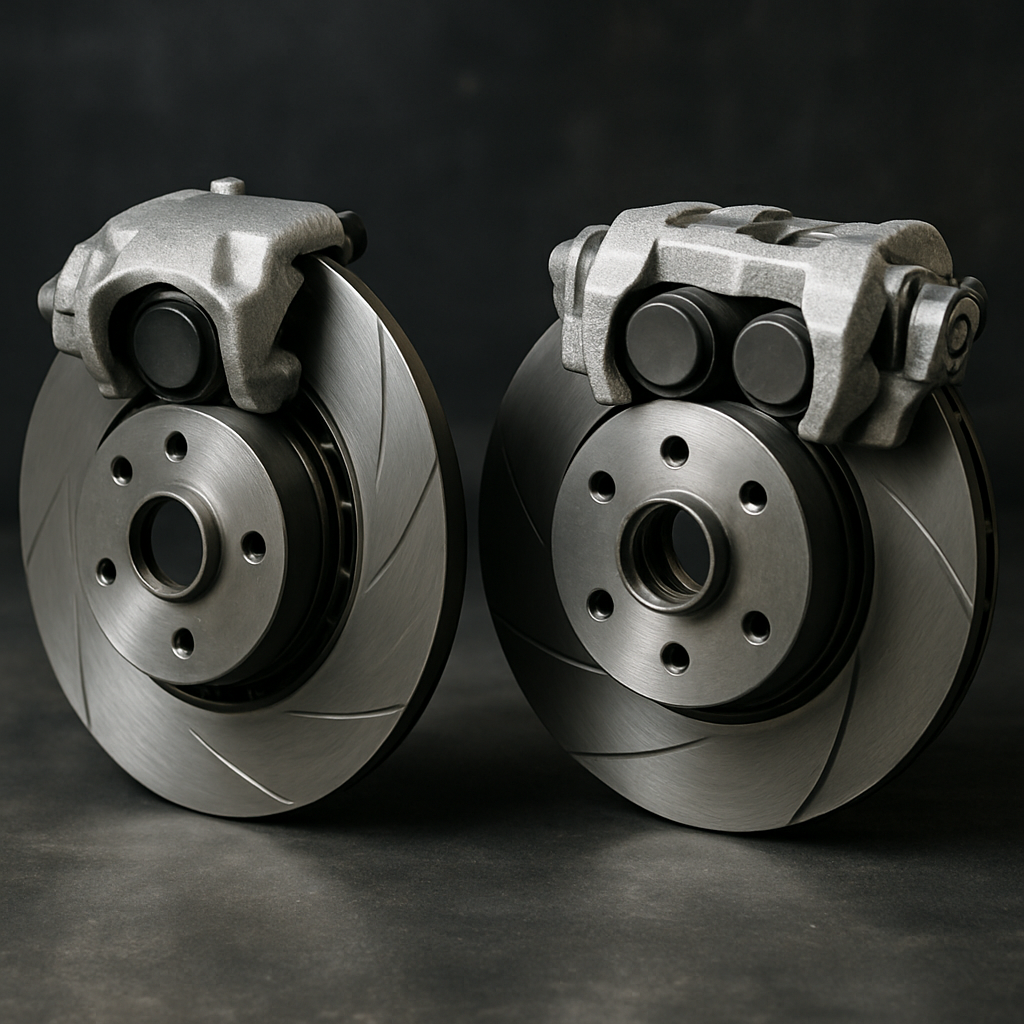
A dual-piston caliper is not automatically stronger than a single-piston design. Braking force depends on total piston area, hydraulic pressure, pad friction, rotor size, and the rest of the brake system. That said, two pistons can spread pressure more evenly across a longer pad and may offer better support for heavier vehicles or harder use, while a single-piston sliding caliper remains an effective, affordable choice for many road cars.
Single-piston vs dual-piston calipers: the basic difference
A brake caliper uses hydraulic fluid pressure from the master cylinder to move piston(s) and squeeze the brake pads against the disc. A single-piston caliper has one hydraulic piston; a dual-piston caliper has two.
On many everyday cars, a single piston sits on the inboard side of a floating or sliding caliper. As the piston pushes the inner pad against the disc, the caliper body slides on its guide pins and pulls the outer pad into contact. Both pads therefore clamp the disc even though there is only one piston.
A dual-piston caliper may also be a floating design, with two pistons on the inboard side. Alternatively, some fixed calipers use opposed pistons, with piston(s) acting on both sides of the disc. The layout matters as much as the piston count, so it is not safe to assume that every two-piston caliper works in exactly the same way.
Are single-piston calipers good?
Yes. A correctly specified, well-maintained single-piston caliper can provide safe, dependable braking for normal road use. They are common because they are comparatively simple, compact, and economical to manufacture and service.
The limitation is not that one piston can only apply braking force at one point on the disc. Rather, a single piston concentrates its force nearer the middle of the backing plate. On a larger pad, this can allow more pad flex than a design that applies force at two positions. A comparison of single- and two-piston calipers illustrates how multiple pistons can distribute load over more of the pad backing plate.
For a light commuter vehicle, that difference may be of little practical consequence. For a truck, SUV, track-focused car, or vehicle that regularly carries heavy loads, the manufacturer may choose a larger disc, larger pad, dual-piston caliper, or a combination of those changes to manage repeated braking demands.
Advantages and trade-offs of dual-piston calipers
The principal benefit of a dual-piston caliper is more even pressure distribution across the pad. This can help support a longer pad shape and reduce the tendency for the pad backing plate to flex under high load. As Hot Rod Hardware’s overview of the two layouts explains, the pistons in a dual-piston unit are generally arranged across the pad rather than concentrated at its centre.
- Potentially more even pad loading: Two pistons can apply force across a broader section of the backing plate.
- Greater design flexibility: Manufacturers can tailor total piston area, pad size, and caliper stiffness to suit the vehicle’s mass and intended use.
- Useful for demanding applications: Larger vehicles and performance-oriented brake packages may benefit from the additional pad support and thermal capacity designed around multi-piston calipers.
- More complexity: Extra pistons mean extra seals, bores, and potential service considerations.
- Not necessarily more stopping power: Two small pistons may have less, similar, or more total area than one larger piston. Piston count alone is not a meaningful performance specification.
Ground Up Motors’ discussion of single- and multi-piston calipers likewise highlights the role of piston area and pad support, but the key comparison is the entire matched brake system, not the caliper in isolation.
Why piston area matters more than piston count
Hydraulic pressure acts over the area of each piston. Two pistons can produce more clamping force than one only if their combined effective area, with the same system pressure and caliper arrangement, is greater. A large single piston may have an equal or larger total area than a pair of smaller pistons.
This is why an upgrade cannot be judged by appearance. A larger total piston area can also require more brake fluid movement to take up pad clearance, which may alter pedal travel if the master cylinder and the rest of the hydraulic system are not correctly matched. Caliper stiffness, disc diameter, disc thickness, pad compound, brake cooling, tyres, and ABS calibration all influence real-world results.
Changing only the caliper without confirming compatibility can create clearance problems, uneven brake balance, or an unsatisfactory pedal. For a road car, an engineered axle or vehicle-specific brake package is a safer choice than mixing unrelated components.
How to tell whether your brake caliper has one or two pistons
Look through the wheel spokes, or remove the wheel only if you can support the vehicle safely on correctly rated axle stands. Do not rely on a jack alone.
- Identify whether the caliper is a sliding unit or a fixed unit. A floating caliper usually has a bulky piston housing on one side and guide-pin boots at its mounting points.
- Look for round piston-bore bulges in the caliper casting. One prominent bore usually indicates one piston; two adjacent bores generally indicate a dual-piston caliper.
- On a fixed opposed-piston caliper, inspect both sides. The visible outer face may have pistons as well as the inner face.
- Confirm using the vehicle’s parts catalogue, workshop information, or a reputable parts supplier with your registration or VIN. Wheel design can hide the caliper’s details, and castings are not always easy to interpret.
Do not count pad retaining pins, guide pins, or decorative shapes in the casting as pistons. If the wheel is removed, refit it using the vehicle manufacturer’s specified wheel-bolt or wheel-nut procedure and torque.
What does a dual-piston caliper look like?
A typical dual-piston floating caliper has two circular piston bores or raised cylindrical sections side by side on the inner half of the caliper. It may still look like a conventional sliding caliper from the outside because the pistons are hidden behind the inner brake pad.
A fixed dual-piston caliper can look different. It is usually a more rigid bridge-like body that does not slide on guide pins, and it may have one piston on each side of the disc. Some performance calipers have four, six, or more pistons, often arranged in opposed pairs.
Dual-piston vs four-piston calipers, and the “four types” question
There is no single universal list of four caliper types because brakes can be classified by construction or by piston count. By piston count, the common descriptions are single-piston, dual-piston, four-piston, and six-piston or larger multi-piston calipers. By construction, the useful distinction is between floating/sliding calipers and fixed opposed-piston calipers.
A four-piston caliper does not automatically outperform a dual-piston caliper for the same reason a dual-piston unit does not automatically outperform a single-piston one: total piston area, stiffness, pads, discs, tyres, and system matching remain decisive. More pistons are often used to distribute load over a larger pad and package piston area within the available wheel space.
Should you upgrade from a single-piston caliper?
For a road vehicle, replace a failed caliper with the correct original-equipment specification unless there is a well-supported reason to upgrade. A piston-count change alone will not cure a long pedal, pulling under braking, vibration, poor tyres, worn discs, contaminated pads, seized guide pins, or a hydraulic fault.
Consider a brake upgrade only when it is designed for your exact vehicle and intended use, clears the wheels, and includes the required discs, pads, brackets, brake lines, and any master-cylinder or brake-balance considerations. If your existing brakes overheat during towing, repeated mountain descents, or track use, have the whole system inspected before choosing parts.
Whether your car has one piston or two, the priority is condition and correct specification: healthy seals, free-moving slides where fitted, evenly worn pads, sound discs, and properly bedded-in friction material matter more than the number cast into the caliper.
Pingback: Steering Wheel Shakes When Braking at High Speeds: Causes, Checks and Fixes - Premier Motoring Blog