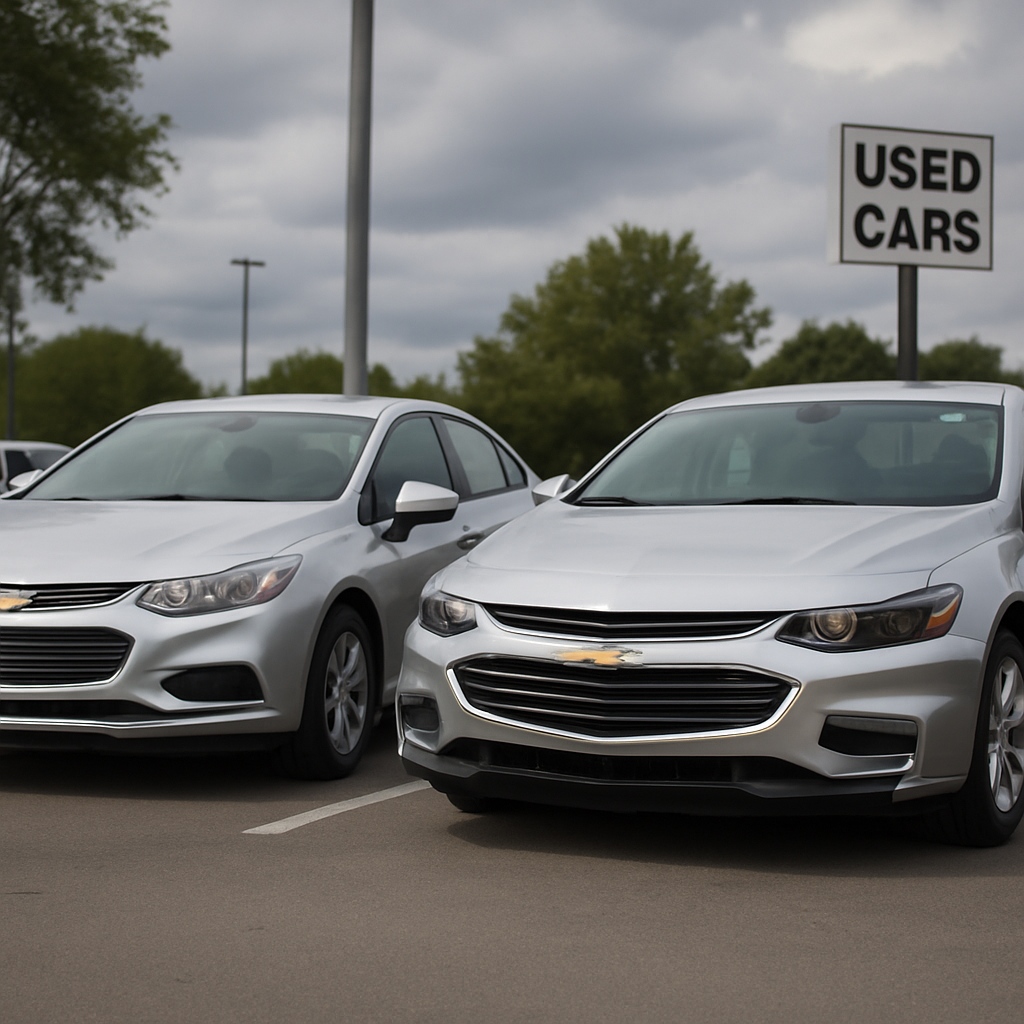
The Chevy Cruze and Chevy Malibu suit different priorities. The Cruze is the smaller, more economical choice for commuters and buyers who want a compact saloon or hatchback, while the Malibu is the larger, more family-friendly sedan with more space. For a used-car buyer, condition, service history, engine, gearbox, and price matter more than the badge alone.
Chevy Cruze vs Chevy Malibu: the key difference
The most useful starting point is vehicle class. The Cruze is Chevrolet’s compact car, whereas the Malibu sits in the larger midsize-sedan category. That distinction affects cabin room, boot space, parking ease, fuel use, and the prices you are likely to see on the used market.
A 2019 Cruze and Malibu comparison also separates the two models by class. Do not rely on a comparison of one model year to judge every Cruze or Malibu, however. Both cars changed over their production lives, and trim level can alter equipment, wheels, tyres, and powertrain.
Is a Chevy Cruze bigger than a Malibu?
No. The Malibu is the larger car. It is the better fit if rear-seat accommodation, a more substantial road presence, or regular passenger use is high on your list. The Cruze is the easier choice if you spend most of your time driving alone or with one passenger, regularly use tight parking spaces, or simply prefer a more compact car.
Both were sold with five-seat layouts, but five seats on a specification sheet do not make them equally comfortable for five adults. Sit in the rear seats yourself, adjust the front seat to the position you would use, and check whether the boot opening and load area suit what you carry.
Cruze vs Malibu vs Impala
Shoppers comparing all three should treat them as a size ladder: Cruze first, Malibu in the middle, and Impala as the larger sedan. That does not automatically make the biggest car the best purchase. The right choice depends on how often you carry passengers, where you park, and whether running costs or interior room are your main concern.
Chevy Cruze vs Chevy Malibu specs: what to compare on a used car
Do not compare only the model names. A well-equipped Cruze can feel more appealing than a basic Malibu, and one engine or gearbox combination may be more suitable for your driving than another. Build your shortlist around the actual cars for sale.
- Model year and generation: confirm the exact year rather than assuming all examples have the same equipment.
- Engine and transmission: ask which engine and gearbox are fitted, then test the car from cold and at normal operating temperature.
- Body style and trim: Cruze hatchbacks and saloons can meet different luggage needs, while trim levels affect comfort and technology.
- Fuel economy: compare official figures for the specific version, then consider your own mix of motorway, town, and short-trip driving.
- Condition and history: check servicing, warning lights, tyres, brakes, fluid leaks, accident repairs, and outstanding finance or title issues where applicable.
Fuel-economy claims should always be tied to the exact car being compared. For example, one dealer comparison lists a highway advantage for the Cruze over the Malibu, but its figures relate to the vehicles and specifications it selected. See the published Cruze and Malibu fuel-economy comparison as an illustration of why engine choice matters, not as a universal figure for every year.
Which is more reliable: the Chevy Cruze or the Malibu?
There is no honest one-word answer without narrowing the question to model year, engine, mileage, maintenance, and the particular car’s condition. A neglected low-mileage Malibu can be a worse purchase than a well-maintained higher-mileage Cruze, and the reverse is equally possible.
For either model, a pre-purchase inspection is more valuable than assumptions based on owner anecdotes. Ask for maintenance invoices, scan the vehicle for stored diagnostic trouble codes, drive it long enough to assess cold starting and shift quality, and inspect for leaks or signs of poor repairs. If an automatic transmission feels hesitant, flares between gears, shudders, or shifts harshly, arrange a proper assessment rather than assuming a fluid change will cure it; our guide to automatic transmission symptoms and diagnosis explains why diagnosis should come before parts replacement.
Turbocharged Cruze examples deserve an especially careful road test and code scan. A loss of power or an engine warning light is not enough to identify the fault, but it should not be ignored. Buyers considering one can also review our explanation of the Chevy Cruze turbo-underboost code before committing to a car with that history.
Price, value, and running costs
The Cruze will often be the lower-cost route into Chevrolet ownership because it is the smaller model, but local supply, condition, trim, and mileage can change that quickly. A side-by-side listing from Cars.com highlights the price gap between a 2019 Cruze and a newer 2025 Malibu; that is useful context, but it is not a direct used-market valuation. Compare like with like: similar years, mileage, condition, and equipment.
Budget beyond the purchase price. Insurance, fuel, tyres, servicing, repairs, and any overdue work can easily outweigh a small difference in the advertised price. A cheaper car with worn tyres, incomplete records, warning lights, or an unresolved gearbox issue is rarely the bargain it first appears to be.
Why did Chevy discontinue the Cruze?
The Cruze’s discontinuation should not be used as a shortcut for judging every used example. A discontinued model can still be a sensible purchase when it is well maintained, priced appropriately, and supported by available parts and competent local repairers. Equally, a current or recently sold model is not automatically the more reliable option.
Before buying, check parts availability in your area, obtain insurance quotations, and make sure an independent specialist is comfortable servicing the exact engine and transmission. The supplied comparison sources do not establish a single technical reason for the Cruze’s discontinuation, so it would be wrong to present its end of production as proof of a specific reliability problem.
What is a Chevy Cruze comparable to?
The Cruze belongs in the compact-car conversation, so compare it with other compact saloons and hatchbacks rather than treating it as a direct alternative to the Malibu. The Malibu is the closer match for midsize sedans. Comparing vehicles in the same class gives you a fairer view of passenger space, parking convenience, fuel use, and price.
Choose the Cruze if compact dimensions and potentially lower day-to-day costs matter most. Choose the Malibu if you value the larger cabin and a more relaxed fit for passengers. In either case, buy the individual car, not the reputation: an inspection, a clean history, and a convincing test drive are the best way to separate a sound used Chevrolet from an expensive project.
Pingback: 2012 Jeep Wrangler Camshaft Position Sensor Replacement: Location, Parts and Cost - Premier Motoring Blog