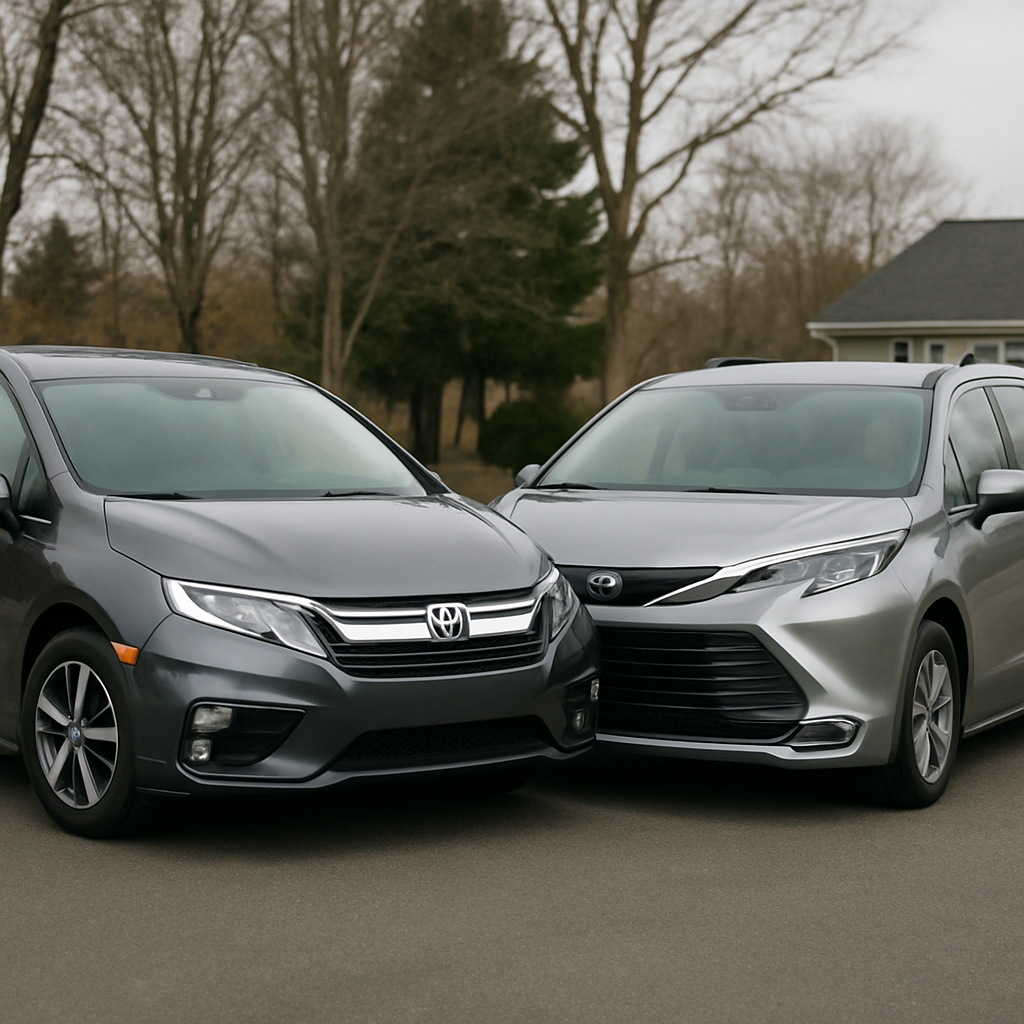
The Toyota Sienna is the better choice if fuel economy and all-wheel drive are high on your list; its hybrid system makes it markedly cheaper to fuel than the Honda. The Honda Odyssey is the stronger pick for families who value a powerful V6, exceptionally useful cargo space, and a more traditional minivan driving feel. Neither is automatically better for every household: the right answer depends on how you use the third row, how far you drive, and whether you need all-weather traction.
Honda Odyssey vs Toyota Sienna at a Glance
- Choose the Sienna for standard hybrid efficiency, available all-wheel drive, and lower fuel use on high-mileage family duties.
- Choose the Odyssey for more horsepower, a larger maximum cargo area, and a particularly practical cabin when carrying bulky loads.
- Both offer three rows, sliding rear doors, strong family-friendly storage, and modern driver-assistance technology, although exact equipment varies by trim and model year.
The Sienna’s central advantage is its hybrid powertrain. A comparison from Toyota of Madison lists EPA-rated combined fuel economy of 36 mpg for front-wheel-drive Sienna models and 35 mpg with all-wheel drive, versus 22 mpg combined for the V6 Odyssey. If your minivan spends its life on school runs, commuting, and long motorway trips, that difference can have a meaningful effect on running costs.
Powertrain, Fuel Economy, and All-Wheel Drive
The Honda uses a 280-horsepower V6 and front-wheel drive. It is the more powerful vehicle on paper, and that matters when the van is fully loaded with passengers, luggage, or a trailer within its rated limits. Its conventional petrol powertrain may also appeal to buyers who prefer the familiar response of a V6 rather than a hybrid system.
Toyota takes a different approach. The Sienna combines a hybrid powertrain with 245 horsepower and offers all-wheel drive on most trims. According to the specifications in Car and Driver’s 2026 Odyssey and Sienna comparison, the Honda has 280 horsepower and 262 lb-ft of torque, while the Toyota has 245 horsepower and 176 lb-ft. The figures do not tell the whole story, but they explain why the Odyssey is likely to feel more effortless under hard acceleration.
All-wheel drive is the more decisive distinction for some buyers. The Odyssey is front-wheel drive only, so the Sienna is the obvious option for households that regularly face snow, steep unpaved driveways, or poor-weather travel. All-wheel drive does not replace suitable tyres or careful driving, but it can be a worthwhile confidence feature in the right climate.
Which Has More Passenger and Cargo Space?
Both vans can carry up to eight occupants in certain configurations, but how they package people and luggage differs. The Odyssey is especially compelling if you often fold the third row and use the van like a small removal vehicle. Toyota of Madison lists 38.6 cubic feet behind the Odyssey’s third row, 91.0 cubic feet behind the second row, and 155.8 cubic feet with the seats stowed. The same source lists 33.5, 75.2, and 101.0 cubic feet respectively for the Sienna.
Those measurements should be treated as a starting point rather than the entire ownership story. Seat design, floor shape, second-row removal or adjustment, and the items you carry can matter more than a single maximum figure. The Sienna can still manage pushchairs, sports equipment, and holiday luggage well, while the Odyssey’s advantage becomes clearer when you routinely carry flat-packed furniture, bikes, or large DIY purchases.
Passenger room is close. Car and Driver lists 160.1 cubic feet of passenger volume for the Odyssey and 162.5 cubic feet for the Sienna, with small differences in legroom and shoulder room across the three rows. Take the children, their child seats, and any mobility equipment to a proper test drive; a van that looks roomy on a specification sheet can feel very different once every seating position is occupied.
Comfort, Technology, and Everyday Family Use
For many owners, the best minivan is the one that makes busy days less tiresome. Check the number and placement of USB ports, cup holders, storage bins, and 12-volt outlets in the exact trim you are considering. Also operate both sliding doors, fold the third row, and try loading a pushchair through the tailgate before signing anything.
Past comparisons have found notable differences in standard equipment between trims. MotorTrend’s comparison highlighted Toyota’s broad standard driver-assistance package and noted that Odyssey equipment could vary by trim. This is precisely why buyers should compare the current model-year specification sheets rather than assuming a feature is standard because it appeared on an older review or a higher-grade demonstrator.
The Odyssey’s cabin arrangement and cargo flexibility will suit some families better, while the Sienna’s hybrid refinement and available all-wheel drive will suit others. Do not overlook visibility, second-row access, and how easily older children can reach the third row; these mundane details become important quickly in daily use.
Safety Features: Compare the Exact Trim, Not Just the Badge
Both models are designed as family vehicles and offer driver-assistance features, but standard and optional equipment can differ by trim, model year, and market. Before purchase, ask the dealer to confirm the fitted safety equipment on the actual vehicle, including automatic emergency braking, adaptive cruise control, lane-support functions, parking sensors, and a reversing camera.
It is also sensible to check whether a used example has outstanding recall work. A recall is a safety action with a manufacturer remedy, whereas a technical service bulletin is guidance for diagnosing or repairing a known concern and is not necessarily a safety campaign. For a second-hand Sienna, our guide to Toyota certified pre-owned checks and warranty considerations can help you assess documentation, inspection claims, and service history.
Running Costs and Long-Term Ownership
The Sienna’s fuel advantage is easiest to quantify, particularly for drivers covering substantial annual mileage. Its hybrid system can reduce petrol consumption without asking you to plug in, and available all-wheel drive avoids the need to move to a different type of vehicle for winter use. Against that, purchase price, insurance, finance rates, tyre costs, servicing, and local fuel prices can all change the real-world calculation.
The Odyssey may cost more at the pump, but its stronger V6 performance and larger usable load area may be worth that trade-off if you rarely drive long distances or frequently need its carrying capacity. Service records matter more than brand stereotypes when shopping used. For Honda buyers, it is also worth understanding what dealer maintenance offers do and do not include; see our explanation of Honda Odyssey complimentary oil-change and service-plan questions before treating a promotional offer as a complete maintenance budget.
Should You Buy a Honda Odyssey or Toyota Sienna?
Buy the Toyota Sienna if you want a hybrid minivan, drive enough for fuel economy to matter, or need all-wheel drive. Buy the Honda Odyssey if maximum cargo flexibility, V6 power, and a more conventional driving experience outweigh its higher fuel consumption. A well-equipped example that fits your child seats, luggage, budget, and local driving conditions is a better choice than chasing a headline specification. Test both with your family and compare the exact trim-level equipment, price, and ownership history before deciding.
Pingback: Subaru Forester Hybrid Reviews: Is the 2025-2026 Model Worth Buying? - Premier Motoring Blog