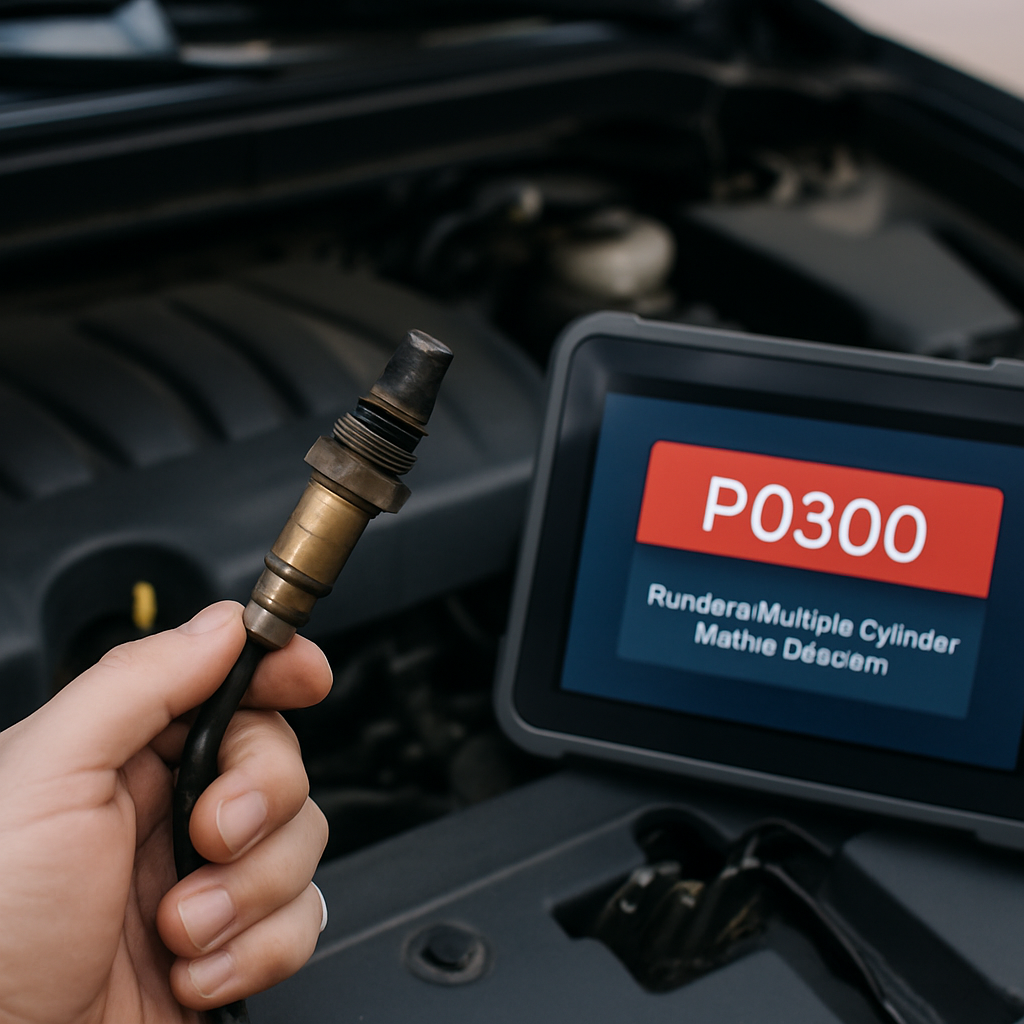
Yes, a faulty oxygen (O2) sensor can contribute to a P0300 code if inaccurate information from the sensor leads the engine computer to adjust the air-fuel mixture in a way that contributes to a misfire. But P0300 does not identify an O2 sensor as the cause. It means the computer has detected a random or multiple-cylinder misfire, and ignition, fuel, intake-air, wiring or mechanical problems may also be responsible.
Do not replace an O2 sensor based on P0300 alone. The cause needs to be confirmed using the other stored codes, symptoms and vehicle-specific diagnostic information.
Can a bad O2 sensor cause a P0300 code?
It can. An O2 sensor is one of the inputs the engine computer uses for fuel control. If a sensor fails or sends inaccurate information, the resulting air-fuel mixture may contribute to misfiring. That makes an O2 sensor a possible cause, not a diagnosis: P0300 itself does not say which part has failed. CarParts.com’s overview of P0300 causes includes sensor faults among the possibilities, alongside ignition, fuel-delivery, vacuum-leak and mechanical problems.
Read all stored codes before deciding what to repair. Other codes may provide useful clues, but neither P0300 nor an O2-sensor-related code alone proves that a particular sensor is faulty or that it caused the misfire. A technician may need to assess the sensor, its wiring and connectors, and the wider engine-management system using the procedure for that vehicle.
If you are asking about a Chevrolet, the same caution applies: the supplied general diagnostic information does not establish an O2-sensor failure pattern that applies to every Chevy. Model year, engine, companion codes and test results matter. A Chevrolet-focused guide discusses checking upstream O2-sensor wiring and connectors as part of diagnosis, but that is not proof that the sensor is the cause in a particular vehicle. Do not infer a specific sensor location or diagnosis from P0300 alone.
What does P0300 mean?
P0300 means the vehicle’s computer has detected a random or multiple-cylinder misfire. It describes the misfire pattern, not the failed component. By contrast, a code such as P0303 identifies a misfire associated with cylinder 3. Read our guide to what P0300 means and what to do next for more on the code and its possible causes, or see how a cylinder-specific P0303 differs.
A random or multiple-cylinder pattern can be a clue that something affecting more than one cylinder is involved, such as fuel delivery, an air leak or a shared ignition issue. It is not proof of any one cause; diagnosis still depends on the vehicle and the accompanying evidence.
What is the most common cause of P0300?
There is no single cause that can be confirmed from P0300 alone, and the likely fault varies by vehicle. Advance Auto Parts identifies worn spark plugs as its most common cause and failed ignition coils as another frequent cause. These are useful possibilities to investigate, not a guarantee that either part is responsible in your car.
Other possible causes include:
- Fuel-delivery problems: for example, a weak fuel pump or clogged injectors.
- Air-fuel mixture problems: such as a vacuum leak or a sensor or wiring fault.
- Mechanical or timing problems: including engine faults that affect combustion.
- Emissions or exhaust problems: including a restricted catalytic converter in some cases.
These possibilities are described in O’Reilly Auto Parts’ P0300 guide and the CarParts.com overview. Fuel-delivery issues are one branch of the diagnosis, not an assumption: for example, our guide to fuel-pump symptoms and testing on a Nissan Maxima applies to that model and should not be treated as a universal P0300 diagnosis.
Possible symptoms include rough running or shaking, hesitation or reduced acceleration, hard starting, and an illuminated check-engine light. A flashing check-engine light can indicate a severe misfire. Continued misfiring may send unburned fuel into the catalytic converter and damage it, so do not ignore a flashing light or pronounced engine symptoms. The information available here cannot establish that a vehicle is safe to drive; seek prompt professional advice if the engine is running badly or the warning light is flashing.
What should you check before replacing an O2 sensor?
Start by having the full set of stored codes read, rather than treating P0300 as a parts recommendation. The next checks depend on the vehicle and its symptoms, but a sensible diagnostic approach is to:
- Note any other codes and describe when the rough running or hesitation occurs.
- If you are competent to do so, look for obvious damage or loose connections in accessible ignition, intake and sensor wiring. Do not work on hot or moving components.
- Have ignition, fuel-delivery, intake or vacuum, wiring and mechanical causes assessed as appropriate for the vehicle.
- Confirm an O2-sensor fault through vehicle-specific testing before replacing the sensor.
If the cause is unclear, a qualified technician can follow the manufacturer’s diagnostic information. A code reader can identify stored codes, but P0300 alone cannot confirm which component has failed.
Can a clogged catalytic converter cause P0300?
It can contribute in some cases. A restricted catalytic converter may limit exhaust flow and increase backpressure, which can contribute to engine misfiring. But P0300 does not prove that the converter is clogged, and the same code can result from ignition, fuel, air-mixture or mechanical problems. The restriction should be diagnosed before considering converter replacement.
The relationship also works in the other direction: an unresolved active misfire can send unburned fuel into the converter and damage it. The converter may therefore be a possible cause to investigate or a component at risk from the misfire. If you also have a P0430 code, our guide to what a P0430 code can mean explains that related code; P0430 alone does not prove the converter is clogged or that it caused P0300.
How do you get rid of a permanent P0300 code?
Fix the underlying cause of the misfire and then have the vehicle’s code status checked. Erasing a code or turning off the warning light does not repair the fault; if the problem remains, the light may return. A permanent diagnostic trouble code is not necessarily removed by a routine scan-tool erase, and the exact conditions for it to clear can vary by vehicle.
There is no universal reset procedure supported by the available information. Do not rely on disconnecting the battery to remove a permanent code. Follow the manufacturer’s service information or ask a qualified technician to verify the repair and confirm the code status.
Pingback: What Happens When a Rocker Arm Actuator Goes Bad? Symptoms, Causes, and Driving Risks - Premier Motoring Blog