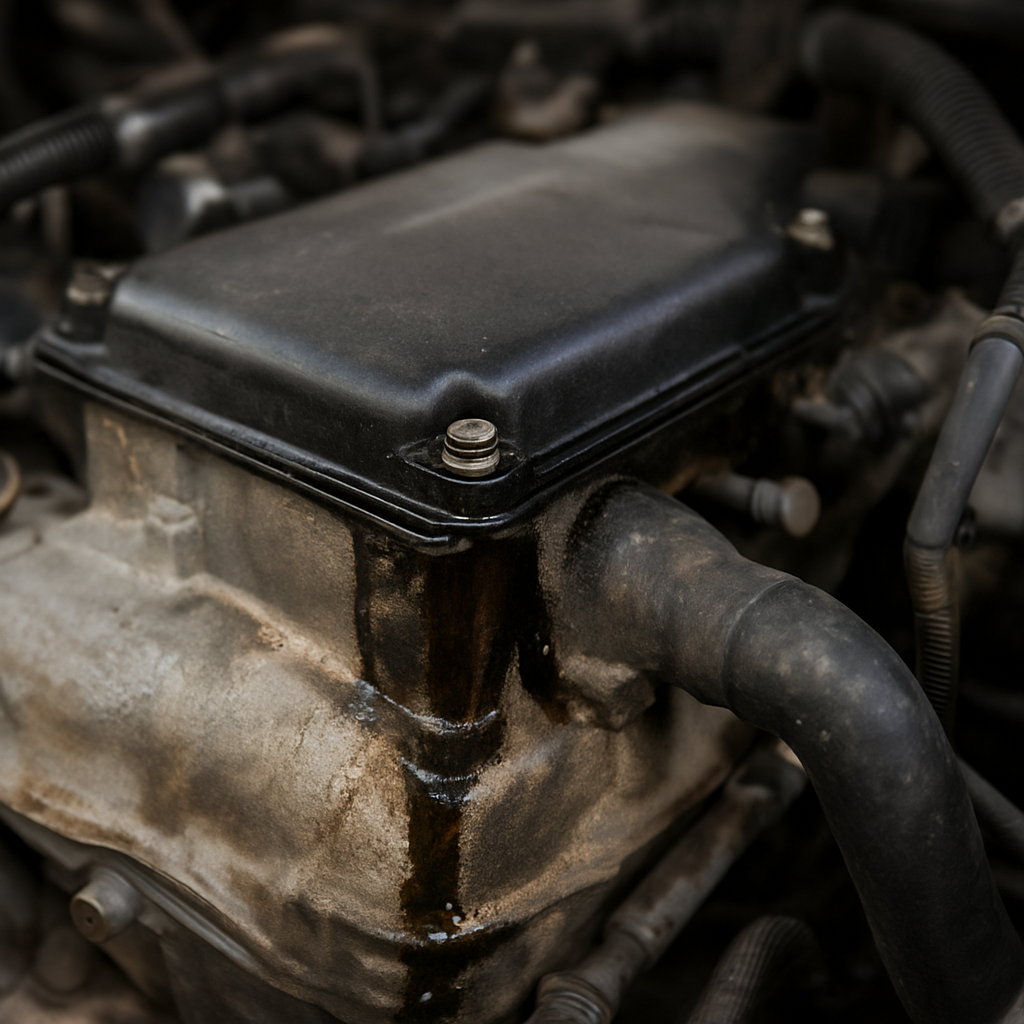
Oil on or around the valve cover, or a burning-oil smell while the engine is running, can indicate that the valve-cover gasket has lost its seal and is allowing oil to escape. These signs suggest a possible leak, but they do not confirm its source: oil can run down the side or back of the engine and make the leak appear to come from somewhere else.
If you suspect a leak, inspect only with the engine switched off and cool. Start at the top of the engine, look for fresh oil around the valve-cover area, then follow any visible trail downwards. Avoid reaching near hot or moving parts. If the source is hidden or uncertain, ask a qualified technician to inspect it.
How to tell if your valve cover gasket is leaking
The valve-cover gasket seals the valve cover to the engine. If the seal fails, engine oil can escape around the edge of the cover. Look for fresh, oily residue around the cover or oil that appears to begin there and run down the engine. A telescoping mirror may help you see a hidden area, but do not put your hands or tools near hot or moving engine parts.
Oil lower down the engine does not, by itself, identify the source. A leak at the valve cover can travel down the side or back of the engine and mimic a leak from another area. Mobil’s valve-cover leak guidance recommends starting at the top and following the oil trail. A clean-looking patch beneath a parked car also does not rule out a leak: oil may escape while the engine is running and be less obvious when the vehicle is at rest.
These checks can help you describe what you see, but they cannot confirm that the gasket is the cause. Other oil-leak sources can leave a similar trail, so a technician may need to clean and inspect the area to locate where fresh oil begins. If you are comparing possible leak sources, remember that an oil trail alone cannot establish a head-gasket problem; you can learn about blown head-gasket symptoms without treating the two conditions as interchangeable.
The same general signs apply if you are asking about a Honda, but the available information does not establish Honda-specific leak locations or failure patterns. Access and diagnosis depend on the exact year, model and engine. Use vehicle-specific service information or arrange an inspection rather than assuming the layout or diagnosis is the same across Honda models.
What the valve-cover gasket does—and how to identify the right part
The gasket forms a seal between the valve cover and the engine, helping keep engine oil inside. If you need a replacement, verify fitment using the vehicle’s year, make, model and engine, or its VIN, with a reputable parts supplier or repairer. There is no universal part number or fitment established here, so do not choose a gasket based on appearance alone.
A replacement gasket may not be the only item that needs attention. The cover and sealing surfaces may need inspection, and the correct procedure depends on the vehicle. Follow the service information for that specific engine or have a qualified technician assess it.
Can a leaking valve-cover gasket cause a burning smell or smoke?
It can. Oil leaking from the valve-cover area may reach a hot exhaust manifold, burn and produce smoke. The smell or smoke may be noticeable around the engine or inside the cabin. This is different from smoke emerging from the tailpipe: either observation needs diagnosis, and neither alone proves that the valve-cover gasket is leaking. For other possibilities when smoke appears around the engine, see our guide to other causes of smoke from the engine area.
If smoke enters the cabin or the leak looks substantial, stop somewhere safe and arrange an inspection rather than assuming it is safe to continue. Smoke or a burning smell does not establish the oil source or the severity of the leak. If you see smoke coming from the exhaust pipe instead, that is a separate observation; our guide to oil or smoke coming from the exhaust pipe covers that issue.
Is a valve-cover gasket leak serious?
It depends on how much oil is escaping and where it is going. A small-looking leak is not automatically an emergency, but visible oil, a burning smell or smoke should not be dismissed. In particular, oil reaching a hot exhaust component can burn and produce smoke, so the location and amount of the leak matter.
Check the oil level using the procedure in your owner’s manual and arrange a diagnosis. Stop safely and seek assistance if smoke enters the cabin, the leak is substantial, or the oil level is below the manufacturer’s permitted range. Do not assume that every gasket leak will cause engine failure, but do not treat a suspected leak as harmless without checking it.
How long can you drive with a valve-cover gasket leak?
There is no safe mileage or time limit established for driving with a suspected valve-cover gasket leak. The urgency depends on the amount and location of the leak, how the oil level is changing, and whether oil is reaching a hot exhaust component. A clean driveway or one oil-level check cannot prove that the leak is safe to ignore.
Check the oil level as directed in the owner’s manual and arrange a prompt professional assessment. If smoke enters the cabin, the leak is heavy, or the level is outside the manufacturer’s permitted range, stop safely and seek assistance. The available information does not support blanket advice that it is safe to drive to a repair shop; use the observed symptoms and professional guidance to decide whether the vehicle needs recovery.
Is there a quick fix for a valve-cover gasket leak?
A bolt check is not the same as repairing a failed gasket. Mobil describes gently checking whether the valve-cover bolts may need tightening before moving on to further diagnosis, but do this only if the vehicle’s service procedure supports it and use the specified torque. Do not guess a torque value or tighten every vehicle’s bolts as a routine fix.
Overtightening may not stop a bad gasket from leaking. It can also crack an aluminium cover or warp a steel one. If oil continues to leak, the source needs diagnosis and a confirmed gasket failure may require replacement. Repair instructions describe cleaning the cover and mating surfaces and using RTV sealant only at specified locations—not applying it indiscriminately. Access and procedures vary by engine, so use vehicle-specific service information or consult a qualified technician if you are unsure.
The available evidence does not establish that an oil stop-leak additive will repair a valve-cover gasket. Do not rely on one as a substitute for locating the leak and repairing the cause.
How much does valve-cover gasket replacement cost?
A reliable, current professional repair-price range is not established by the available information. Cost depends on the vehicle and the work required, so ask for a vehicle-specific quote that separates parts and labour. A low-priced gasket does not necessarily mean the complete repair will be inexpensive.
Family Handyman gives an example of a DIY job costing less than $25, but that is the source’s example—not a universal current parts price or a professional repair quote. It should not be used to estimate the cost for every vehicle. Confirm the correct part and ask the repairer what inspection or additional work the quote includes.
Can a valve-cover gasket leak cause oil consumption?
An external leak can let oil escape from the engine and may contribute to a falling oil level, but the amount lost from a particular leak cannot be determined from the symptom alone. External oil escaping around a gasket is also different from oil being burned inside the engine. A falling dipstick reading by itself does not prove internal oil burning or confirm that the valve-cover gasket is responsible.
Monitor the oil level using the owner’s-manual procedure and have the leak source and any continuing oil loss assessed. If the level continues to fall after an apparent gasket repair, ask for further diagnosis rather than assuming the gasket was the only cause.