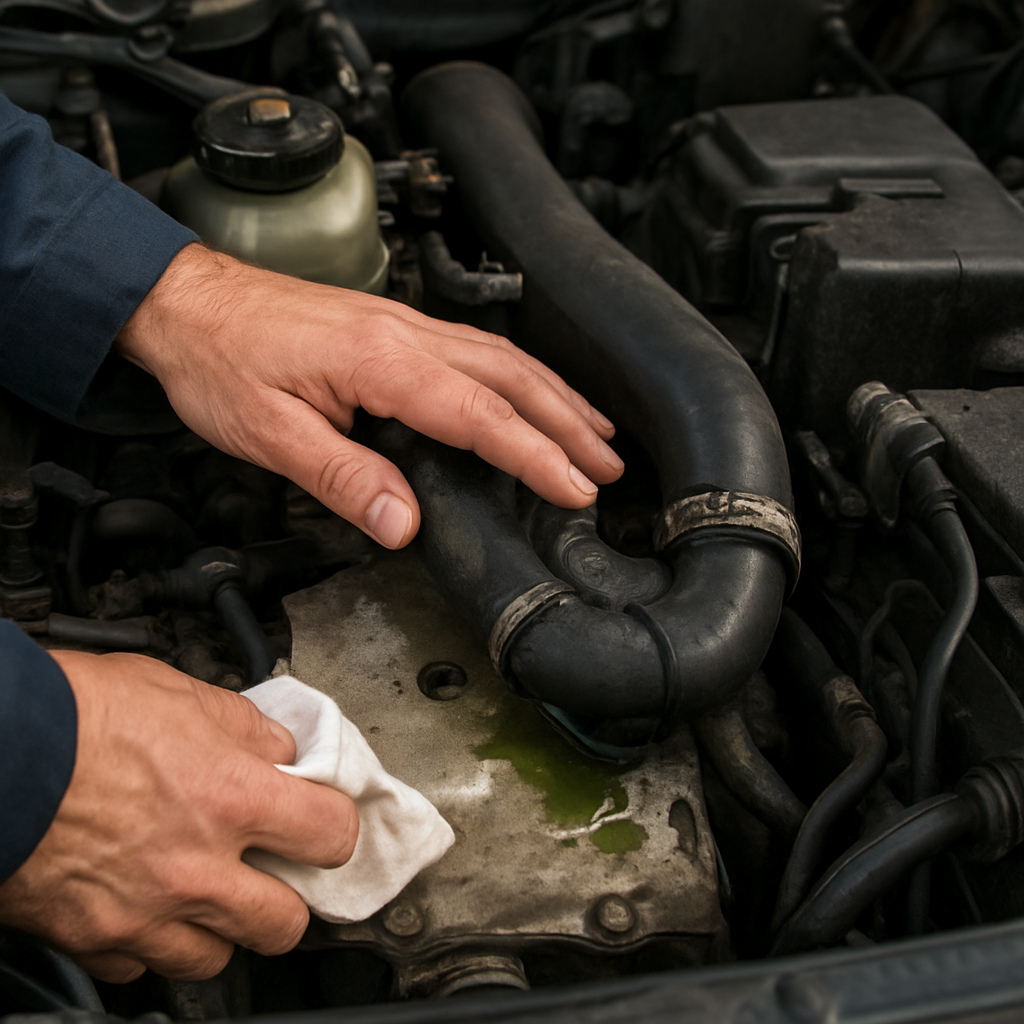
A blown head gasket can cause coolant loss, but so can an external leak from a hose, radiator, water pump, pressure cap or another part of the cooling system. A visible leak does not rule out a head-gasket failure, and low coolant alone does not prove one. The distinction comes from the overall pattern of symptoms and, when necessary, professional testing.
A failed head gasket may allow coolant to escape outside the engine, enter a cylinder and leave through the exhaust, or mix with engine oil. Other faults can produce similar signs, so treat symptoms as clues rather than a diagnosis.
Blown head gasket or external coolant leak: what the symptoms can tell you
| What you notice | What it may suggest | What it cannot prove |
|---|---|---|
| A puddle or visibly wet component | An external leak from a hose, radiator, water pump, pressure cap, gasket or another engine area | That the head gasket is the source — or that it is not involved |
| Coolant keeps falling but no leak is visible | An internal leak, including coolant entering a cylinder, or an external leak that is difficult to see | A confirmed head-gasket failure |
| Persistent, sweet-smelling white exhaust after warm-up | Coolant may be entering a cylinder and being burned | That the head gasket is the only possible cause |
| Continuous bubbling in the coolant reservoir | Combustion gases may be entering the cooling system | A definitive diagnosis without further checks |
| Milky or frothy oil | Coolant may be mixing with oil | That the head gasket is necessarily responsible |
| Overheating, misfire or rough running | A serious cooling-system or engine problem, potentially including a head-gasket or cracked-head issue | Which component has failed |
A brief cloud of water vapour on a cold start can be normal condensation. White exhaust that persists after the engine has warmed up, particularly when it smells sweet and coolant is also disappearing, is more concerning. It still needs diagnosis rather than a conclusion based on appearance alone. For more context, see other causes of white exhaust smoke; that guide is Toyota-focused, so its model-specific context should not be assumed to apply to every vehicle.
Coolant mixed with oil is also a warning sign, but it is not unique to a failed head gasket: an intake-gasket problem can be another explanation. A cracked cylinder head can cause symptoms similar to head-gasket failure. Fel-Pro’s explanation of cracked heads and head-gasket symptoms describes this overlap.
A head-gasket failure can itself cause a visible external coolant leak if the failure is between a coolant passage and the outside of the engine. In other cases, the leak is internal. A technical overview of head-gasket failure patterns describes these different leak paths and why coolant loss can lead to overheating.
How to spot a coolant leak — and what else can look like a head-gasket problem
Start with observations only, and make them with the engine cold. Check whether the coolant level is falling by comparing it with the vehicle’s normal cold-level markings. Look beneath the vehicle and around accessible parts of the engine bay for a puddle, damp area or visible residue. Note where it appears to be coming from, but do not assume the source from the position of a drip: coolant can travel before it reaches the ground.
Possible external sources include a hose, radiator, water pump, pressure cap, another gasket or a leak elsewhere in the engine. A loose, damaged or incorrect pressure cap can also contribute to coolant loss. A wet area near the head-gasket joint may raise suspicion, but it does not confirm the diagnosis; a technician may need to trace the leak. Do not open a radiator or coolant pressure cap while the engine is hot.
Low coolant or a puddle can therefore be caused by a cooling-system leak without any head-gasket failure. Conversely, a head gasket can leak internally without leaving a puddle. If the source is not obvious, or the level keeps dropping, arrange an inspection rather than relying on a visual check. A water-pump fault is one of several possible cooling-system issues; read more about how a water-pump problem can affect engine cooling.
Checks you can make — and tests a technician may use
Without tools, you can monitor the coolant level when the engine is cold, look for visible leaks, check the oil for a milky or frothy appearance, and note whether white exhaust continues after warm-up. Also record any overheating, misfire, rough running or repeated coolant loss. Several clues together are more concerning than one in isolation, but they still do not confirm a blown head gasket.
Do not remove a hot radiator or pressure cap to look for bubbles. If bubbling is visible in the reservoir during normal operation, note it for the technician rather than treating it as proof. You can read more about what bubbling in the coolant reservoir can mean.
A technician may use a cooling-system pressure test or a block test, and may compare compression between cylinders as part of the overall diagnosis. The findings should be interpreted together with the symptoms rather than treated as a single universal answer for every failure pattern. The Garage Boy guide to interpreting head-gasket checks together outlines this approach.
Because a cracked head and a failed head gasket can look alike, a technician may need further investigation. Fel-Pro notes that confirming a suspected crack can require removing the head and having it pressure-tested by a machine shop. A visual check at home cannot reliably confirm or rule out a head-gasket failure. Seek professional diagnosis before authorising major engine work.
Can a car run fine with a head-gasket leak?
Yes. A vehicle may appear to run normally despite a small or developing leak. Normal performance does not rule out a head-gasket problem, and it does not establish that continued driving is safe. Watch for unexplained coolant loss, a rising temperature, persistent white exhaust, bubbling, oil contamination or rough running, and arrange diagnosis if coolant is disappearing without an identified external leak.
The available evidence does not establish how long a vehicle can run safely with a suspected leak or how quickly it may worsen. Do not use the absence of obvious symptoms as reassurance.
What does a blown head gasket sound like?
There is no dependable sound that confirms a blown head gasket. A less typical compression leak to the outside may cause ticking at idle, rough running or loss of power, but ticking has many possible causes and is not unique to a gasket failure. Treat it as one clue only, especially if it occurs alongside coolant loss or overheating, and have the source checked.
What causes a head gasket to fail?
Overheating is a usual cause of head-gasket failure or a cracked head. Fel-Pro notes that the gasket may fail before the head cracks, although both can occur. Overheating may itself begin with a cooling-system fault, such as low coolant from a hose or other gasket leak, a water-pump failure, a broken belt that stops driving the pump, or an electric-fan failure.
Finding a failed gasket is not the whole job: the original cause of overheating also needs to be identified and addressed. Otherwise, the underlying cooling problem may remain. Read more about what can cause a head gasket to fail.
Can a diagnostic code confirm a blown head gasket?
No specific diagnostic code is established by the available evidence as confirmation of a blown head gasket. A misfire or flashing Check Engine light can accompany a head-gasket or cracked-head problem, but these signs can have other causes too. A stored code is one clue for a technician to interpret alongside coolant-loss patterns, symptoms and appropriate testing. The absence of a code does not, by itself, rule out a problem.
Can you keep driving with a coolant leak or suspected head-gasket failure?
Do not assume that a vehicle with a coolant leak or suspected head-gasket failure is safe to drive. Running with low coolant can cause overheating, and overheating or coolant mixing with oil can lead to severe engine damage. If the temperature rises, the engine overheats or a severe warning appears, stop driving and arrange professional help. Significant coolant loss or suspected coolant-oil mixing also calls for prompt inspection or recovery rather than continued use.
Never open the cooling system while it is hot or pressurised. Topping up does not establish that a leak has been fixed or make a vehicle safe to drive. For more guidance on whether it is safe to drive with a coolant leak, see our related guide.
Can you fix a blown head gasket without replacing it?
The evidence available for this article does not establish a non-replacement treatment as a proven, durable repair for a failed head gasket. Do not rely on a sealant or workaround as a confirmed fix. First have the fault diagnosed, then ask a qualified repairer to assess the appropriate repair for the actual failure.
The supplied evidence also does not support a useful universal head-gasket replacement price. Request a vehicle-specific inspection and written quote rather than relying on an unsupported estimate.