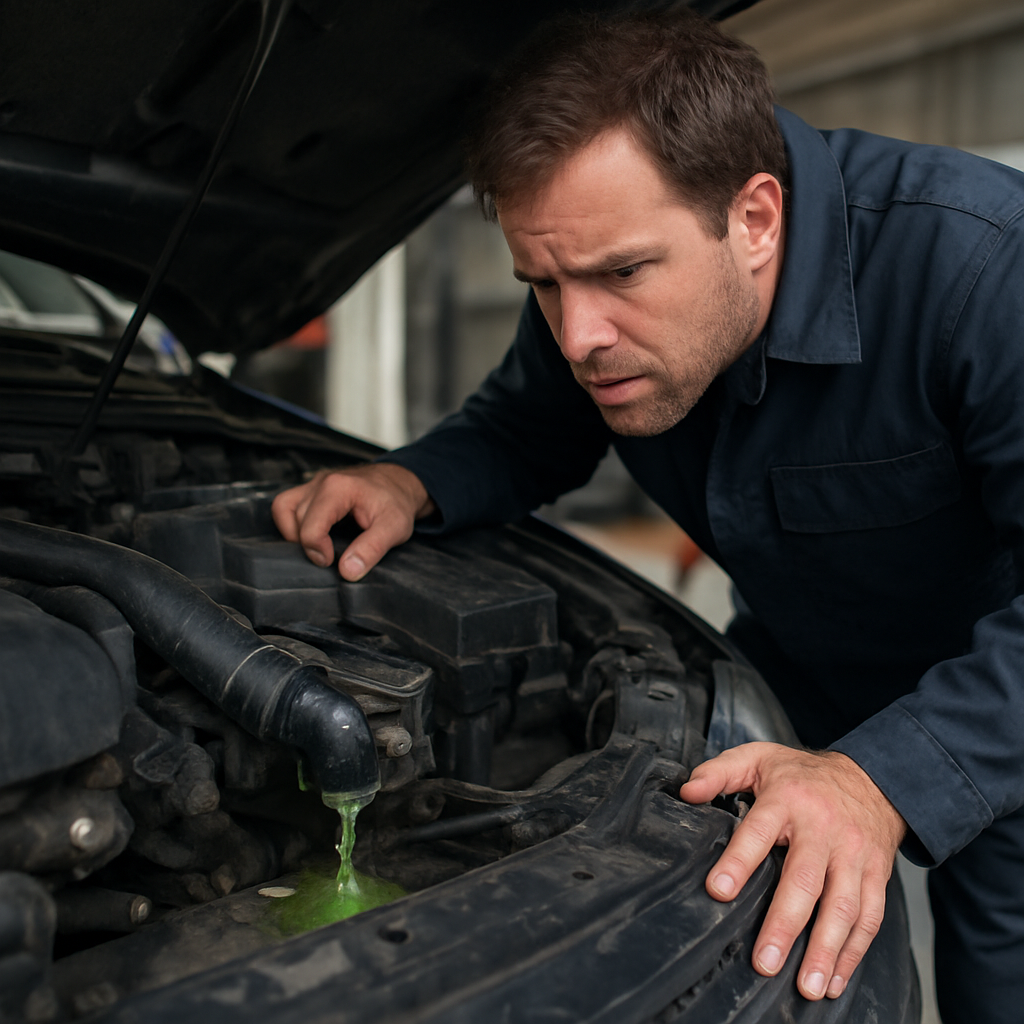
Overheating or an erratic temperature reading can be consistent with a water-pump or thermostat problem, but neither symptom identifies the failed part by itself. A coolant leak near the water pump may offer a more specific clue, yet its source still needs confirmation. Treat these signs as reasons to investigate the cooling system—not as a diagnosis—and stop driving if the engine is overheating.
Water pump or thermostat: which symptoms point where?
The water pump moves engine coolant through the cooling system, while the thermostat helps control coolant flow as the engine warms up. Because both components are part of the same system, a temperature problem alone may not distinguish between them. Other cooling-system faults can produce similar symptoms, so further inspection is needed before replacing either part.
| Observation | What it may suggest | What it cannot prove |
|---|---|---|
| Engine overheating or temperature changes | A cooling-system fault needs investigation. | Whether the water pump, thermostat or another component is responsible. |
| Coolant below the water-pump pulley or near the pump’s weep-hole area | A leak from the pump may be possible. | That the pump is definitely the leak source; coolant must be traced to confirm it. |
| A suspected pump seal or bearing problem | A pump fault can be present even if the pump is still moving some coolant. | That every pump fault immediately stops coolant circulation. |
| Bubbling or boiling coolant | A serious cooling-system issue requiring investigation. | That either the pump or thermostat has failed. |
A Car Talk discussion describes a coolant stream below the pump pulley as a possible pump-leak clue. A Zcar forum discussion also notes that a pump may continue pumping despite a seal or bearing problem. These observations can help direct an inspection, but neither establishes a complete diagnostic procedure.
Do not rely on the claim that a bad water pump necessarily prevents the thermostat from opening. That is not a universal rule. A temperature-gauge reading, rapid temperature change, bubbling or a visible leak is not enough on its own to identify the failed component or rule out other cooling-system faults.
What can you check without removing the water pump?
The most useful owner-level check is visual: with the engine cool, look for coolant below the water-pump pulley or around the pump’s weep-hole area. A trace or stream in that area can suggest a pump leak, but coolant can run down from another component and collect there. The leak may need to be traced by a technician before the pump can be blamed with confidence.
Do not open a radiator cap or pressurised coolant reservoir while the system is hot. There is no universal owner-level test that can confirm a water pump is working properly without removal or vehicle-specific diagnostic equipment. A visual inspection cannot establish whether the pump is circulating coolant adequately, nor can it distinguish every pump fault from a thermostat or another cooling-system problem. For further testing, follow the service information for the specific vehicle or ask a qualified technician to diagnose the system.
One forum discussion suggests watching for the thermostat to open and then checking the temperature reading. This is not a validated universal test. Do not open a hot cooling system or treat visible coolant movement as proof that the pump or thermostat is sound.
Does antifreeze go through the water pump?
Yes. The water pump moves engine coolant through the cooling system. Drivers often use “antifreeze” to mean coolant generally, or to describe one component of the coolant mixture; it does not necessarily mean the vehicle contains undiluted antifreeze. The precise coolant route and any suitable testing method depend on the vehicle. Seeing coolant move, where it can be observed safely and appropriately, is not a definitive test of pump condition.
What other tests or answers can you rely on?
Can a sound identify a bad water pump?
A sound alone cannot confirm water-pump failure. It can be difficult to distinguish a possible pump-related noise from noises produced by belts, pulleys and other engine-bay components. This also applies to a noise heard during acceleration: have its source diagnosed rather than replacing a water pump based on the sound alone.
Is there a hose test or multimeter test?
There is no universal hose or multimeter test that applies to every vehicle. The correct method depends on the pump design and the manufacturer’s procedure; some vehicles may use electrically driven pumps, while others do not. Do not use an improvised hose method or generic electrical readings as a pass-or-fail test. Follow vehicle-specific service information or have the cooling system tested professionally.
How can you tell if a thermostat is stuck open?
Temperature behaviour alone is not enough to confirm that a thermostat is stuck open. A reliable diagnosis requires a vehicle-appropriate inspection or test procedure rather than an assumption based on one gauge reading or driving symptom.
Should the thermostat be replaced with the water pump?
There is no universal yes-or-no answer. Whether both parts should be replaced depends on the vehicle, access required for the repair, the confirmed fault and the manufacturer’s service guidance. Ask for a recommendation based on the specific vehicle and diagnosis.
How much does a water pump or thermostat repair cost?
A responsible quote depends on the vehicle and whether the repair involves the pump, thermostat or both, as well as the parts required and labour involved. Jeep Grand Cherokee owners can consult this Jeep Grand Cherokee water-pump replacement information, but it should not be used as a price guide for other vehicles.
What should you do if the engine is overheating?
Stop driving if the engine is overheating and arrange appropriate assistance. Do not assume it is safe to continue because the cause might be a thermostat or water pump. A temperature reading is a warning clue, not a component diagnosis. For more context on what to do when an engine temperature is unusually high, see our temperature guide. If overheating happens specifically at idle, read about other causes of overheating at idle; that pattern still does not confirm a pump or thermostat fault.
If you find coolant, avoid assuming the leak is from the pump or that continued driving is safe. See what to do if you find a coolant leak, and have the leak source and cooling-system fault confirmed before deciding on a repair.