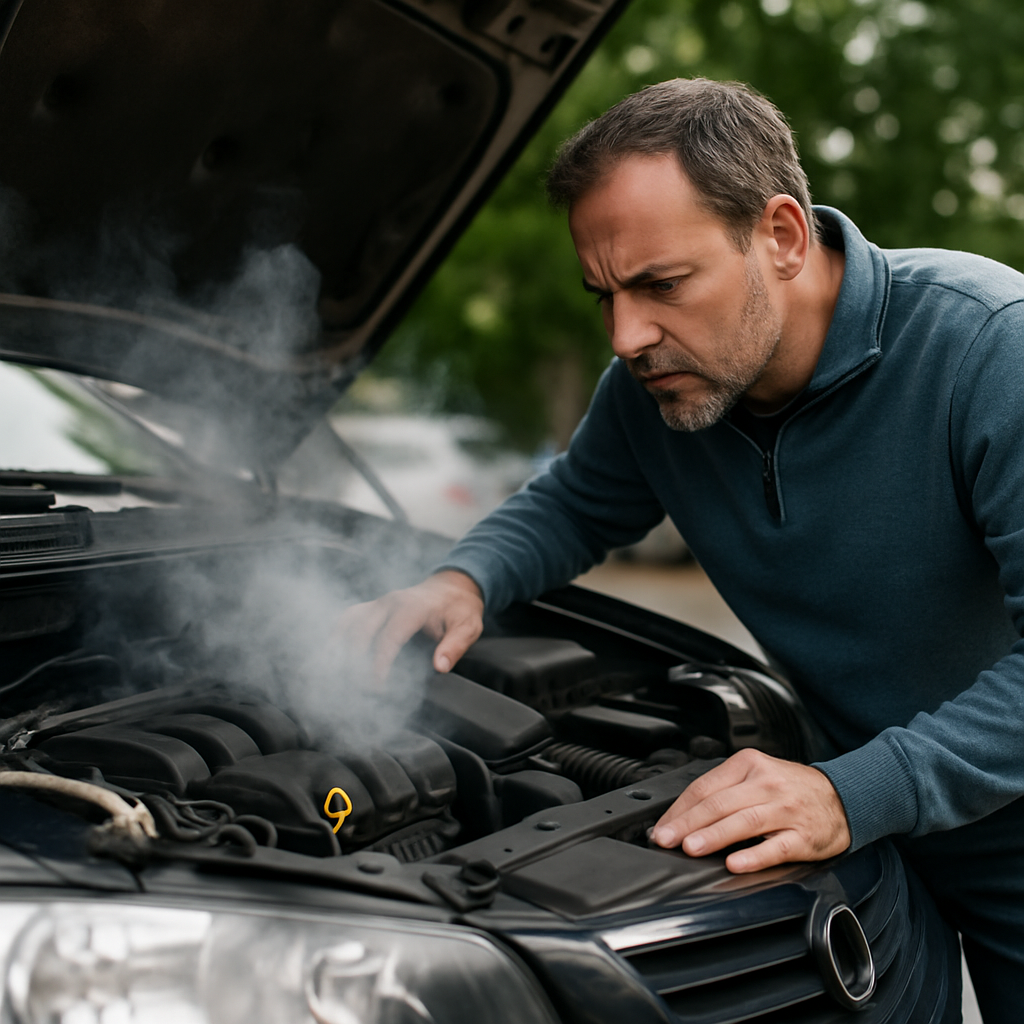
A car that overheats while idling may have a cooling-system problem that becomes more apparent when there is little airflow through the radiator. The radiator fan helps draw air through it when the vehicle is stopped or moving slowly; when the car is moving, airflow can help cool the radiator. This pattern can point towards a problem, but it does not identify a failed part on its own.
Why a car can overheat at idle but cool down while driving
At a standstill, the radiator receives less airflow from the vehicle’s movement, so the cooling fan plays an important role. If the temperature rises at a stop and falls after you set off, that change is useful information for a technician. It does not prove that the fan is faulty: low coolant, a leak, restricted radiator airflow or another cooling-system issue could also contribute.
Can idling make a car overheat? A temperature rise can occur while a car is idling, particularly if the cooling system is not managing heat effectively. Idling alone, however, does not confirm a fault, and vehicles can behave differently depending on their design and conditions. If the engine also overheats while moving, treat that as a broader overheating problem rather than an idle-only pattern.
If it overheats at idle with the air conditioning on
Note whether the temperature rises with the air conditioning on, during prolonged idling, or in hot weather. These are useful circumstances to report, not proof that the air-conditioning system itself is causing the problem. Hot weather can put additional stress on a cooling system; one source also advises using the air conditioning sparingly in hot conditions. Neither point makes AC use alone a diagnosis.
If the temperature reaches the red zone or an overheating warning appears, follow the safety steps below. Do not keep the engine running to test whether switching the air conditioning off will resolve an actual overheat.
If the cooling fan seems to work, what else could be wrong?
Seeing or hearing a fan operate does not show that it is performing adequately in all conditions, or that the rest of the cooling system is working properly. Other possibilities include low coolant or a cooling-system leak, a thermostat problem, a restricted radiator, a water-pump problem or air in the system. These are possibilities to investigate, not conclusions that can be drawn from the temperature pattern alone.
When the vehicle is safely parked, note when the temperature rises and whether you can see signs of a leak or coolant loss. Do not open or handle a hot, pressurised cooling system. If the overheating recurs or the cause is not clear, arrange a professional diagnosis rather than replacing a part based only on the symptom.
What if the engine overheats while driving too?
Overheating both while stopped and while moving is different from a temperature rise that occurs only at idle. Possible causes can include low coolant or leaks, thermostat failure, radiator restriction or a water-pump problem. Airflow from driving will not resolve every cooling-system fault, so a temperature drop while moving does not mean the vehicle is safe to continue using.
If the gauge reaches the red zone or the vehicle displays an overheating warning, pull over safely and turn the engine off immediately.
What it may mean if the heater stops producing heat
Engine overheating together with little or no cabin heat is an additional symptom worth reporting to a technician. It does not, by itself, confirm low coolant, trapped air, a failed water pump or any other specific fault. Cooling-system problems can have several causes, and the available information does not establish a definite diagnosis from this combination of symptoms.
If the engine is overheating, prioritise stopping safely and switching it off. Do not keep the engine running just to test the cabin heater.
What to do if the engine overheats while you are stopped
If the temperature gauge reaches the red zone, AAA advises pulling over safely and turning the engine off immediately. Treat an overheating warning as a reason to stop, not as a problem that has been repaired because the gauge later drops.
There is no reliable temporary workaround that makes continued driving safe. If the warning returns, or you have not established and resolved the cause, arrange appropriate assistance or an inspection. Do not open the cooling system while it is hot or pressurised.
Common causes and how a repair shop can narrow them down
The correct repair depends on the cause. A technician may investigate:
- Cooling-fan operation: whether the fan and its control system provide adequate airflow when needed.
- Low coolant or a leak: a leak can reduce the amount of coolant available to carry heat away from the engine.
- A thermostat problem: a faulty thermostat can interfere with coolant flow.
- Radiator restriction or blocked airflow: restriction within the radiator or an obstruction affecting airflow can reduce cooling.
- A water-pump problem or air in the system: either may affect cooling-system circulation.
A sensible diagnostic direction is to check for leaks and low coolant, assess airflow and fan operation, and investigate possible circulation or restriction issues as appropriate. A technician may also use further tests if the evidence points to a more complex fault. For example, a block test can be used in technician-level diagnosis when a combustion leak into the cooling system is suspected; the idle-overheating symptom alone does not establish that such a leak exists.
For more detail on the range of possible overheating causes, see CarParts.com’s overview of overheating at idle and Firestone’s explanation of what can cause an engine to overheat. Neither symptom pattern nor a single owner observation is a substitute for diagnosis.
Can an overheating episode ruin the engine?
Overheating can cause serious, potentially permanent engine damage, but an overheating warning does not prove that the engine is ruined. Equally, the fact that the engine still runs does not prove that it is unharmed. There is no reliable damage threshold or safe duration that can be inferred from the information available.
Do not ignore repeated or unresolved overheating. Stop and switch off the engine if the gauge reaches the red zone or an overheating warning appears, then have the cause and any possible damage assessed before continuing to use the vehicle.