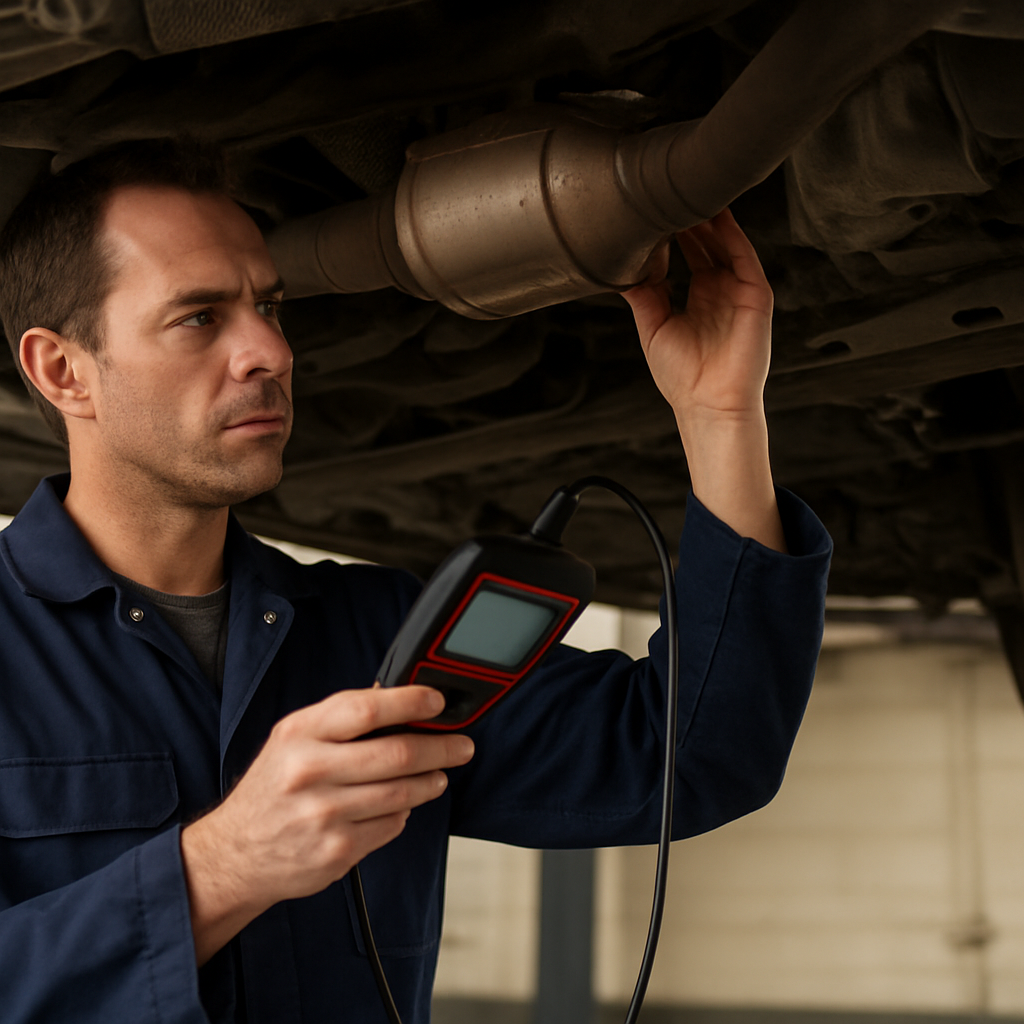
A new catalytic converter does not guarantee that P0420 will disappear or stay away. P0420 means the vehicle’s computer has detected catalyst-system efficiency below its programmed threshold; it does not, by itself, prove that the replacement converter has failed or that an oxygen sensor needs replacing. An installation or exhaust problem, inaccurate sensor information, wiring trouble, an underperforming replacement part or another engine fault may still need investigation.
Why P0420 Can Return After a New Catalytic Converter
The powertrain control module (PCM) assesses catalyst performance using oxygen-sensor information from before and after the converter. As Kelley Blue Book’s explanation of P0420 outlines, the code relates to catalyst efficiency, but it does not identify the root cause on its own. For a fuller explanation, see our guide to what P0420 means.
If the engine management light remains on after replacement, or returns later, possible explanations include:
- The replacement converter is not meeting the vehicle’s requirements or is not performing adequately. This is a possibility, not a conclusion that can be drawn from the code alone. Confirm that the part and installation are suitable for the specific vehicle before authorising another replacement.
- An exhaust leak or installation issue. A leak around an exhaust joint or nearby connection can affect the readings used to assess the system. A visual check may reveal obvious damage or a loose connection, but it cannot rule out a small leak.
- An oxygen-sensor signal or circuit problem. A sensor may be supplying inaccurate information, or its wiring or connector may be damaged. Sensor data should be assessed using vehicle-specific service information; P0420 does not automatically mean that the sensor itself has failed.
- Another engine-running or fuel-delivery fault. An underlying fault may affect emissions or sensor readings and should be investigated when other codes or symptoms are present. A specific cause cannot be identified without vehicle-specific testing.
Replacing both the converter and an oxygen sensor does not rule out these possibilities. If the original cause was not corrected, if a part or connection is not performing as required, or if another fault is present, P0420 may return. Automatically replacing both oxygen sensors is not a reliable diagnostic plan; the system should be tested first.
What to Check After Replacing the Catalytic Converter
Use an ordered diagnostic process rather than continuing to swap parts:
- Retrieve and record all available codes and scan data before clearing anything. Check for other stored or pending codes as well as P0420. Other faults may change what should be investigated first. A scan tool can retrieve codes, while a technician can interpret the available data in the context of the vehicle.
- Review the repair and the replacement part. Confirm what was fitted and whether the part and installation meet the requirements for the vehicle’s make, model and engine. Requirements vary, so do not assume that all replacement converters are interchangeable.
- Look for obvious installation damage or a loose exhaust connection. Carry out only a visual check when the vehicle is parked safely and the exhaust is cool. Do not touch hot exhaust components or work underneath a vehicle that is not properly supported.
- Have the exhaust system, sensors and wiring evaluated. A technician can check for leaks and assess oxygen-sensor signals and circuits with suitable equipment and vehicle-specific service information. Sensor readings should not be judged against a universal voltage rule.
- Investigate related engine faults before condemning the new converter. Other codes, drivability symptoms or warning indications may affect the diagnosis. Seek qualified help if you lack scan data or service information, or before paying for another converter or sensor.
These are diagnostic leads, not confirmed explanations for every vehicle. Our guide to P0420 checks to consider before replacing a catalytic converter also explains why proper diagnosis should come before another parts replacement.
P0420 alone is not enough to determine whether a vehicle is safe to drive. If the car is running poorly, has other warning lights or codes, or shows other concerning symptoms, arrange a prompt professional assessment. For broader guidance, read what to do when the engine management light is on.
Why P0420 Can Come and Go
An intermittent warning does not identify which part has failed. Sensor readings or wiring, an exhaust leak and catalyst efficiency remain diagnostic possibilities, but a temporarily extinguished engine management light does not prove that the underlying issue is fixed.
If P0420 returns, record the stored and any available pending codes and scan data before clearing anything. If the warning is intermittent or its cause remains unclear, a technician can assess the data and inspect the system. Do not rely on the light going out as confirmation that the repair has worked.
Will P0420 Go Away, and How Long Does It Take?
The warning may not disappear immediately after a converter replacement, and the repair alone does not guarantee that it will stay away. There is no reliable vehicle-independent number of hours, miles or drive cycles for P0420 to clear. Avoid relying on a fixed timeframe; ask a qualified technician to check the vehicle’s monitor status and follow the vehicle-specific service information.
Is P0420 a Permanent Code?
Whether P0420 is shown as a permanent diagnostic trouble code depends on the vehicle and its diagnostic system. The conditions for clearing a permanent code are not established by P0420 alone. Do not assume that every P0420 is either permanent or non-permanent; use an appropriate scan tool and consult manufacturer or authoritative OBD-II information for the vehicle’s code status and clearing conditions.
Is There a Cheap, Permanent Fix for P0420?
There is no universal, easy or guaranteed cheap fix. A durable repair depends on what diagnosis finds: the converter, an exhaust connection, sensor information or wiring, or another engine fault may need attention. It would be misleading to quote a general repair cost because the vehicle, fault and required work can differ substantially.
Having the codes and system checked before buying more parts is the practical way to avoid repeat repairs that may not address the cause. Do not treat a code suppressor, sensor spacer or unexplained parts replacement as a proven repair. Diagnosis can narrow down the cause, but no outcome can be guaranteed without the vehicle details, scan data and an inspection.
Should You Clear the Engine Management Light After the Repair?
Clearing a code is not the same as fixing the fault. Record the codes and available scan data first. If the cause is uncertain or the warning has returned, have the vehicle diagnosed rather than using a reset to conceal an unresolved problem. A light that goes out after a reset does not establish that catalyst efficiency has been restored, and there is no vehicle-independent reset procedure that can guarantee the light will stay off.