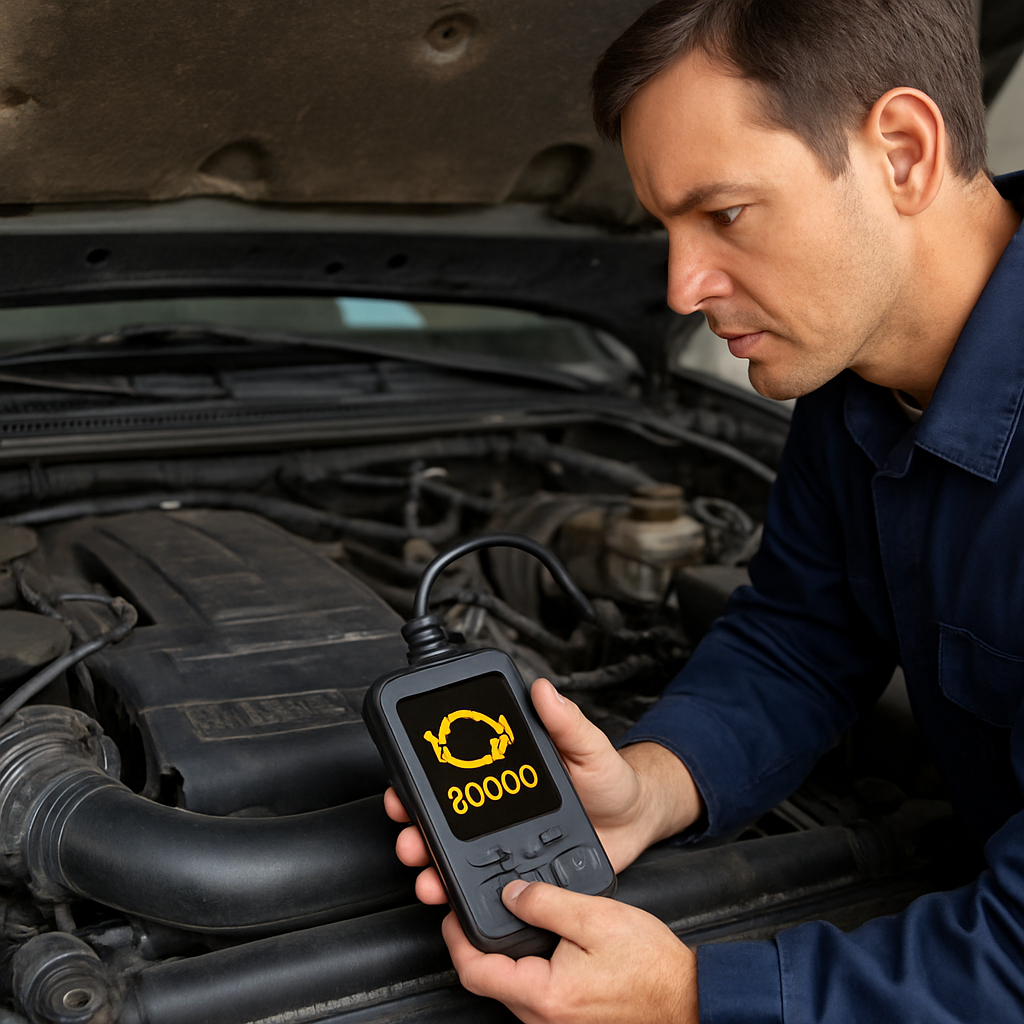
P0300 means the engine control system has detected a random or multiple-cylinder misfire on your Nissan Xterra. It identifies a misfire condition, not the component that has failed or the reason it is happening. Ignition, fuel-delivery and mechanical issues can all produce this code, so the underlying fault should be diagnosed before parts are replaced.
What P0300 means on a Nissan Xterra
P0300 is the generic diagnostic trouble code for a random or multiple-cylinder misfire. The definition applies to Nissan vehicles, including the Xterra, but the code does not identify a particular Nissan component or prove that any specific part is faulty.
A misfire occurs when combustion does not take place as expected in one or more cylinders. Unlike a cylinder-specific code, P0300 does not name one cylinder as the source of the problem. For example, P0305 indicates a misfire detected in cylinder 5; see our guide to how a cylinder-specific misfire code differs for further context.
Possible causes of P0300
Kelley Blue Book’s overview of P0300 identifies worn or damaged spark plugs as a common and relevant possible cause of a misfire. That does not mean spark plugs are the most common cause on every Xterra, or that they are necessarily responsible for the code on your vehicle.
Other possible cause categories include:
- Ignition-system faults.
- Fuel-delivery problems, including an issue involving the fuel pump or an injector.
- Poor fuel quality.
- Less commonly, engine or timing-related problems.
These are possibilities rather than a ranked list of Xterra-specific faults. A Nissan-focused diagnostic discussion also identifies fuel quality and fuel-pump pressure as worthwhile considerations in some P0300 cases. Fuel pressure testing is a diagnostic step, however; it does not by itself show that the pump has failed or establish the correct repair.
Record all stored fault codes and note when the issue occurs, including any change in the way the engine runs. Rough running, hesitation and reduced power can be useful observations for a technician, but they do not identify the failed part on their own. For more general background, see our guide to common reasons an engine can misfire.
Do not assume that an oxygen sensor, distributor bearing, vacuum leak or catalytic converter is at fault solely because P0300 is stored. A sensor issue can be difficult to isolate, and Kelley Blue Book advises ruling out more apparent possible causes before concluding that a sensor has failed. Our article on when an oxygen-sensor fault may be relevant to P0300 provides general context, but it is not a diagnosis of a particular Xterra.
What to check next
Because P0300 does not identify one failed component, the sensible next step is to have the misfire diagnosed rather than replacing parts by guesswork. Give the technician the full list of stored codes, the warning-light behaviour, and details of when the problem began. If the code appeared after refuelling, it may also be useful to note when and where the fuel was purchased; this is helpful context, not proof that the fuel caused the fault.
Fuel quality can be one factor in a P0300 diagnosis, but the code does not confirm bad fuel. Read more about how fuel quality can relate to P0300.
Is P0300 expensive to fix?
The code alone cannot establish whether the repair will be inexpensive or costly. P0300 can be associated with several different underlying faults, and the cost depends on the confirmed cause and the work required to correct it. The available information does not support a reliable Xterra-specific price or labour estimate.
Ask for the cause to be diagnosed and for an estimate based on the confirmed fault before authorising repairs. Avoid replacing spark plugs, sensors, a fuel pump or other components solely because P0300 is present; the code does not establish which, if any, of those parts has failed.
When a P0300 warning needs prompt attention
Kelley Blue Book distinguishes between a steadily illuminated check-engine light, which it associates with an active misfire, and a flashing check-engine light, which it associates with a severe misfire. Neither warning-light pattern identifies the failed component, and a steady light should not be treated as proof that continued driving is safe.
As cautious general guidance, if the check-engine light is flashing or the engine is running very poorly, stop using the vehicle when it is safe to do so and arrange prompt professional assessment. If the light is steady, arrange diagnosis rather than relying on the light alone to decide whether the vehicle can be driven. For related general information, see our guide to misfire-code driving and safety considerations; advice about another code does not establish that an Xterra with P0300 is safe to drive.