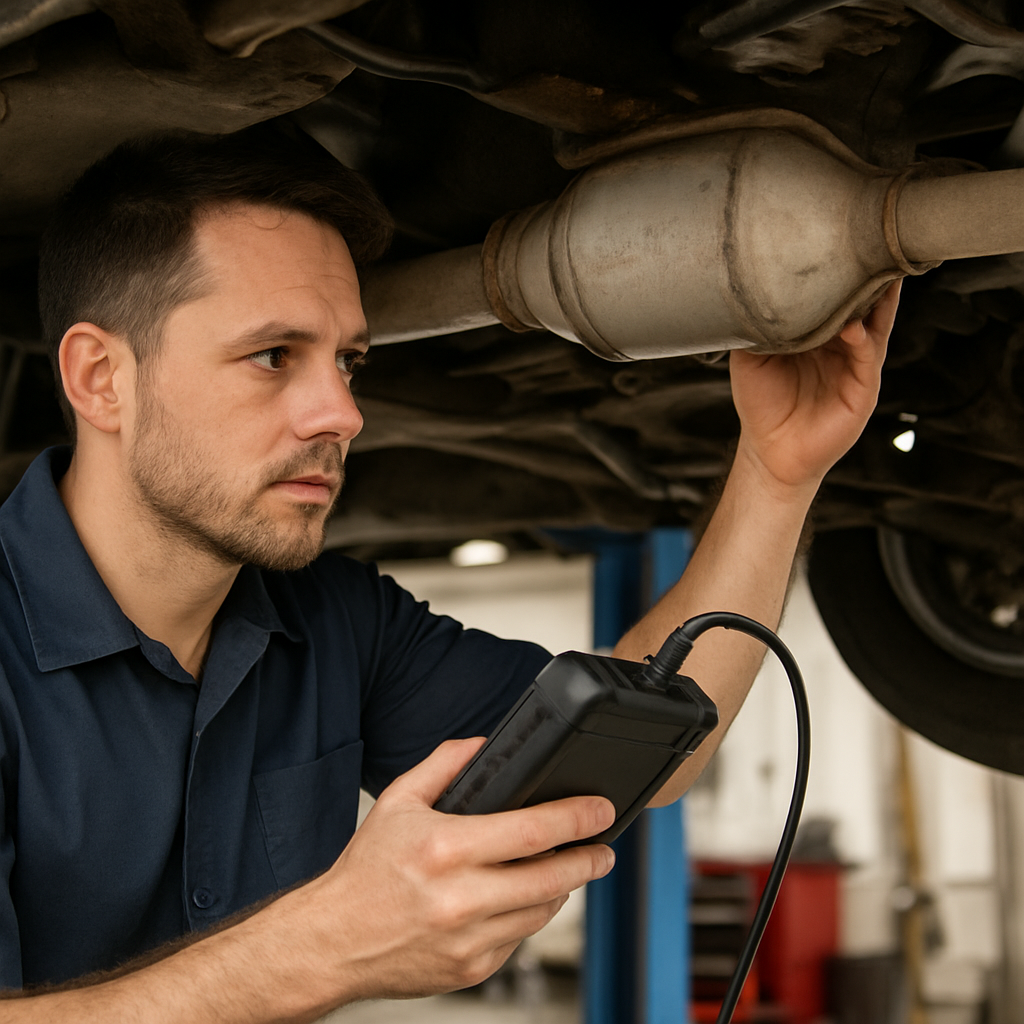
You may be able to resolve a P0420 code without replacing the catalytic converter if diagnosis finds another correctable fault, such as an exhaust leak, damaged sensor wiring or an engine-running problem. However, P0420 alone does not prove the converter has failed, and clearing the code or using a cleaner does not establish that the cause has been repaired.
What P0420 means and what to check before replacing the catalytic converter
P0420 means the vehicle’s catalyst system has been judged to have efficiency below the threshold monitored by its engine-control system. It is a diagnostic result, not confirmation of which component has failed. A worn or failed catalytic converter is one possibility, but an exhaust leak, a sensor or circuit fault, or an engine problem can also affect the result. For a fuller explanation, read what catalyst efficiency below threshold means.
“Bank 1” identifies the engine bank referenced by the code. Its physical location depends on the vehicle’s engine layout, so do not assume it is on a particular side. Use vehicle-specific service information to identify the correct bank and follow the appropriate diagnostic procedure.
Preserve the diagnostic evidence before clearing anything. A diagnosis-first check should include:
- Save all diagnostic codes and freeze-frame data. Other stored or pending codes, plus the conditions recorded when the fault appeared, can help identify the cause.
- Review related codes. Misfire or fuel-mixture codes, such as P0300, P0171, P0172, P0174 or P0175, may point to an engine problem that needs attention before the catalyst can be assessed reliably.
- Inspect the exhaust for leaks. Have suspected leaks confirmed and repaired before concluding that the converter is at fault.
- Check sensor wiring and connectors. Look for damaged wiring, poor connections or other faults affecting oxygen or air-fuel sensors and their circuits.
- Test sensors rather than replacing them by default. P0420 alone is not a reason to replace one or both sensors. Replace a sensor only when testing shows that it is faulty.
- Investigate engine-running problems. Misfires, rich or lean running, oil burning and coolant entering the exhaust can affect catalyst testing or damage the converter. Address any confirmed problem before judging the converter.
The P0420 diagnostic guidance similarly recommends saving codes and freeze-frame data, checking for leaks and sensor-circuit faults, and resolving engine-running issues before replacing the converter. The vehicle-specific service procedure matters because diagnostic monitors and sensor systems vary.
For a Toyota Camry, see our Toyota Camry-specific P0420 causes and checks; those details should not be assumed to apply to other vehicles. If you suspect a sensor issue on a Toyota, this guide to signs of a bad oxygen sensor on a Toyota may also help, although symptoms alone do not confirm a faulty sensor. For help understanding a confirmed misfire, see common causes of an engine misfire.
Can you fix a catalytic converter without replacing it?
Sometimes the code can be resolved without converter replacement because the actual fault is elsewhere. Examples include a confirmed exhaust leak, wiring or connector fault, faulty sensor, misfire or fuel-mixture problem. Repairing that cause may allow the catalyst system to pass its monitor again.
That is different from repairing a converter that has itself been confirmed as worn out or failed. The available evidence does not establish a reliable method of restoring a failed converter without replacement. Replace the converter only when the vehicle-specific diagnostic procedure confirms that it has failed, and use a replacement suitable for the vehicle and local emissions requirements.
Can a catalytic-converter cleaner or Cataclean fix P0420?
A catalytic-converter cleaner may be an option to consider when there are no other engine problems or related codes and deposits are a plausible contributor. However, the available evidence does not show that a cleaner will repair a failed converter or reliably prevent P0420 from returning. A cleaner should not take the place of diagnosis.
Does Cataclean help with P0420? The supplied evidence does not test or verify Cataclean’s effectiveness, so there is no basis to promise that it will clear the code. A code disappearing after a treatment would not, by itself, prove that the underlying fault has been permanently repaired.
MotorPower Care, which sells its own cleaner, describes a fuel-treatment process, a suggested highway-driving cycle and a later code check. It also describes a separate foam product applied through an oxygen-sensor port. These are that seller’s product directions and claims, not universal repair instructions or independent proof that the treatment works. The seller claims its products address P0420 and P0430, but that is not a guarantee, and the two codes do not necessarily have the same cause on every vehicle. See the seller’s product-specific P0420 claims and directions for its own wording.
An Underhood Service article says cleaning may help in some cases and mentions possible engine or injector cleaning. The available excerpt does not provide a validated procedure, eligibility criteria or success rate, so it should not be treated as a universal fix. The supplied evidence also does not establish an engine flush as a remedy for P0420 or P0430. Do not use an engine flush for this purpose without vehicle-specific manufacturer guidance and a diagnosis that supports it.
If P0420 returns after a treatment, do not keep repeating additives instead of investigating the cause. Follow the vehicle-specific diagnostic procedure. Avoid improvised cleaning methods, including spraying carburettor or throttle-body cleaner into a running engine; the available evidence does not establish this as a safe or effective repair.
Is there a permanent, easy or cheap fix for P0420?
There is no universal easy, cheap or permanent fix established by the available evidence. A lasting repair depends on identifying and correcting the actual fault. A confirmed leak, wiring or connector problem, faulty sensor, misfire or fuel-mixture issue may be repairable without replacing the converter, but none should be assumed to be the cause without testing.
Clearing the code or trying a cleaner is not proof of a permanent repair. If the underlying issue remains, the code may return. Proper diagnosis can help avoid replacing parts based on the code alone, but no reliable repair prices, labour times or guaranteed savings are available here for comparison.
How to clear P0420 — and why clearing it is not a repair
Save the codes and freeze-frame data before erasing anything. Once the cause has been addressed, a scan tool can be used to clear the stored code. Clearing it only erases the recorded warning; it does not repair a leak, sensor fault, engine problem or failed converter.
After a repair, recheck for returning codes and allow the vehicle’s required catalyst monitor and other applicable monitors to run according to its service information. The time or distance required can vary, so a fixed drive cycle should not be assumed. MotorPower Care’s page mentions clearing the code with a scanner or disconnecting the battery as part of its product process. Treat this as seller-specific guidance, not a universal recommendation; do not disconnect the battery without checking vehicle-specific instructions.
Can you keep driving with P0420?
P0420 may be present without obvious changes in how a vehicle drives, but that does not establish that every vehicle with the code is safe to drive or that the underlying fault is harmless. The cause matters. A misfire or fuel-mixture problem can damage the converter if left unresolved, and a vehicle that feels normal may still have a fault requiring diagnosis.
Arrange prompt diagnosis, particularly if there are additional codes or a change in performance. The available evidence does not support a safe mileage limit or a set amount of time to keep driving. For context on a confirmed failed converter, see our separate guide to the risks of driving with a confirmed broken catalytic converter; a P0420 code alone does not confirm that the converter is broken.
Should you bypass the P0420 code?
Do not treat suppressing the warning as a repair. The available evidence does not establish whether an oxygen-sensor spacer, simulator or other bypass is technically suitable for a particular vehicle or legal where you live, so installation instructions are not appropriate. Hiding the warning does not show that catalyst efficiency has been restored or that an underlying engine fault has been fixed. Diagnose and repair the cause instead.