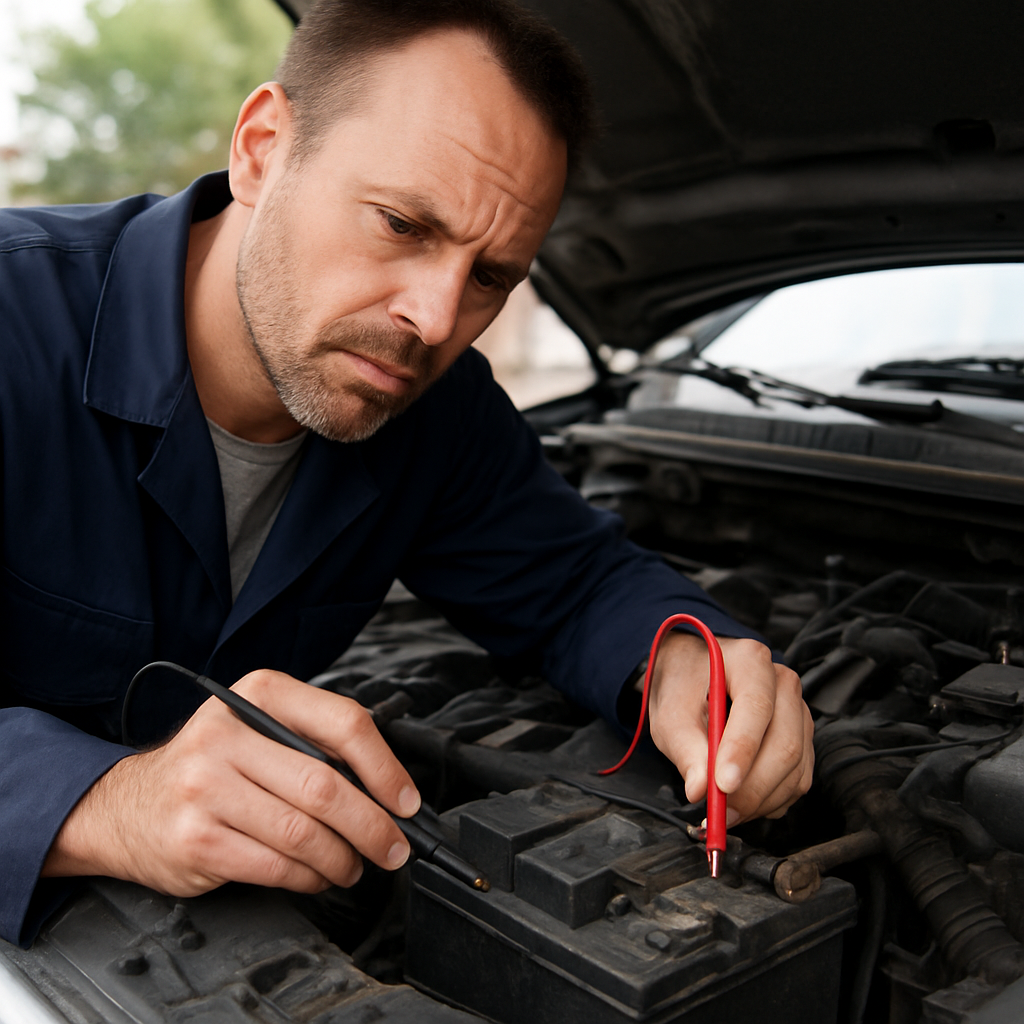
A true no-crank condition means the engine does not turn over when you try to start it. A weak or discharged battery, or a problem with its connections, is a common cause. A faulty starter, or a fault in the circuit that sends the starter its command, is another possibility. These symptoms can narrow the search, but they do not confirm which component has failed.
First, distinguish no-crank from two other faults: an engine that turns over but will not fire, and an engine that starts but then stalls. Each points towards different areas of diagnosis.
Common causes of a no-crank condition—and what to check first
If the engine does not turn, begin with the battery and its connections. A battery may be too weak to operate the starter even when the dashboard lights, radio or other accessories still work. A loose or visibly corroded battery connection is also worth noting. This guide to distinguishing no-crank from crank-no-start explains why working accessories do not rule out a weak battery.
The starter itself may be at fault, or it may not be receiving the signal it needs to operate. The ignition switch and starter relay are examples of components within that command circuit. Clicking, silence or illuminated dashboard lights can offer useful clues, but none proves that a particular part has failed. For a closer look at one common symptom, see our guide to a car that clicks but won’t start. If the lights come on but there is no click, read what to check when the lights come on but there is no click.
Before making any checks, stop in a safe location. Keep clear of moving or energised components and limit yourself to observations you can make safely. A sensible first pass is:
- Make sure the selector is fully in Park. If appropriate and safe, try starting in Neutral.
- Observe what happens during the start attempt: is there silence, a click, or does the engine turn over?
- Look at the battery terminals for an obvious concern, such as visible corrosion or a connection that appears loose.
- If the vehicle has a key fob or a spare key, try the spare where available. The result may help narrow the possibilities, but it is not a diagnosis.
Checking the fuel gauge is a sensible basic check, but fuel level is more relevant when the engine cranks but does not start than when it does not turn over at all. Cold weather can expose an ageing or weak battery, although cold conditions alone do not establish that the battery is the cause. Nalley Automotive includes Park or Neutral selection, the sound during a start attempt, a spare key, battery terminals and cold-weather battery stress among its initial checks and possible causes.
If these basic observations do not resolve the issue, or you are unsure what they mean, arrange qualified diagnosis rather than replacing parts based on a sound or dashboard light alone. For a model-specific example, see our 2016 Honda Accord push-button-start guide. It applies to that model and should not be treated as guidance for every push-button-start vehicle.
If the engine cranks but will not start, check a different set of causes
In a crank-no-start condition, the starter turns the engine but the engine does not catch and run. This is different from a no-crank problem. Broad diagnostic areas include fuel delivery, ignition or spark, and engine-management sensors.
Start with the simple possibility of low fuel, bearing in mind that a fuel gauge is not always accurate. If the engine cranks normally but will not catch, a weak fuel pump or a clogged fuel filter are possible explanations, not confirmed diagnoses. Worn spark plugs or other ignition components may also be considered, particularly if rough running or misfiring occurred before the starting problem.
A sensor fault is another possibility. The Orlando Auto Repair guide explains that a failed crankshaft-position sensor can prevent the engine control unit from determining engine position, and it may be associated with intermittent starting or stalling shortly after start-up. It also lists camshaft and mass-airflow sensors as possible considerations. These examples do not establish that a sensor is at fault in any particular car. If your engine is definitely turning over, see our crank-but-won’t-start troubleshooting guide for a closer look at this separate symptom.
The AAA overview of starting problems also discusses fuel-related symptoms and the difference between an engine that cranks and one that does not. If the cause is not apparent from basic observations, professional diagnosis is preferable to guessing at a fuel, ignition or sensor fault.
Starter or alternator? Why symptoms may not identify the failed part
A click, silence or dashboard lights that remain on cannot reliably establish whether the starter or alternator has failed. AAA notes that dashboard lights with no start, a single click or silence can point towards a starter issue, but these clues do not confirm a failed starter. A weak battery can create a similar no-start complaint, and working accessories do not rule out a battery problem.
The available information does not provide a dependable symptom-by-symptom comparison or the measurements needed to distinguish a starter from an alternator conclusively. Do not replace either part on the basis of these signs alone. If the basic checks do not reveal an obvious issue, ask a qualified technician to assess the starting and charging systems.
If the car starts and then dies immediately
An engine that catches and then stalls is not a no-crank condition, and it differs from an engine that never fires. A crankshaft-position sensor problem is one possibility: the Orlando Auto Repair guide lists intermittent starting and stalling shortly after start-up among potential signs. Fuel-related problems are another area that may require investigation, but the available evidence does not establish one cause as the most likely explanation for an immediate stall.
A symptom alone cannot confirm a sensor, fuel-system or other component failure. If the engine repeatedly starts and dies, arrange professional diagnosis rather than assuming a particular part is at fault. For a related symptom, read more on a car that stalls and then won’t start.
If no-start incidents recur and a battery problem is suspected, the underlying cause may still need investigation. Our BMW X5 battery-drain guide is specific to that model and should not be used as guidance for every vehicle.