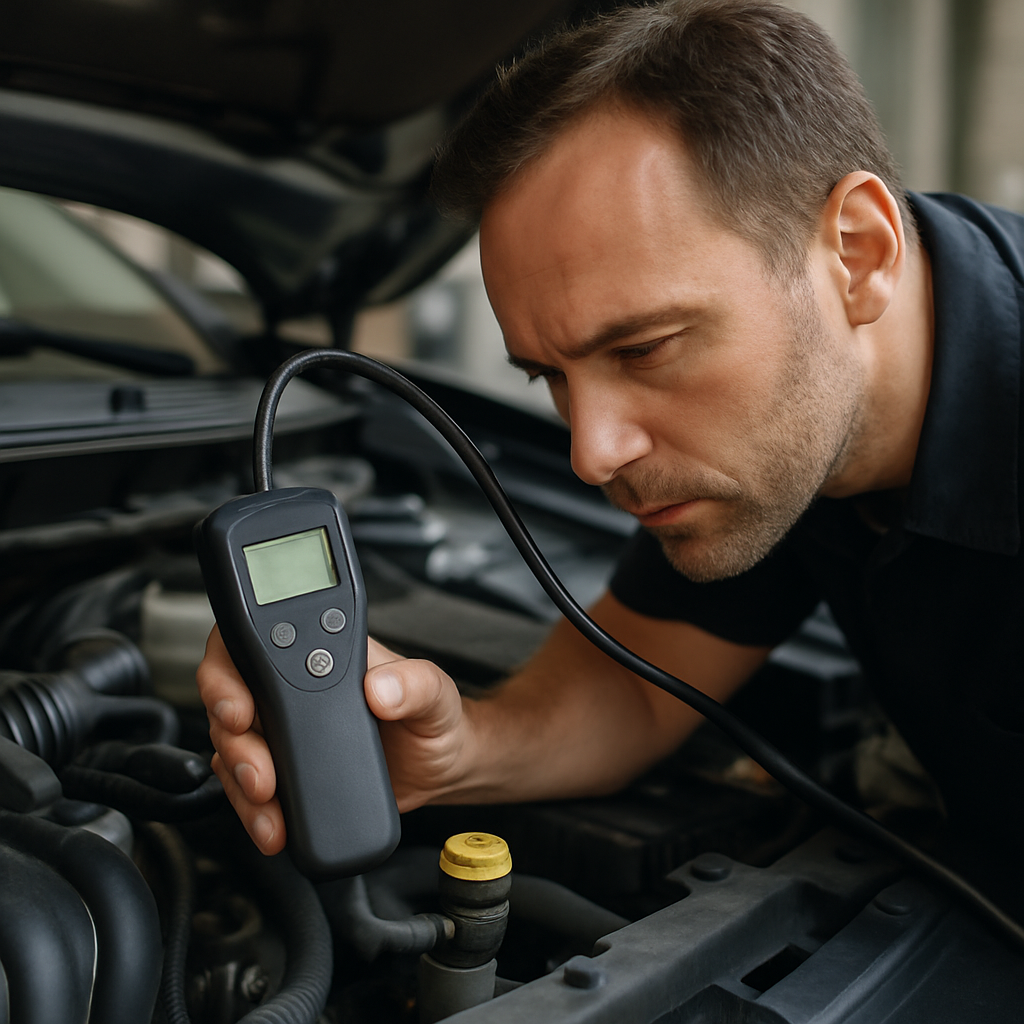
An EVAP leak means your car’s evaporative-emissions system has failed a check for containing fuel vapours. It is a fault in the vapour-containment system—not, by itself, proof that liquid petrol is leaking or that a particular part has failed. The stored diagnostic code can help classify the fault, but further checks may be needed to find its cause.
What an EVAP leak means
EVAP stands for evaporative emission control system. In plain language, it is designed to keep fuel vapours from the tank and fuel system contained rather than allowing them to escape into the air. When the vehicle’s computer detects a problem with that system, it can illuminate the malfunction indicator lamp (MIL), commonly called the check-engine light.
A leak-detected message or code means the system has identified a fault; it does not confirm that fuel is visibly leaking or identify the failed part. A loose or damaged fuel cap is one possible cause, but the issue may be elsewhere. The system and diagnostic process can also vary by vehicle, so a code needs to be interpreted in the context of the car.
What the check-engine light, EVAP message or code can tell you
An EVAP fault may produce a check-engine light and, in some cases, a fuel odour. Those signs do not pinpoint the cause. A scan tool can retrieve the stored diagnostic trouble code, which gives a useful clue about the type of fault but does not necessarily locate it. The supplied EVAP code guide describes these examples:
| Code | Indicated fault category |
|---|---|
| P0441 | Incorrect purge flow |
| P0442 | Small EVAP leak detected |
| P0455 | Gross or large EVAP leak detected |
| P0456 | Small EVAP leak detected |
| P0457 | Leak detected associated with a loose or off fuel cap |
These descriptions classify the detected fault; they do not prove which component has failed. Even a small-leak code does not tell you what to replace. Vehicle-specific testing may be needed to distinguish a cap problem from another fault. A generic EVAP code also does not establish that a leak-detection pump or any other particular component is faulty.
A fuel odour should be investigated promptly. An EVAP code alone does not confirm a liquid-fuel leak, but neither does it rule one out. Do not treat a normal-feeling drive as proof that there is no other fault or that the vehicle is safe in every circumstance. One EVAP diagnostic overview notes that an EVAP leak by itself may not stop the engine from running; that is not a safety guarantee for an individual car.
What you can check yourself—and when not to guess at a repair
Start with a simple, low-risk check: make sure the fuel cap is fitted correctly and look for obvious damage to the cap or its seal. A loose or damaged cap is a possible EVAP fault, but checking it does not establish that it caused the warning. For more detail on that particular issue, see our guide to a loose gas cap and the check-engine light.
If the cap looks damaged, follow your vehicle’s guidance on replacing it with a suitable cap. If the warning remains or returns, the fault may be elsewhere and needs diagnosis. Do not replace parts just because a generic EVAP code is present, and do not assume that tightening the cap or clearing the code proves the system is repaired.
For a small EVAP leak, the word “small” describes the detected leak category—not the repair. The leak must be located and the actual fault confirmed before a reliable repair can be chosen. Some owner-level checks are possible, but the available evidence does not support one universal DIY method for finding and fixing every EVAP leak without specialised testing. For procedures beyond a basic cap check or code reading, use vehicle-specific service information or a qualified technician.
Can you check for an EVAP leak without a smoke machine?
You can inspect accessible areas visually and use a suitable OBD-II scanner to retrieve EVAP-related codes. Some more advanced scanners can command an EVAP test, depending on the vehicle and the tool. These checks can narrow down what to investigate, but a code does not necessarily show where a leak is, and a visual inspection may not reveal a small or hidden fault.
A professional smoke test is one way to make leaks visible: smoke is introduced into the system under controlled conditions, and escaping smoke can indicate a leak that was not apparent during a visual check. It is not a guarantee that every fault will be found by the same method, but a basic scanner or visual inspection is not a guaranteed substitute. A description of EVAP smoke testing explains why this method can help reveal less obvious leaks.
Do not use flame, propane or improvised pressure-testing methods around a fuel-vapour system. If basic checks do not explain the code, leave further testing to someone with appropriate equipment and vehicle-specific information.
Where to take a car with an EVAP leak
Choose a qualified repair shop or technician able to retrieve diagnostic codes and test the EVAP system. When arranging the work, ask the shop to confirm the stored code, identify the cause through testing and explain how the proposed repair addresses that finding. A code alone is not a sound reason to replace a particular part.
If a visual check does not reveal the problem, diagnosis may require equipment beyond a basic code reader, such as a suitable smoke-testing setup or a vehicle-capable scan tool. Ask whether the estimate separates diagnostic charges from the repair, where the shop itemises them.
How much does EVAP leak repair cost?
The cost varies widely according to the source of the leak. A cap-related issue and a fault that requires more diagnosis or repair elsewhere are not the same job, so a code by itself is not enough to give a reliable price. The available evidence does not support a general dollar range.
Ask for a confirmed diagnosis and an itemised estimate before approving repairs. If the shop charges separately for diagnosis, ask how that charge relates to the proposed repair. This helps you understand whether the quote is based on a located fault or only on the code category.
Does an EVAP leak mean there is a Jeep Grand Cherokee recall?
An EVAP warning or leak code alone cannot establish whether a Jeep Grand Cherokee is covered by a recall. Recall applicability depends on the specific vehicle, and the information available here does not confirm a campaign or its eligibility. Check an authoritative recall database or contact the manufacturer with the relevant model year and VIN; do not assume that a general EVAP fault is a recall issue.