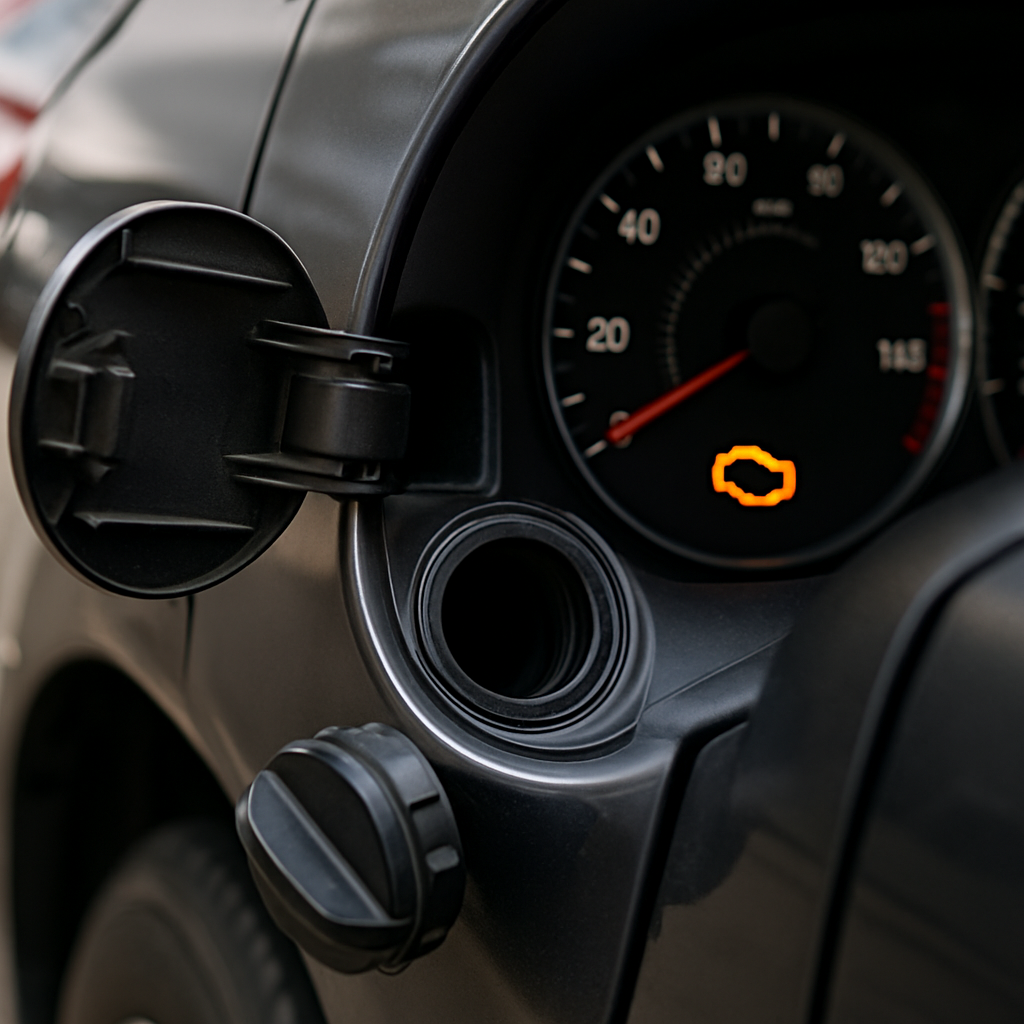
A loose, missing, or poorly sealing gas cap can allow fuel vapours to escape from the evaporative-emissions system (EVAP), which may trigger the check engine light. The warning does not prove that the cap is at fault, however: another leak or fault in the EVAP system can produce a similar alert.
Why a loose gas cap can turn on the check engine light
The gas cap helps seal the fuel tank and contain fuel vapours. The EVAP system is designed to keep those vapours from escaping, while the vehicle’s onboard diagnostics monitor the system for leaks. If the cap is not sealing properly, the vehicle may detect a leak, store a diagnostic trouble code, and illuminate the check engine light.
This is an emissions-system warning, not proof that the engine itself is failing. A loose or faulty cap is one possible cause, but a warning related to an EVAP leak can also come from elsewhere in the system. CarParts.com explains that other EVAP faults can also produce leak codes, so the light alone cannot identify the failed part.
Can a loose gas cap set a diagnostic code?
Yes. If the vehicle detects an EVAP leak, it may store a diagnostic trouble code (DTC). Codes such as P0457, P0440, and P0441 are examples associated with EVAP problems in the supplied technical material, but none of them proves by itself that the gas cap is defective. The same system code can have more than one possible cause, and its exact meaning should be interpreted for the vehicle in question.
A code reader can help identify which system has registered a fault. If a code points to an EVAP leak, check the cap as a simple first step, but do not treat the code as a parts diagnosis. A technician may need to check for a leak or another fault elsewhere in the EVAP system.
How to check and fix a loose gas cap
- Park safely and switch off the vehicle. Check the cap only when you can do so without being exposed to traffic or other hazards.
- Remove and reseat the cap. Check that it is aligned correctly, then tighten it according to your vehicle’s design. Do not force it.
- Inspect the cap and sealing area. Look for obvious cracks, damage, dirt, or a worn or damaged seal. Do not try to repair a damaged seal with improvised materials.
- Replace a cap that is missing or will not seal. Use a replacement specified for your vehicle; a cap that looks similar may not be the correct fit.
Reseating or replacing a faulty cap may address the cause, but it does not guarantee that the warning light will go out immediately. These checks can help rule out a straightforward cap issue; they do not confirm that the rest of the EVAP system is working properly.
How long does the check engine light take to go off?
There is no dependable universal time, mileage, number of starts, or number of drive cycles for the light to clear after the cap is tightened. The vehicle may need to run its EVAP checks again before it updates the warning. The timing depends on the vehicle and its diagnostic system, so avoid relying on a fixed mileage estimate.
A scan tool may be able to clear a stored code, but erasing it is not proof that the leak has been repaired. If the code or warning returns, the underlying cause still needs to be identified. The available guidance on gas-cap-related warnings also notes that a returning light may indicate a fault elsewhere in the EVAP system.
What about a Toyota?
The supplied evidence does not establish a Toyota-specific reset time. The same qualified guidance applies: after correcting the cap, the vehicle may need to rerun its checks, but no set interval can be promised. Consult the owner’s manual or a Toyota-qualified service provider for model-specific advice.
How soon can a loose gas cap trigger the light?
There is no fixed delay established for the warning to appear after a cap is left loose or after refuelling. It depends on when the vehicle’s diagnostic system detects and records the leak. If the light comes on after a fuel stop, checking that the cap is correctly seated is sensible, but the timing alone does not confirm the cause.
What if the light stays on after you tighten the gas cap?
The warning may remain on for a time after the cap has been reseated, so its continued illumination immediately afterwards does not, by itself, show that the correction failed. Check that the cap is properly fitted and look for obvious damage to the cap or its seal. If it is defective, use a vehicle-appropriate replacement.
If the warning persists after the vehicle has had an opportunity to rerun its checks, or if it returns, retrieve the diagnostic code if possible and arrange for diagnosis. An EVAP leak or another fault elsewhere in the system remains possible. Repeatedly tightening the cap or clearing codes without finding the cause does not establish that the problem is fixed.
What problems can a loose gas cap cause?
A cap that does not seal can let fuel vapours escape, lead the EVAP system to register a leak, and illuminate the check engine light. You may notice a fuel smell, but odour alone does not establish that the cap is the source. Where an emissions inspection requires the emissions system to be functioning, an unresolved warning or fault may affect the result.
These consequences concern vapour containment and emissions; they do not establish that the engine is failing. The available evidence does not support a predictable drop in fuel economy or a claim that a loose cap inevitably damages the engine or other components.
Is a loose gas cap dangerous?
A suspected loose cap can be an emissions-system issue without being an immediate engine emergency, but that does not make every situation safe. If you notice a strong or persistent fuel smell, visible fuel, unusual vehicle operation, or another serious warning, stop in a safe place and seek professional help. If fuel is present or the smell is strong, avoid ignition sources.
A fuel smell should not automatically be attributed to the cap. If it continues after the cap is properly fitted, treat it as a possible sign of another problem and have the vehicle checked.
Can you drive with a loose gas cap?
A cap-related EVAP fault may not stop a vehicle from running, but a suspected loose cap does not prove that the vehicle is safe to drive or rule out another cause of the check engine light. If you can do so safely, correct the cap while parked and monitor whether the warning persists. Do not continue driving if there is visible fuel leakage, a strong fuel smell, unusual operation, or another serious warning; stop safely and seek assistance. For a warning that remains on or returns, have the code and the EVAP system diagnosed rather than assuming the cap is the cause.
Pingback: Bad Idle Air Control Valve Symptoms: Causes, Codes and Driving Risks - Premier Motoring Blog