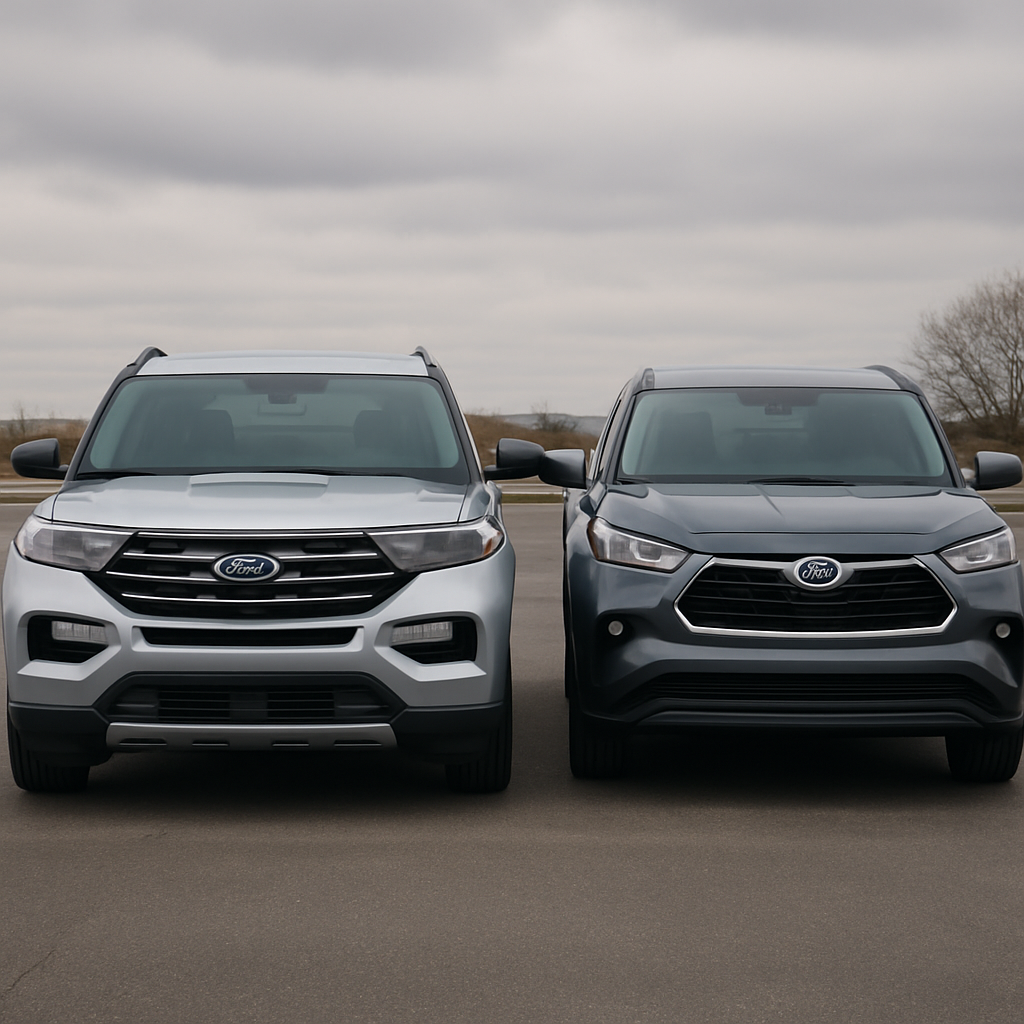
The Ford Explorer is the better fit if you want stronger available performance, a more assertive driving character, and serious towing potential. The Toyota Highlander is usually the more sensible choice for buyers who prioritise fuel economy, a hybrid option, and a reputation for dependable long-term family transport. Neither is automatically better: the right choice depends on how you use the third row, how much you tow, and whether lower running costs matter more than power.
Because specifications, equipment, and pricing change by model year and trim, compare the exact vehicles you are considering rather than relying on a badge-to-badge verdict. This guide focuses on the current comparison while also highlighting what used-SUV shoppers should inspect.
Ford Explorer vs Toyota Highlander: the key differences
These are both three-row SUVs aimed at families, but they take different approaches. The Explorer leans towards performance and towing, while the Highlander leans towards efficiency and everyday ease of ownership.
- Choose the Explorer if you value brisker acceleration, available higher-output engines, and towing capability.
- Choose the Highlander if you want a calmer family SUV, particularly if a hybrid powertrain and lower fuel use are priorities.
- Test the third row yourself. A third row does not mean equal adult comfort, access, or luggage space in every configuration.
- Compare like for like. A base-model price comparison can be misleading if the vehicles have different drivetrains, safety equipment, towing packages, or luxury features.
The 2026 Ford Explorer and Toyota Highlander comparison from Car and Driver identifies a clear powertrain distinction: it lists a 300-hp turbocharged four-cylinder and a 400-hp V-6 for the Explorer, against a 265-hp turbocharged four-cylinder for the Highlander. That difference matters most when the SUV is full of passengers, carrying holiday luggage, or towing.
Size, seating, and family practicality
For shoppers searching Ford Explorer vs Toyota Highlander size, exterior measurements tell only part of the story. Bring the family to the test drive, install the child seats if possible, and check the whole routine: opening the rear doors in a tight car park, reaching the third row, folding seats, and loading a pushchair or luggage behind them.
The key question is not simply which SUV is bigger. It is whether its usable space suits your household. A family with young children may value easy access to the third row and accessible ISOFIX positions; a family with older teenagers may place more weight on legroom and headroom in the rearmost seats. If you regularly travel with all seats occupied, assess how much cargo room remains rather than assuming a three-row SUV will carry seven people and their bags comfortably.
The Explorer’s more performance-oriented character may appeal on a long motorway journey or when loaded, while the Highlander’s hybrid availability can make it attractive for frequent urban and mixed-route driving. Try both on the roads you use most, including a stretch with poor surfaces, because ride comfort and cabin noise are personal judgements.
Performance, towing, and fuel economy
The Explorer offers more powertrain variety in the current comparison data, including the higher-output V-6 noted above. That gives it a meaningful advantage for drivers who want stronger overtaking response or regularly pull a trailer. Towing limits are not universal, though: they can depend on the model year, engine, drivetrain, equipment package, payload, and local-market specification.
Do not choose on the headline maximum alone. Check the vehicle handbook and the rating for the exact VIN or trim, then calculate the real load: passengers, cargo, tow-bar equipment, and trailer nose weight all affect what is appropriate. The Highlander can still be a capable family tow vehicle in a suitable configuration, but its appeal is generally stronger for buyers who place efficiency above maximum pulling ability.
A Highlander hybrid may be especially compelling if your mileage includes regular stop-start traffic. On the other hand, a hybrid’s savings should be weighed against its purchase price, availability, insurance, and the way you actually drive. A short test drive will not establish real-world economy, but it can show whether the power delivery and braking feel suit you.
Toyota Highlander vs Ford Explorer price: compare the whole deal
Vehicle price comparisons can become confusing because advertised figures may be MSRP, transaction prices, regional offers, or prices for differently equipped trims. One dealer comparison, for example, reports a lower comparable price for a particular Highlander SE AWD than an Explorer Limited 4WD, illustrating why trim-level detail matters more than a broad claim that one model is always cheaper.
Build a comparison around the exact vehicles on offer. Include:
- purchase price and finance rate;
- drivetrain, engine, and trim level;
- factory options, especially towing equipment and driver-assistance systems;
- insurance, tax, tyres, servicing, and expected fuel spend;
- warranty remaining on used vehicles; and
- the condition, mileage, and service history of a pre-owned example.
For a used Highlander, a documented inspection and warranty can be as valuable as a small saving on the sticker price. Our guide to Toyota certified pre-owned checks and warranty considerations explains the questions to ask before treating certified status as a substitute for inspecting the individual vehicle.
Ford Explorer vs Toyota Highlander reliability and ownership
“Which is more reliable, Ford or Toyota?” is understandable, but it is too broad to settle a purchase. Reliability varies by model year, engine, drivetrain, maintenance record, climate, and how a previous owner used the SUV. Toyota has a strong mainstream reputation for long-term dependability, which is one reason the Highlander is often the safer default recommendation for cautious used-car buyers. That reputation is useful context, not a guarantee that every Highlander will be trouble-free or every Explorer will be problematic.
A better approach is to investigate the exact vehicle. Ask for service invoices, confirm recall work has been completed, scan for warning lights and stored faults during a professional pre-purchase inspection, and take a long enough drive to assess shifting, steering, brakes, infotainment, and climate control. A clean history report is helpful, but it does not replace an inspection.
On an older Explorer, maintenance history is particularly important. If there is engine noise, poor running, or evidence of neglected servicing, do not assume it is minor; our overview of Ford Explorer timing-chain replacement considerations for 2014-2018 models may help you frame questions for a technician. It applies to the models discussed in that guide, not to every Explorer generation or engine.
What are the disadvantages of the Ford Explorer?
The Explorer’s possible trade-offs are its potentially higher fuel consumption than a Highlander hybrid, a more complicated decision between several powertrains and trims, and the need to verify the history of any used example carefully. Buyers who do not need the extra performance or towing capacity may decide that the added capability is not worth the running-cost compromise.
Used-car condition also matters. Electrical issues can be expensive to trace if they have been ignored, so look for corrosion around battery terminals, warning messages, slow cranking, or evidence of improvised wiring repairs. For context on one age-specific concern, see our guide to battery corrosion and common problems on the 2016 Ford Explorer. That article should not be used to diagnose a different model year without proper testing.
What Toyota is equal to the Ford Explorer?
The Highlander is Toyota’s closest direct answer to the Explorer for most buyers because both are mainstream, family-focused three-row SUVs. It is not a perfect one-to-one match, however. The Explorer’s available performance and towing orientation may make it feel closer to a different type of buyer’s brief, while the Highlander hybrid offers an efficiency route that is central to its appeal.
The Toyota 4Runner is sometimes included in Ford Explorer vs Toyota 4Runner searches, but it serves a different purpose. A buyer choosing between the Highlander and Explorer is usually comparing comfortable family crossovers. A 4Runner comparison makes more sense when off-road ability, ruggedness, and a different ownership character are higher priorities than on-road efficiency and modern crossover manners.
How to choose between an Explorer and a Highlander
Start with your non-negotiables. If you tow frequently, want the strongest available engine choices, or prefer a more powerful driving experience, shortlist the Explorer. If you cover plenty of urban miles, want a hybrid option, and place long-term ownership confidence near the top of the list, start with the Highlander.
Then test comparable trims on the same day and use the same checklist. Sit in every seating position, try the cargo area with the third row raised, check visibility, and review the exact towing and safety equipment. For used examples, pay for an independent inspection before committing. The better SUV is the one that meets your real passenger, cargo, budget, and ownership needs without asking you to pay for capability you will never use.
Pingback: GM V8 Engine Updates for the 2027 Silverado and Sierra Explained - Premier Motoring Blog