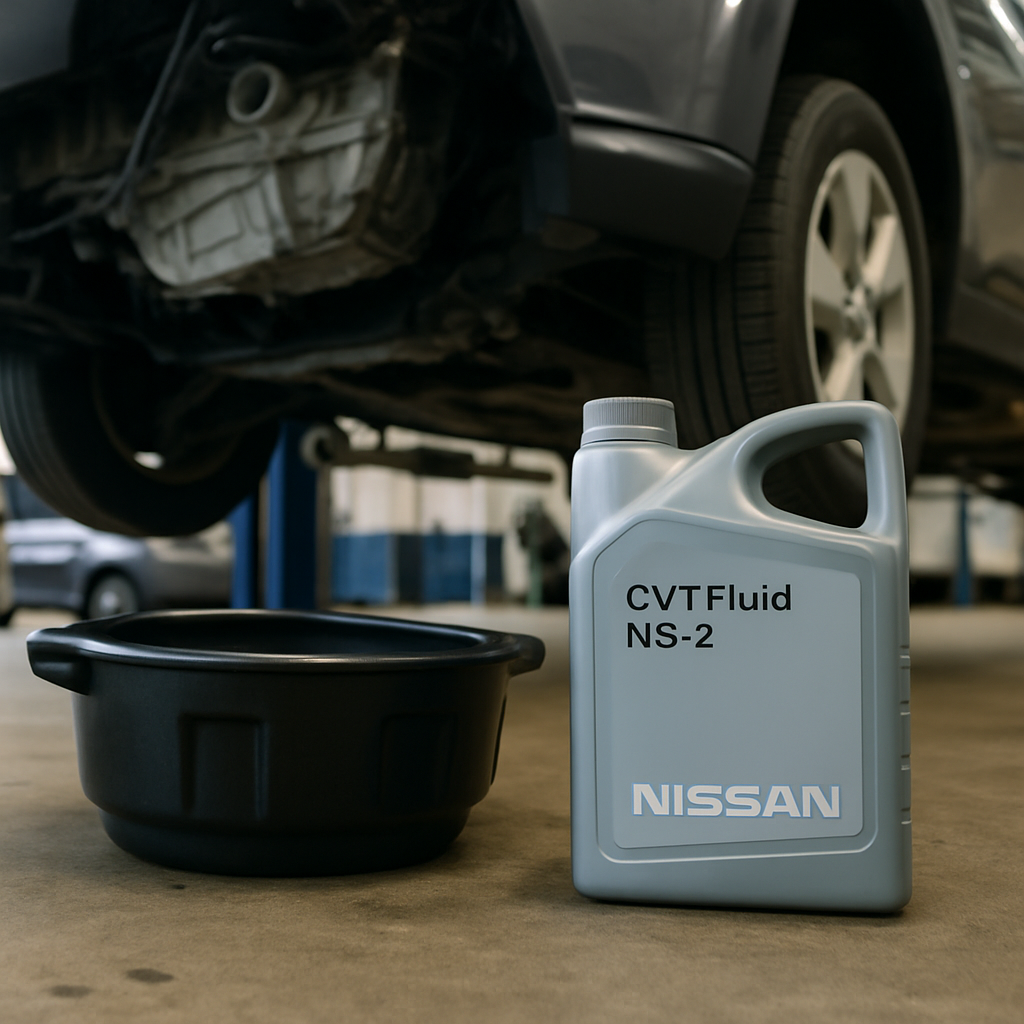
A Nissan NS-2 CVT fluid equivalent is not simply any CVT fluid. It is an aftermarket product whose current manufacturer product data sheet or vehicle application guide explicitly lists Nissan NS-2—sometimes described by the fluid maker as CVT Type N/NS-2—for the exact vehicle or transmission concerned. Nissan NS-3, NS-1, Matic fluid, ordinary automatic-transmission fluid (ATF), and a bottle labelled only “universal CVT fluid” are not automatic NS-2 replacements.
You do not necessarily have to buy a Nissan-branded bottle where an aftermarket product is clearly documented for the required NS-2 application. However, a brand name, retailer category, bottle colour or owner recommendation is not enough to establish compatibility.
Quick answer: how to choose an NS-2 equivalent
- Confirm the factory requirement: check the owner’s manual and the correct service information for the vehicle. Do not assume every Nissan CVT uses NS-2.
- Verify the exact fluid product: find the precise aftermarket product, not merely the brand, in the fluid manufacturer’s current product documentation or application guide.
- Confirm the application: the documentation should expressly identify Nissan NS-2/Type N where applicable and support the specific vehicle or transmission. If either source is unclear, use genuine Nissan NS-2 or obtain VIN-based confirmation from a Nissan dealer or qualified transmission specialist.
What type of fluid is used in a Nissan NS-2 CVT transmission?
An NS-2-equipped transmission uses CVT fluid formulated for that application, not conventional ATF. A continuously variable transmission relies on fluid for controlled friction as well as lubrication, cooling and wear protection. Those properties need to suit the transmission for which the fluid is specified.
Nissan sells genuine NS-2 CVT Fluid as part number 999MP-CSHNS2. Nissan’s official NS-2 CVT Fluid listing identifies it as a quart product for Nissan CVTs. Treat this as the reference product when your vehicle documentation calls for NS-2.
Using an incorrect fluid may affect the CVT’s friction performance, lubrication and protection, and may contribute to transmission problems. That is why a fluid described only as “transmission fluid”, “synthetic ATF” or “for most CVTs” should not be treated as suitable without more specific documentation.
Do you have to use genuine Nissan CVT Fluid NS-2?
No—not automatically. Nissan branding is not the deciding factor. If the vehicle requires NS-2, an aftermarket fluid may be a reasonable choice only when the maker of that exact product explicitly documents Nissan NS-2 suitability and the application can be confirmed for the vehicle or transmission.
Genuine Nissan NS-2 is the sensible default when:
- an aftermarket compatibility claim cannot be verified in current manufacturer documentation;
- the vehicle’s manual or service information is unclear or conflicts with a retailer lookup;
- the vehicle has an unknown fluid-service history and a top-up or fluid mixing is being considered;
- VIN-based fitment cannot be confirmed;
- the vehicle is subject to a warranty condition or service-record requirement for which OEM documentation is preferred; or
- the CVT already has symptoms and needs diagnosis rather than a speculative fluid change.
Manufacturer-documented NS-2 options: what can be verified
The useful question is not “Which brand is best?” but “What does the manufacturer of this exact fluid currently state about Nissan NS-2 and my application?” Product formulations and compatibility lists can change, so check documentation at the time of purchase.
| Product | What can be verified from the available documentation | Important caution |
|---|---|---|
| Genuine Nissan NS-2 CVT Fluid Part no. 999MP-CSHNS2 |
Nissan identifies this as NS-2 CVT Fluid for Nissan CVTs on its official product listing. | Confirm that NS-2 is the specification required for the exact vehicle before ordering; Nissan CVTs do not all necessarily use the same fluid designation. |
| Aftermarket CVT fluid | Consider it only where the fluid maker’s current product data sheet or application guide expressly identifies Nissan NS-2 or Type N/NS-2 for the relevant application. | “Universal CVT fluid”, a retailer fitment filter, a forum post and a front-label claim alone do not prove that the exact product is appropriate for a particular Nissan. |
Named products from brands such as Idemitsu, Valvoline, Castrol, AMSOIL, Aisin and Lubegard are frequently discussed by owners and may appear in retailer searches. That does not make every product from those brands an NS-2 equivalent. Use only the exact product that its manufacturer currently documents for Nissan NS-2 and the relevant vehicle or transmission. An aftermarket maker’s wording such as “meets”, “recommended for” or “suitable for” is the fluid maker’s compatibility claim; it should not be presented as a Nissan endorsement unless Nissan says so.
How to verify an NS-2 equivalent before buying
- Start with the vehicle documentation. Find the required transmission-fluid specification in the owner’s manual or applicable Nissan service information. Year, model and engine alone may not settle the question.
- Identify the exact product and SKU. “Valvoline CVT fluid” or “Idemitsu CVTF” is not sufficiently specific. Record the complete product name and packaging/SKU if available.
- Use the fluid manufacturer’s current technical material. Look for an official product data sheet or application guide, rather than relying on a marketplace listing, a shelf label or a search result.
- Look for the actual NS-2 designation. The documentation should explicitly include Nissan NS-2, or Type N/NS-2 where the manufacturer uses that terminology. A generic statement that it serves many CVTs is not the same thing.
- Confirm vehicle or transmission fitment. Where the guide allows vehicle lookup, check the exact application. If the manual, application guide and retailer information do not agree, obtain VIN-based confirmation before filling the transmission.
- Keep a record. Retain the receipt, product name, stated specification, date and mileage. This is useful for future servicing and diagnosis.
Have the model year, model, engine, drivetrain where relevant, VIN and the exact fluid product ready when contacting a dealer, retailer or fluid manufacturer. VIN-based lookup is particularly useful when a vehicle’s service history, transmission identification or market specification is uncertain.
Can you use NS-3 instead of NS-2 CVT fluid?
Not unless Nissan service information or the fluid manufacturer specifically authorises that substitution for the exact transmission. NS-2 and NS-3 are different Nissan CVT-fluid designations. A newer-sounding designation, a retailer’s suggestion, internet discussion or local availability does not establish that one can replace the other.
| Fluid designation | Use it when | Substitution rule |
|---|---|---|
| NS-2 | The vehicle-specific Nissan documentation requires NS-2. | Use genuine NS-2 or an exact aftermarket product documented for Nissan NS-2 and the application. |
| NS-3 | The vehicle-specific Nissan documentation requires NS-3. | Do not substitute it for NS-2, or NS-2 for it, without explicit application documentation. |
| NS-1, Matic J, Matic S, Dexron and ordinary ATF | Only where the exact vehicle or transmission documentation calls for that separate specification. | These are separate fluid questions, not assumed NS-2 equivalents. Do not cross-substitute by name. |
This does not mean every designation is unsuitable in every possible transmission; it means no interchangeability should be assumed. Follow the specification assigned to the vehicle’s exact transmission.
Is “universal CVT fluid” safe for a Nissan that needs NS-2?
“Universal” describes a product category or marketing position, not a universal approval. Some multi-vehicle CVT fluids may have manufacturer documentation covering particular Nissan NS-2 applications, but the word on the front of the bottle is not enough on its own.
Before considering a universal CVT fluid, ask the retailer or fluid maker:
- Does the current documentation for this exact product explicitly list Nissan NS-2 or Type N/NS-2?
- Does the application guide cover my exact vehicle or transmission?
- Can you provide the current product data sheet or official application-guide entry?
- Has the product formulation or compatibility guidance changed since the fluid was last purchased?
Do not use fluid colour, an anecdotal report that a product “worked fine”, or a retailer category as proof of compatibility.
Replacing Nissan NS-2 CVT fluid: quantity, level and unknown fluid history
Identify the service procedure before buying fluid. A routine drain-and-refill, sump removal and total system capacity are different measurements. A drain-and-refill normally does not remove all fluid from the transmission, so the amount drained or refilled may not match the total capacity.
The practical order is: identify the correct factory procedure, buy the procedure-specific quantity, then set and final-check the level using that procedure. CVT level checks can be temperature-sensitive and may require the vehicle to be level and the fluid to be assessed in a specified way. Do not set the level by colour, generic capacity figures, or the amount drained from another vehicle.
If the previous fluid is unknown
Do not try to identify the installed fluid by its colour. Fresh fluids can look different between products, and used fluid can darken with age and heat. Because a drain-and-refill may leave some old fluid in the transmission, seek VIN-based or professional advice before mixing formulations when the prior fluid cannot be identified. Do not assume a fluid conversion, blend ratio or flush is appropriate without the correct manufacturer information.
Where to buy Nissan NS-2 CVT fluid or an equivalent
Availability varies by retailer, location and stock. A Nissan dealer parts department can help identify the genuine NS-2 reference product, and Nissan’s official online catalogue listing provides the product name and part number to check before contacting a seller.
When buying an aftermarket alternative, ask for the exact product rather than “Nissan CVT fluid”. Verify its stated NS-2 application in the manufacturer’s current documentation before purchase. The lowest-priced bottle is not a saving if it is the wrong specification.
When a CVT fluid change needs more than new fluid
Fresh, correct fluid may be part of maintenance, but it is not a diagnosis or a guaranteed cure for a transmission fault. If the CVT slips, surges, overheats, shudders, makes unusual noises, triggers a warning message, leaks, smells burnt or shows heavy darkening or metal debris, have the vehicle assessed before authorising a flush or adding fluid.
A technician can check for leaks, confirm the required specification, assess the level by the correct method and determine whether the concern is related to fluid condition, an electrical issue or internal transmission wear. Correct Nissan NS-2 fluid is important where NS-2 is specified, but it cannot by itself resolve every drivability fault.
Pingback: P0300 Random/Multiple Cylinder Misfire Detected: Causes, Symptoms, and Fixes - Premier Motoring Blog
Pingback: Nissan Rogue Clicking Noise When Starting: Causes, Dashboard Clicks, and Model-Year Issues - Premier Motoring Blog
Pingback: Transmission Flush Near Me: How to Choose a Shop, Price, and Service - Premier Motoring Blog
Pingback: Nissan Altima Transmission Fluid Change: What to Verify Before Service - Premier Motoring Blog