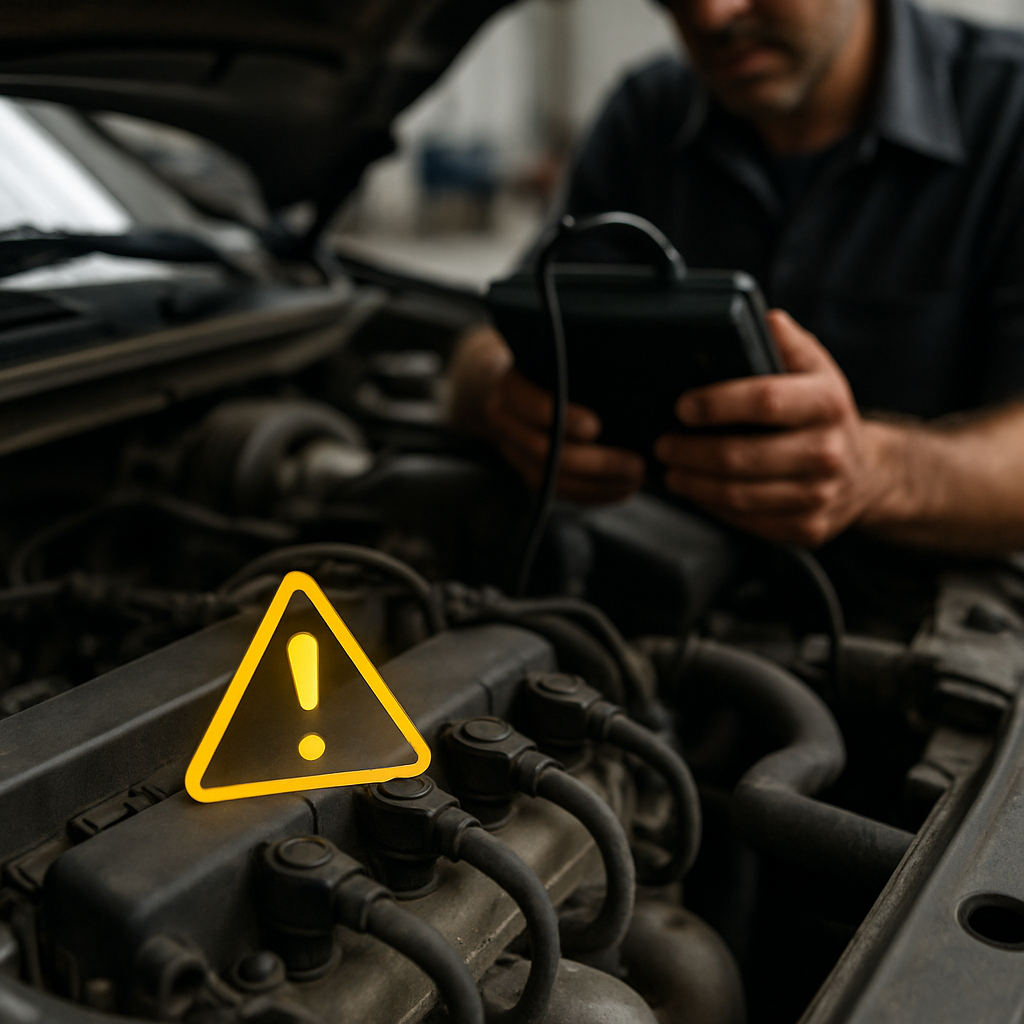
P0300 means the engine control system has detected misfires occurring randomly or across more than one cylinder. It does not identify one failed part. Worn spark plugs, ignition faults, air leaks, fuel-delivery problems, sensor issues, and internal engine faults can all produce this code. If the check-engine light is flashing, stop driving as soon as it is safe to do so; continued misfiring can damage the catalytic converter.
What P0300 Random/Multiple Cylinder Misfire Detected Means
A petrol engine needs the right amount of air and fuel, effective compression, and a spark at the correct time. A misfire happens when combustion in a cylinder is incomplete or does not occur. P0300 is set when the fault pattern is random or affects multiple cylinders, rather than consistently identifying one cylinder.
The code may appear alone, but it can also accompany cylinder-specific codes. For example, P0301 identifies a misfire detected on cylinder 1, while P0302 identifies cylinder 2. This distinction matters: a VW showing P0300, P0301, and P0302 needs diagnosis focused on the cylinders named by the additional codes, as well as on faults capable of affecting the whole engine. OBDeleven’s P0300 diagnostic overview explains that random misfires can arise from ignition, fuel, or mechanical problems.
Multiple Cylinder Misfire Symptoms
A P0300 fault can feel minor at first, particularly at idle, but it can quickly become more obvious under load. Typical multiple cylinder misfire symptoms include:
- Rough, uneven idle or vibration through the car
- Hesitation, bucking, or poor acceleration
- Reduced power and poorer fuel economy
- Hard starting, stalling, or a no-start condition
- A steady or flashing check-engine light
- Limp-home mode on some vehicles
The symptoms alone cannot confirm the cause. A rough idle that improves with engine speed may point a technician towards one set of tests, while misfiring under acceleration can lead them towards ignition or fuel-delivery checks. Treat those patterns as diagnostic clues, not proof that a particular component has failed.
Multiple Cylinder Misfire Causes
Because P0300 involves a random or shared pattern, start by considering faults that can affect several cylinders. Common possibilities include worn, damaged, contaminated, or disconnected spark plugs; faulty ignition coils, leads, or wiring; an air leak; restricted or inconsistent fuel delivery; low system voltage; and timing or mechanical engine problems. this overview of P0300 causes also lists low oil level, emissions-system restrictions, head-gasket leaks, and catalytic-converter problems among potential contributors.
An intake or vacuum leak can allow unmetered air into the engine, upsetting the air-fuel mixture and potentially creating a lean condition. Conversely, a restricted air filter can reduce airflow and make the mixture excessively rich. The same diagnostic guidance notes that either mixture problem can interfere with reliable combustion.
Make-specific searches such as P0300 on a Ford, Chevrolet Silverado, Nissan, or another vehicle should be narrowed to the exact model, engine, model year, and any accompanying codes. P0300 is a standard code, but coil arrangements, known weak points, and test procedures vary substantially between engines.
Can I Still Drive My Car With a P0300 Code?
It is best not to continue driving with P0300, especially if the check-engine light flashes, the engine runs badly, or the vehicle has little power. A flashing light can accompany active misfiring, and Hot Shot’s Secret advises stopping as soon as possible when it occurs.
If the light is steady and the vehicle seems to run normally, avoid hard acceleration, towing, and long journeys until it is inspected. Misfires can worsen without warning, and unburned fuel may overheat the catalytic converter. If the engine is shaking heavily, stalling, or entering limp mode, arrange recovery rather than attempting to drive it to a workshop. Kelley Blue Book’s P0300 guidance similarly warns that multiple-cylinder misfires can seriously affect drivability and may lead to stalling or a no-start condition.
How Do I Fix P0300 Random Misfire?
You fix P0300 by finding and repairing the underlying fault, then confirming that the misfire does not return. Clearing the code or fitting parts at random may turn off the light temporarily, but it does not establish why the engine misfired.
- Read all stored codes and freeze-frame data. Look for P0301 through P0306, fuel-trim codes, air-flow or pressure sensor codes, and voltage-related faults. Note when the code set, such as at idle, on a cold start, or during acceleration.
- Check basic condition and recent work. Inspect for loose intake pipes, damaged electrical connectors, obvious ignition damage, and missed maintenance. Confirm the engine oil level is correct before further diagnosis.
- Inspect the ignition system. A technician may examine plug condition and gap, coils, leads where fitted, and wiring. Where the vehicle design permits, swapping a suspected coil between cylinders can help establish whether the misfire follows the component.
- Test air and fuel delivery. Diagnosis may include checking for intake leaks, evaluating fuel pressure and injector operation, and reviewing sensor data. Do not open fuel-system connections without the appropriate safety procedures and manufacturer information.
- Check mechanical timing and engine condition if needed. If ignition and fuelling checks do not identify the fault, compression, valve timing, and other mechanical tests may be necessary.
- Verify the repair. After the actual cause is corrected, clear the codes with a suitable scan tool and road-test or run the vehicle as appropriate to confirm that misfire counts and codes do not return.
A P0300 troubleshooting guide makes the same practical point: additional cylinder-specific codes can make testing more targeted. Replacing plugs or coils may be appropriate when inspection and testing support it, but neither is an automatic cure for every random-cylinder misfire.
Is P0300 Expensive to Fix?
P0300 itself has no fixed repair price because it describes a condition rather than a failed component. The cost can be modest when the fault is limited to routine ignition maintenance, but it can rise considerably if diagnosis finds a fuel-system, timing, wiring, emissions, or internal mechanical issue.
Budget for diagnosis as well as parts. The final bill depends on the vehicle, engine layout, labour rates, access to the affected parts, whether original-equipment or aftermarket components are used, and whether prolonged misfiring has caused secondary damage. Prompt diagnosis is usually the better financial choice: repair guidance for the code notes that replacing a spark plug is comparatively inexpensive, whereas the overall cost depends on what is wrong with the engine.
Do Not Treat P0300 as a Parts List
P0300 tells you the engine is not combusting reliably; it does not tell you to buy a particular coil, injector, or sensor. Record the symptoms, scan for every related code, and have the fault tested methodically. Acting early, particularly when the warning light flashes, gives you the best chance of preventing a drivability problem from becoming a more costly catalytic-converter or engine repair.
Pingback: Toyota Certified Pre-Owned: Warranty, Value, and What to Check Before Buying - Premier Motoring Blog
Pingback: Automotive Diagnostic Trouble Codes: What They Mean and What to Do Next - Premier Motoring Blog