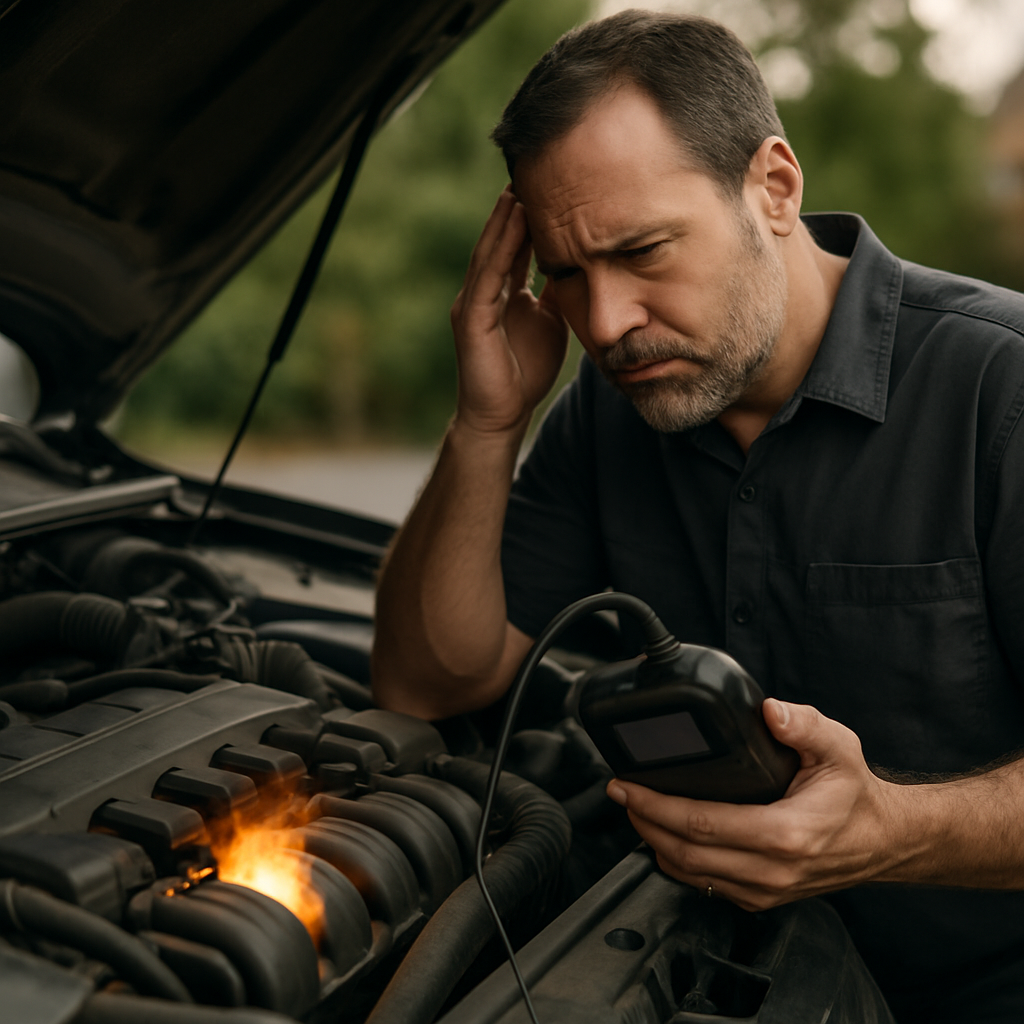
P0300 means the vehicle’s computer has detected a random or multiple-cylinder misfire. In plain English, one or more combustion events are not contributing normally, but the code does not identify a failed part by itself. Worn spark plugs, an intake-air leak, an air/fuel-mixture problem and damaged wiring are among the possible causes. Record any other stored codes and the conditions in which the fault occurs before clearing anything or buying parts.
A misfire can make an engine run roughly, respond poorly to accelerator input and use more fuel. It should be addressed promptly, but the immediate risk depends on how severe and persistent the misfire is and how the vehicle is actually running.
What P0300 Means: Random or Multiple Cylinder Misfire Detected
P0300 is an OBD-II diagnostic trouble code for a misfire pattern that is random and/or affects more than one cylinder. It differs from a code that consistently identifies one cylinder. A misfire is a combustion event that does not occur normally enough for that cylinder to make its expected contribution to the engine.
The wording varies slightly between manufacturers. For example, code references list Chevrolet as “Engine Misfire Detected,” Jeep as “Cylinder Misfire Fault Detected Random Cylinders,” and Audi as “Random Cylinder Misfire Detected”; the general diagnostic meaning remains the same. AutoCodes’ cross-make P0300 reference illustrates those wording differences.
| Code pattern | What it tells you | What it does not tell you |
|---|---|---|
| P0300 | The computer has detected random and/or multiple-cylinder misfires. | Which component has failed, or that every cylinder is misfiring at the same time. |
| P0301–P0308 | A misfire has been associated with a numbered cylinder; for example, P0303 refers to cylinder 3. | Why that cylinder is misfiring. Further testing is still needed. |
Additional codes can materially change the direction of diagnosis. Read and retain all stored codes rather than focusing on P0300 in isolation. Our guide to how to interpret diagnostic trouble codes provides useful broader context.
Is a P0300 Code Bad? When to Stop Driving and Get Help
A P0300 code should not be ignored. Sources on the code associate unresolved misfires with poorer fuel economy and the possibility of further engine damage; severe cases can involve stalling or the engine shutting down. CarParts.com’s overview of P0300 also stresses that an unresolved misfire can become more expensive than diagnosing it early.
That does not mean every stored P0300 is an immediate emergency. An intermittent fault on an engine that currently feels normal is a different situation from a pronounced, continuous misfire. Still, clearing the code is not a repair and does not establish that the underlying problem has gone away.
Stop in a safe place and arrange appropriate professional assistance rather than continuing normal driving if the engine has a severe misfire, a marked loss of power, stalls, or has other serious running symptoms. If the vehicle is running acceptably but the code is stored or returns, arrange diagnosis promptly and avoid assuming it is harmless.
Common P0300 Symptoms and When the Misfire Happens
The following are possible signs of a P0300-related misfire:
- An illuminated check-engine light.
- Noticeable misfiring or rough engine running.
- Reduced response when pressing the accelerator.
- Reduced fuel efficiency.
- In severe cases, stalling or engine shutdown.
The fault can be intermittent. That means the engine may feel normal during one journey or at the time a technician inspects it, even though the computer has recorded a misfire pattern. Do not dismiss a stored or returning code solely because the symptom is not present at that moment.
Before a diagnostic appointment, note whether the problem occurs at idle, while accelerating or under load, and whether there is a loss of response. An under-load misfire is useful context for scan-data review, but it does not by itself prove a faulty plug, coil, injector or vacuum leak.
What Can Cause a P0300 or Multiple-Cylinder Misfire?
P0300 is a symptom code, not a parts list. Multiple cylinders can be affected by a shared-system issue, but the code does not prove that all cylinders are misfiring simultaneously. The practical approach is to consider systems capable of affecting more than one cylinder, then test the evidence on the specific vehicle.
Ignition wear or faults
One source identifies faulty spark plugs as its most frequently cited P0300 cause. Spark plugs deteriorate with use, and plugs replaced as a set may reach a problematic condition at around the same time. That makes worn plugs a common possibility, not a universal diagnosis. Ignition faults may also involve related components, but P0300 alone is not a sound reason to replace plugs, coils or other ignition parts without confirming the cause. This P0300 explainer from eEuroparts sets out both the spark-plug point and the distinction between P0300 and cylinder-specific codes.
Intake leaks and unmetered air
A vacuum leak or other intake-air leak can contribute to a multi-cylinder misfire. Intake gaskets are specifically identified as a potential source in the code reference. Because an intake leak can affect the air available to more than one cylinder, it is a sensible shared-system possibility when P0300 is present; it is not proof that an intake gasket has failed.
Air/fuel-mixture control issues
An improper air/fuel ratio can cause a misfire. The research notes that an oxygen-sensor failure can lead to incorrect fuel control and thereby contribute to a misfire. This is a possible route to P0300, not evidence that the oxygen sensor is necessarily at fault on a particular vehicle.
Wiring and connector condition
Damaged or corroded wiring and connectors can also be relevant. A visual inspection of accessible connectors and wiring can therefore be worthwhile, particularly where there is obvious damage or corrosion. It cannot, however, rule out every electrical or control issue without suitable testing.
Fuel-delivery, ignition and mixture-related possibilities can overlap in the symptoms they produce. Avoid replacing plugs, coils, injectors, sensors or a catalytic converter simply because P0300 is stored. The verified root cause—not the code wording—determines the correct repair.
How to Diagnose and Fix P0300 Without Guessing at Parts
There is no universal P0300 fix. The repair may be straightforward once the cause is found, but it must match the verified issue. A conservative diagnostic path is more useful than parts swapping:
- Scan and save all codes first. Look for P0301–P0308 and any other accompanying faults. Record them before clearing anything.
- Record the operating conditions. Note whether the engine acts up at idle, during acceleration or under load, and whether reduced response or stalling occurs.
- Inspect what is safely accessible. Check visible wiring and connectors for damage or corrosion. Where appropriate, have the intake system checked for leaks.
- Use scan-tool information where available. Live data and misfire information may help show which cylinders are recording events. Scanner capability and vehicle-specific procedures vary, so this is often where a qualified technician’s equipment is valuable.
- Clear codes only after recording them, then verify. A test drive after diagnostic work can establish whether P0300 returns. Clearing the code is a verification step, not a cure or a way to conceal the fault.
- Repair the confirmed cause. Depending on test results, that may mean correcting an ignition issue, an intake leak, a mixture-control fault or a wiring problem rather than following a fixed component-replacement order.
The diagnostic sequence above aligns with the approach described by Fixter’s P0300 troubleshooting guide, which recommends reading stored codes, using live data where possible and confirming the result after work. Owner observations and a careful visual inspection are reasonable starting points; diagnosis requiring scan data, leak testing or electrical testing may be better left to a qualified technician.
Can You Have P0300 When the Engine Seems to Run Normally?
Yes. The available sources describe P0300-triggering misfires as potentially intermittent. The engine may therefore seem to run normally at one point, while the fault occurs only under certain conditions or returns later. A normal-feeling engine at one moment does not prove the code is false or that there is no active issue.
Keep the code record, note the driving conditions and check for other codes. If P0300 returns, use scan data or professional diagnosis to find the cause instead of guessing at a sensor or component.
P0300 on Chevrolet, Jeep and Audi: What Stays the Same
For Chevrolet, Jeep and Audi, P0300 remains a general engine-misfire code even though brand-specific wording may differ. The same limited interpretation also applies to searches for a 2007 Jeep Wrangler, 2017 Jeep Wrangler or Jeep Liberty: the code indicates a random or multiple-cylinder misfire pattern, not a model-specific failed part.
Engine design, diagnostic software and service procedures vary by year, engine and market. Use the vehicle’s own scan information, service data and any related codes before applying a generic repair recommendation. There is not enough evidence here to name a common failure, procedure, technical service bulletin or recall for any of those vehicles.
The same caution applies to an “Activa” P0300 query. Without the make, model, year, engine and manufacturer diagnostic documentation, it is not possible to confirm that an Activa uses the standard automotive OBD-II P0300 definition. Check the relevant handbook or manufacturer-specific diagnostic information before treating the general meaning in this article as Activa-specific guidance.
Related Codes and Why the Underlying Misfire Should Be Fixed First
P0301 through P0308 can help narrow the investigation to a numbered cylinder, although they do not identify the cause by themselves. Other accompanying faults may matter too; for example, a timing-related code such as a related camshaft-timing fault code should be assessed on its own evidence rather than assumed to explain P0300.
The relationship with the catalytic converter also requires care. The research describes a failing or clogged converter as a possible contributor to intermittent misfiring, while continuing misfires may, in turn, lead to more serious damage. Neither direction is confirmed by P0300 alone. Diagnose the misfire’s root cause before treating a downstream emissions component as the repair. For background, see how the catalytic converter fits into the emissions system.
Repair costs cannot be responsibly reduced to a single figure because P0300 can stem from several different systems, and the required tests and repairs vary. The useful next step is a recorded-code review and evidence-based diagnosis, particularly if the code returns or the engine is running poorly.