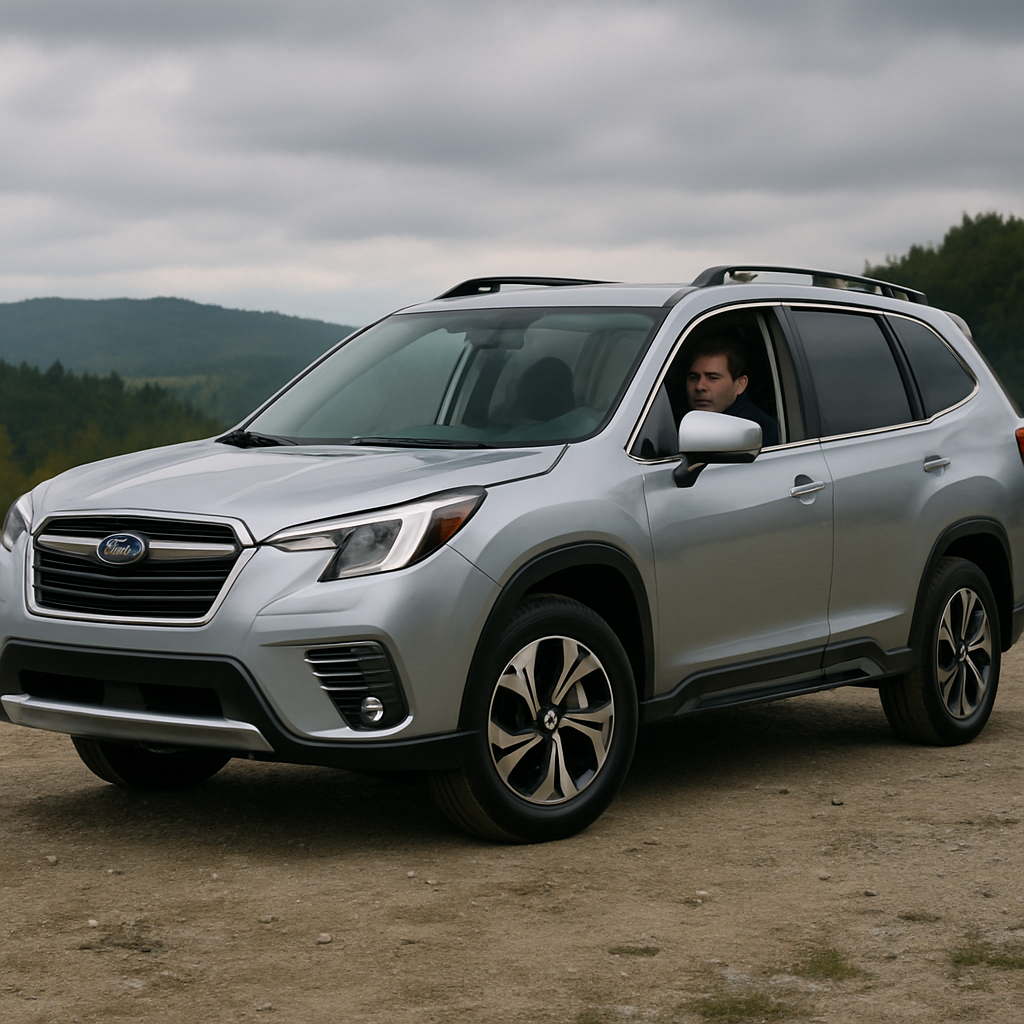
The new Subaru Forester Hybrid is worth a close look if you want the Forester’s excellent visibility, roomy cabin, and standard all-wheel drive, but would like better fuel economy and smoother low-speed response. It is not the class leader for efficiency or driving enjoyment, and its long-term reliability record is still developing because this is a new hybrid powertrain in the US-market Forester. The best buying decision comes down to how much you value Subaru’s practical SUV strengths over the extra mpg offered by some rivals.
What the Forester Hybrid adds to the regular Forester
The 2025 and 2026 Forester Hybrid pairs a 2.5-litre flat-four petrol engine with electric motors, a small lithium-ion battery, an eCVT, and standard all-wheel drive. Car and Driver’s 2026 Forester Hybrid overview lists combined system output at 194 horsepower, 14 horsepower more than the non-hybrid Forester.
This is a conventional hybrid rather than a plug-in vehicle. Its purpose is to recover energy during braking, use electric assistance when it is helpful, and reduce fuel use without asking the owner to charge it from a socket. The hybrid is also positioned above the entry-level non-hybrid Forester in price: Car and Driver lists a starting price of $36,180 for the 2026 model. Check local specifications, trim availability, and on-the-road pricing before ordering, as these vary by market.
How does it drive?
The strongest theme in recent Subaru Forester Hybrid reviews is that the electrified drivetrain makes everyday driving more polished rather than transforming the vehicle into a sporty SUV. Electric assistance improves the initial pull away from rest, where conventional Foresters can feel abrupt, and helps the car feel less strained in ordinary urban traffic.
Ride comfort, generous glass area, and the upright driving position remain central Forester virtues. In its 2026 road test report, Consumer Reports praised the comfortable ride and airy visibility, while finding handling only average and power merely adequate when more effort is required. It also noted that the engine can become conspicuous under hard acceleration.
That last point matters on a test drive. The eCVT is designed to hold the engine where it can produce the required power, so sustained overtaking or steep climbs may bring a higher, more constant engine note than some drivers expect. It is not necessarily a fault, but it is a characteristic worth trying for yourself with passengers aboard.
Fuel economy: a useful improvement, not a segment benchmark
The official EPA figure quoted by MotorWeek’s 2025 road test is 35 mpg city, 34 mpg highway, and 35 mpg combined. That is a meaningful gain over the standard Forester and may be enough to justify the hybrid for drivers who cover substantial urban or mixed-route mileage.
However, the Forester Hybrid is not automatically the most economical choice in every comparison. Consumer Reports achieved 34 mpg overall in its testing, compared with 37 mpg for the Mazda CX-50 Hybrid, and 35 mpg for both the Honda CR-V Hybrid and Hyundai Tucson Hybrid. Real consumption will depend on temperature, journey length, speed, terrain, tyres, and how often the petrol engine is asked to work hard.
Are there any problems with the Subaru Forester Hybrid?
There is an important distinction between known design traits and proven widespread faults. Available review material identifies traits such as modest acceleration, average handling, and a louder engine under demand; it does not establish a comprehensive pattern of hybrid-system failures. As a newly introduced US-market model, the Forester Hybrid simply does not yet have the years of ownership data needed to make firm long-term reliability claims.
Prospective owners should therefore avoid treating isolated owner posts or early impressions as proof of a common defect. During a test drive, check that the power delivery feels predictable, the eCVT response suits you, the infotainment system works as expected, and there are no warning messages. Before signing, ask the dealer to explain warranty coverage applicable to your market, and check the vehicle’s VIN for any future recall or service action.
If a warning light appears, the vehicle loses power, or the drivetrain behaves markedly differently from normal eCVT operation, have it assessed rather than assuming that engine revs alone mean there is a fault. Hybrid and high-voltage components are not suitable for improvised DIY diagnosis.
Is the Forester Hybrid worth it?
For the right buyer, yes. It makes most sense for someone who already likes the Forester’s easy visibility, practical rear accommodation, standard all-wheel drive, and relaxed ride, and who wants lower fuel consumption without moving to a plug-in or full-electric vehicle. The hybrid’s extra low-speed assistance is also likely to be welcome in stop-start traffic.
It is less compelling for drivers who put the highest priority on sharp steering, brisk acceleration, or maximum possible fuel economy. The hybrid premium also deserves a simple calculation: compare the additional purchase cost with realistic annual fuel savings, rather than assuming that a hybrid will repay its price quickly on very low annual mileage.
- A good fit: drivers wanting a comfortable, spacious, all-weather family SUV with improved economy.
- Test carefully: drivers sensitive to engine noise under acceleration or to the response of an eCVT.
- Consider alternatives: buyers seeking the strongest fuel economy, more engaging road manners, or a longer-established hybrid ownership record.
Which is more reliable: the Toyota RAV4 or the Subaru Forester?
It is too early to give a definitive reliability verdict between the new Forester Hybrid and the Toyota RAV4 Hybrid. A model’s reputation does not prove the reliability of a newly introduced powertrain, and the supplied road-test evidence does not provide a like-for-like long-term reliability comparison.
A sensible approach is to compare the specific vehicles you are considering: their build date, warranty terms, dealer support, recall history, service records where relevant, and the reliability information available at the time you buy. If long-term uncertainty is your main concern, waiting for more independent ownership data on the Forester Hybrid is a reasonable choice.
Mazda CX-50 Hybrid or Subaru Forester Hybrid?
The Mazda CX-50 Hybrid is the stronger choice if your priority is the best verified fuel economy from these two models, based on Consumer Reports’ 37 mpg overall result for the Mazda against 34 mpg for the Forester Hybrid. The Subaru’s case is different: it is aimed at buyers who place greater weight on the Forester’s open sightlines, comfortable ride, and familiar Subaru packaging.
Do not choose between them from economy figures alone. Sit in both front and rear seats, try the driving position, assess outward visibility, and take each over the roads you actually use. The Forester Hybrid is a well-rounded upgrade to an already practical SUV, but it is best bought for its complete package rather than on the expectation that it will outdo every hybrid rival in every category.
Pingback: How to Make a Mullein Tincture Recipe for Dosage and Dream Elixirs with Leaf Ratio Tips - Premier Motoring Blog