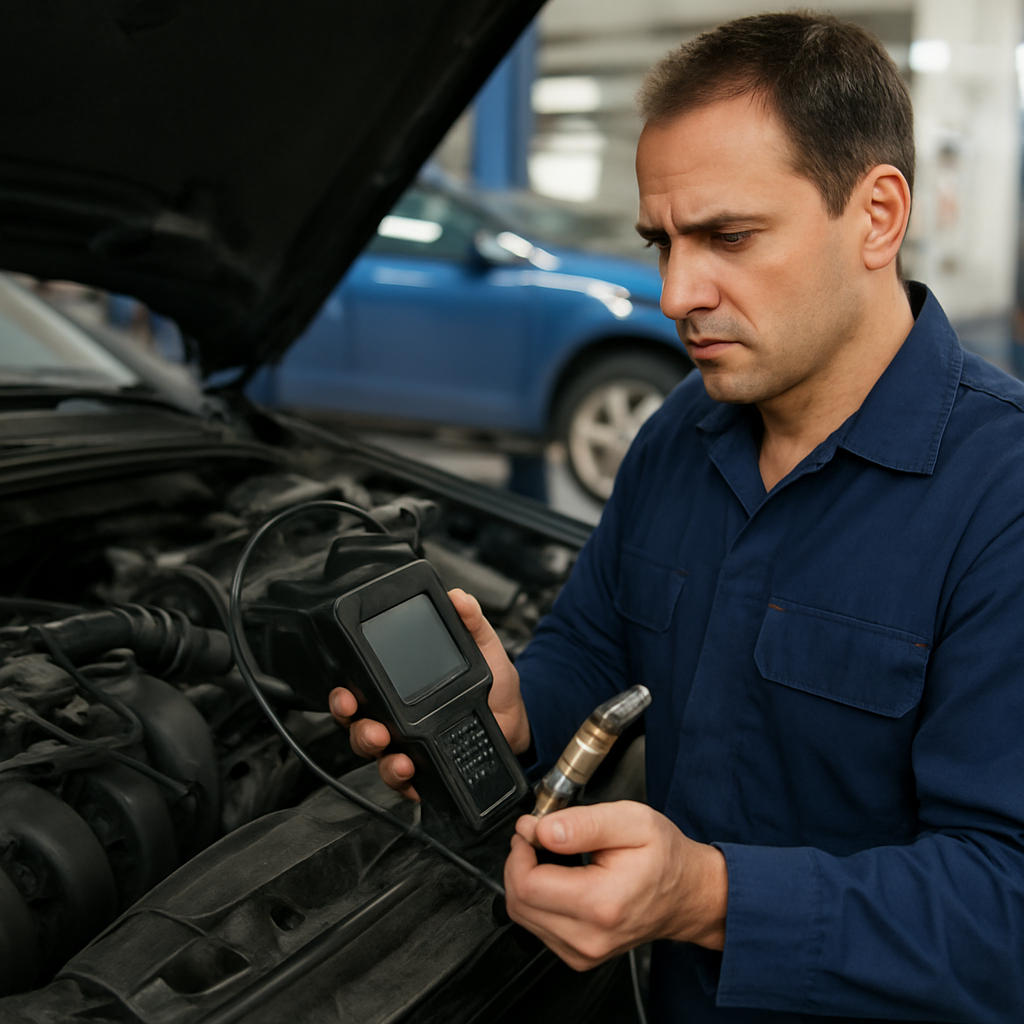
No. An oxygen-sensor-related code does not always mean the sensor itself has failed. A code or sensor reading tells you what the engine control system detected; it does not, on its own, identify the failed part. For example, a lean condition can be caused by a vacuum leak or a faulty fuel injector, and replacing the oxygen sensor will not correct either cause.
Before authorising a replacement, obtain the exact code and diagnose the condition it describes. A code mentioning oxygen-sensor data may indicate a sensor fault, another engine problem, or the need for further diagnosis.
Does an O2 Sensor Code Always Mean the Sensor Is Bad?
No. An oxygen sensor reports information about the exhaust, so a reading that appears lean does not automatically prove the sensor is defective. The Walker Products oxygen-sensor troubleshooting guide uses a lean mixture as an example: a vacuum leak or faulty fuel injector can produce a lean condition, and replacing the sensor will not fix those underlying causes.
P0171 and P0174 are examples of lean-condition codes, not proof that an oxygen sensor has failed. A lean code or lean sensor reading should be treated as a clue to investigate rather than as a parts-replacement instruction. The Counterman discussion of lean codes and oxygen-sensor readings makes the same diagnostic distinction.
If you are seeing a lean code, our guide to system-too-lean codes on Banks 1 and 2 covers that related condition. The code alone still does not confirm which component needs repair.
What Bank 1, Bank 2, Sensor 1 and Sensor 2 Codes Tell You
Bank and sensor labels help identify the area of the engine or exhaust system to which a code refers, but the label is not a diagnosis. Bank 1, Bank 2, Sensor 1 and Sensor 2 do not, by themselves, establish that the named sensor has failed. Exact locations and code descriptions can vary by vehicle, so check the scan tool’s full code description and vehicle-specific service information rather than relying on a generic location guide.
It is also important to distinguish a code describing a lean condition from one that identifies an oxygen-sensor circuit or performance concern. P0171 and P0174, for example, are lean-condition examples; they should not be presented as oxygen-sensor failure codes. For a focused discussion of one specific sensor-related code, see our guide to the P0138 code.
At a broad level, upstream or control sensors and downstream or diagnostic sensors have different roles. Walker Products describes downstream sensors as monitoring the exhaust leaving the catalytic converter and its output or health. That monitoring role does not mean a downstream sensor code alone proves the converter is faulty, or that the sensor itself is the cause. For more context, read how to distinguish an O2-sensor concern from a catalytic-converter problem.
Removing a downstream sensor is not a repair: it removes that monitoring function and can produce a check-engine or malfunction indicator lamp warning, according to Walker Products. A code should not be used on its own to diagnose a catalytic converter. If the issue is a converter-efficiency code, our P0420 guide before replacing a catalytic converter provides a related next step.
Possible Symptoms of a Bad Oxygen Sensor
The available evidence does not establish a definitive symptom checklist for a failing oxygen sensor, or separate symptom patterns for Bank 1 and Bank 2. Reduced fuel economy is mentioned as a possible symptom in a forum discussion about oxygen-sensor faults, but it is not a confirmed or unique diagnostic sign. Other problems can also affect fuel economy, and a symptom by itself cannot identify the failed component.
In practical terms, a car may not show one unmistakable behaviour that confirms an oxygen-sensor fault. A code, a reading or a change in fuel economy can help direct diagnosis, but none is enough on its own to establish that the sensor needs replacing.
Can an O2 Sensor Be Bad Without a Check-Engine Light?
It is possible for a sensor problem not to produce a specific code or warning, according to the forum discussion cited above. That source is not authoritative service guidance, so this point should be treated cautiously: the absence of a check-engine light does not prove the sensor is healthy, just as reduced fuel economy does not prove it is faulty.
If you have a persistent concern, have the vehicle assessed using diagnosis appropriate to its make, model and engine. The available evidence does not establish a universal scan-tool threshold or test procedure, so a generic voltage figure should not be used as a pass-or-fail rule.
What to Check Before Replacing an Oxygen Sensor
- Get the exact code and description. Record the complete code, including any bank or sensor-position designation. Do not rely only on a dashboard message or shortened description.
- Identify the condition described by the code. A lean-condition code such as P0171 or P0174 is not, by itself, proof of a failed oxygen sensor.
- Consider other supported causes. For a lean condition, Walker Products identifies a vacuum leak or faulty fuel injector as possible explanations. Replacing the sensor will not correct those causes.
- Confirm the diagnosis before authorising replacement. Replace the sensor when diagnosis confirms a sensor fault, not simply because a code mentions oxygen-sensor data.
The exact scan-tool description and vehicle-specific service information are especially important when interpreting Bank 1, Bank 2, Sensor 1 or Sensor 2. The available evidence does not support a universal code catalogue, voltage test procedure or vehicle-specific repair instructions.
Is There a Temporary Fix for a Bad O2 Sensor?
The available research does not establish a reliable temporary fix. If the code reflects another problem, such as the supported examples of a vacuum leak or faulty fuel injector, replacing or bypassing the oxygen sensor will not address the underlying cause.
Do not remove or disable a downstream sensor to work around a code. It has a monitoring role, and removing it takes away that function and can trigger a check-engine or malfunction indicator lamp warning. The practical next step is to identify the exact code and diagnose its cause before deciding what needs repair.