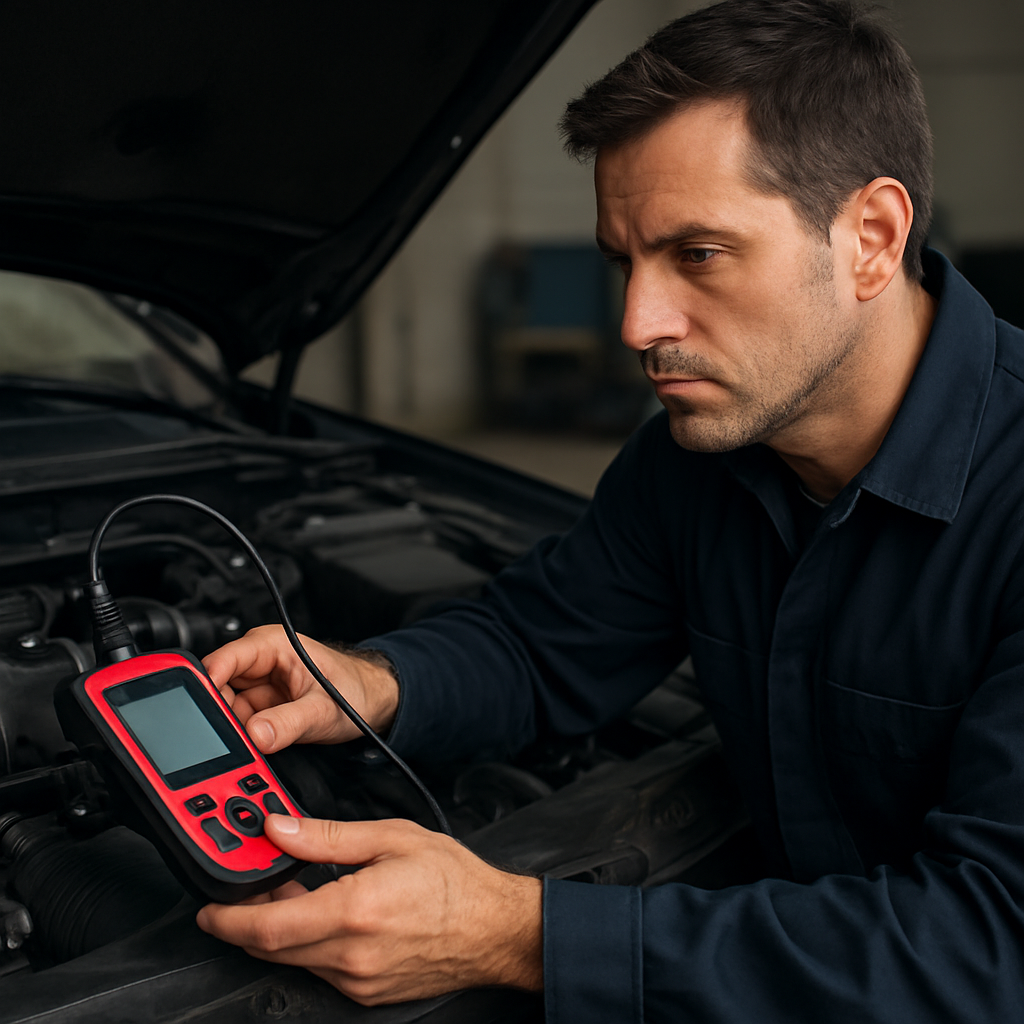
If a scan report shows a lean condition on both engine banks, the correct fix is to identify the underlying fault before replacing parts. The available diagnostic information for P0171 describes a fuel-trim condition on Bank 1; it does not establish a shared cause, code pairing or repair procedure for both banks. Reviewing fuel trims and freeze-frame data, then confirming the fault, can help avoid replacing a sensor that is merely reacting to another problem.
What does “system too lean” mean, and what is Bank 1?
A lean reading means the engine-control system has identified a fuel-trim condition consistent with too much air or insufficient fuel in the mixture. It describes what the system has detected; it does not prove that a particular component has failed.
Kelley Blue Book identifies P0171 as “Fuel Trim System Too Lean (Bank 1)”. That definition applies to P0171, but it does not by itself explain a report involving both banks or confirm why the condition was detected.
Bank 1 is an engine-bank designation, but there is no universal physical left- or right-side location across all engine layouts. Consult vehicle-specific service information rather than assuming which side is Bank 1.
What can cause a lean reading on one or both banks?
For P0171 diagnosis, the supplied source identifies several possibilities: vacuum leakage, a dirty or faulty mass airflow (MAF) sensor, an air-fuel or oxygen-sensor issue, and an exhaust leak. These are diagnostic areas to investigate, not confirmed causes for a particular vehicle or for lean readings on both banks.
An oxygen-sensor or air-fuel-sensor reading does not automatically mean that sensor has failed. It may be reporting a condition caused elsewhere in the system. The source cautions that replacing the sensor may not solve a fault caused by vacuum leakage or a dirty or faulty MAF sensor. Fuel-trim and freeze-frame information can help place the reading in context before a repair is chosen.
The source’s discussion of fuel injectors relates to rich-condition codes P0172 and P0175. It should not be treated as evidence that injectors are the cause of the lean condition discussed here.
How to diagnose and fix a lean condition on both banks
There is no universal repair based only on the words “system too lean”. A sensible diagnostic path is to:
- Confirm the exact codes and vehicle details. Record the complete scan results and identify the vehicle’s year, engine and configuration. The available source defines P0171 for Bank 1, but it does not establish a code pairing or a shared fault for both banks.
- Review fuel trims and freeze-frame data. These records show the conditions under which the system detected the lean reading. The source recommends analysing them because different underlying faults can produce similar readings.
- Investigate the supported possibilities. Diagnosis may include checking for vacuum leakage, evaluating the MAF sensor, considering air-fuel or oxygen-sensor readings in context, and checking for exhaust leaks. No single check is established as the answer for every vehicle.
- Repair only what testing identifies. Repair a leak if testing confirms one. Clean or replace a sensor only when diagnosis supports that action. The supplied source recommends that qualified technicians handle MAF removal and cleaning, and that exhaust repairs receive professional help.
- Scan again after the repair. Check whether the original code or related codes remain or return, rather than assuming the fault is resolved because a part has been replaced.
For optional background, see how to clean a mass airflow sensor safely. This is not a diagnosis: the source cited here recommends leaving MAF removal and cleaning to qualified technicians.
Searches relating to the Chevrolet Silverado, GMC Yukon, Chevrolet models, Nissan, Chevrolet Cruze, Ford, Mercedes and Chevrolet Malibu seek vehicle-specific guidance. The general approach above can help frame the investigation, but the available source does not verify a known failure pattern or specific repair for any of those vehicles. Component locations, code interpretation and test procedures can vary by vehicle, so use the applicable service information or consult a qualified technician. Silverado owners can also read our Silverado guide to P0171 and P0174 lean codes for related model-specific context.
What does P0171 mean on a 2019 Jeep Wrangler?
P0171 is identified as “Fuel Trim System Too Lean (Bank 1)”. That is the general meaning of the code; it does not prove that a particular component has failed on a 2019 Jeep Wrangler. The supplied source does not provide Wrangler-specific causes, diagnostic procedures, service information or repair instructions. Use information applicable to that vehicle or have a qualified technician diagnose it. For another make-specific example, see our Toyota-specific P0171 guide; Toyota guidance should not be assumed to apply to a Jeep.
Is a P0171 repair expensive?
The available evidence provides no repair prices, labour rates or vehicle-specific estimates, so it cannot establish whether fixing P0171 will be inexpensive or expensive. The cost depends on the actual confirmed fault and the vehicle. Diagnosing the cause before replacing parts can help avoid paying for a repair that does not address the problem.
A lean code alone also does not establish whether a vehicle is safe to drive, as the supplied information does not assess drivability risk. Do not treat the code as a confirmed component failure or a complete safety assessment; have the fault evaluated using vehicle-specific diagnostic information.