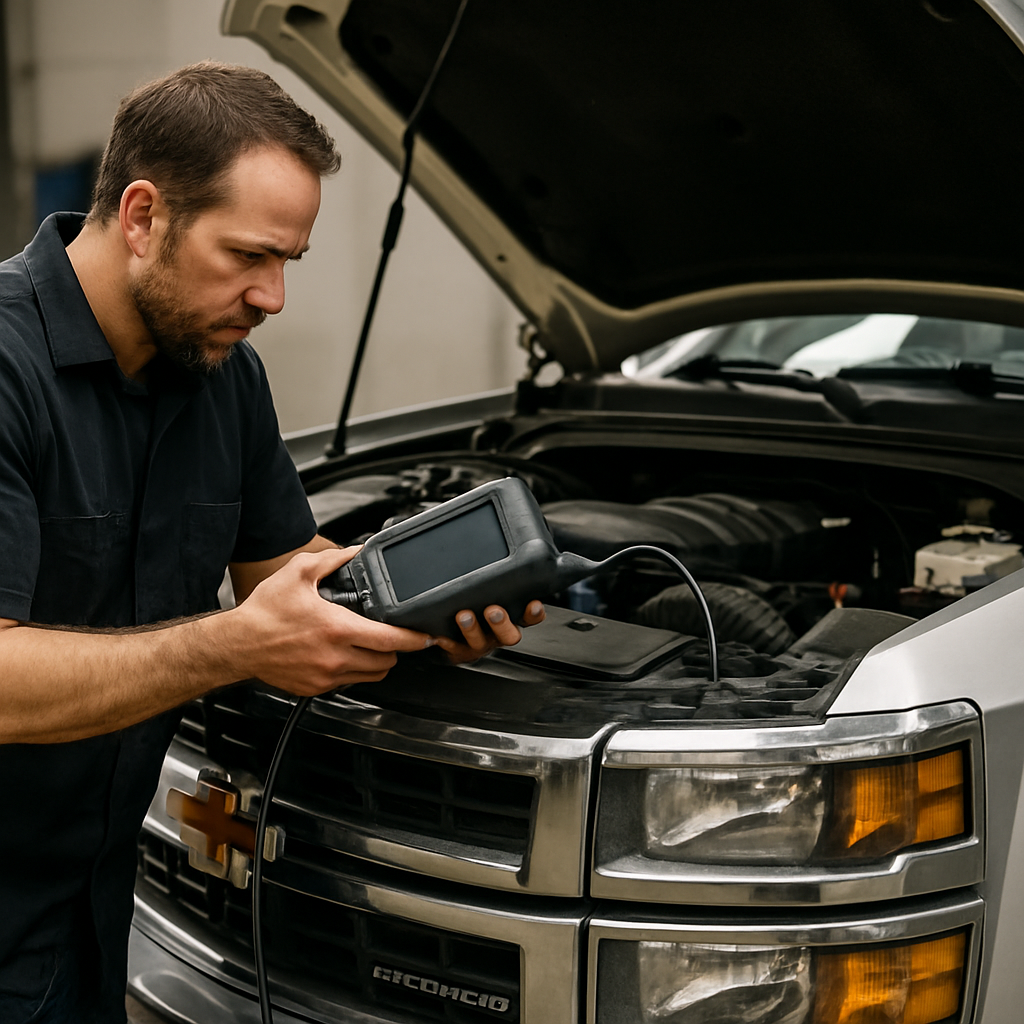
If your Chevy Silverado has P0171 and P0174, the engine control module has detected a fuel-trim condition that is too lean on both banks: P0171 applies to bank 1, and P0174 applies to bank 2. Lean means there is too much air relative to fuel, or too little fuel relative to air. The pair of codes does not identify a failed oxygen sensor, fuel pump, intake gasket, or other individual part. It identifies a mixture-control symptom that needs a cause-led diagnosis.
Because both codes are present, start by looking for faults capable of affecting the engine’s overall air/fuel calculation or both banks, rather than replacing a part for bank 1 alone. Supported possibilities include unmetered air entering the intake, a dirty or inaccurate mass airflow (MAF) sensor, and low fuel pressure. The correct repair depends on which of those conditions, if any, is verified.
What P0171 and P0174 Mean on a Chevy Silverado
P0171 is the OBD-II description for a fuel-trim system that is too lean on bank 1. P0174 reports the same type of condition on bank 2. On a V-type engine, the banks are the two sides of the engine; bank 1 is the side that contains cylinder 1. The physical location of bank 1 should be confirmed from service information for the exact Silverado engine rather than assumed from a general diagram.
Fuel trim is the module’s ongoing adjustment to the amount of fuel delivered. It calculates a starting point using inputs including the MAF sensor, manifold absolute pressure (MAP) sensor, engine-coolant-temperature sensor, throttle information, and other operating data, then uses oxygen-sensor feedback to refine the mixture. If the module has to sustain a substantial fuel-trim correction in response to a lean condition, it can store P0171, P0174, or both.
As this fuel-trim diagnostic overview explains, a lean code is a symptom rather than a diagnosis. That distinction matters: oxygen sensors report what the exhaust indicates, but the codes alone do not prove that an oxygen sensor has failed.
| Code | What it reports | What it does not prove |
|---|---|---|
| P0171 | Fuel trim too lean on bank 1 | A specific failed component or a bank-1-only fault |
| P0174 | Fuel trim too lean on bank 2 | A specific failed component or an immediate safety hazard |
| P0171 and P0174 together | A lean condition has been reported on both banks | That an intake leak, MAF sensor, fuel pump, MAP sensor, or oxygen sensor is definitely the cause |
What Causes P0171 and P0174 at the Same Time?
Two simultaneous lean codes are a reason to investigate faults that can influence both banks or the engine’s overall fueling calculation. They are not proof that one particular fault is present. The most relevant supported cause categories are unmetered intake air, airflow-measurement issues, and low fuel pressure.
Unmetered air after the MAF sensor
An air leak in the duct between the MAF sensor and throttle body can allow air to enter after the MAF has measured the incoming airflow. A disconnected vacuum line or an intake-manifold leak can have a similar effect. Because that air is absent from the original airflow calculation, the module may need to add fuel in response to oxygen-sensor feedback. If the correction remains substantial enough, lean codes may result.
This is why accessible intake ducting, clamps, and visible vacuum connections deserve attention before parts are ordered. It does not mean an intake-manifold gasket or any particular hose should be replaced on the basis of the codes alone. Forum reports of individual repairs can point to areas worth inspecting, but they are not confirmation of the fault on another truck.
MAF measurement issues
A dirty MAF sensor is another supported possibility. The MAF sensor is important because its signal is part of the module’s airflow and fueling calculation. If its measurement is inaccurate, the calculated fuel delivery may not match the engine’s actual airflow. The codes do not, however, establish contamination or sensor failure by themselves.
Do not treat a MAF replacement as a default P0171/P0174 repair. A technician can consider the sensor’s readings alongside operating conditions, other stored codes, and fuel-trim information. The supplied research does not provide a Silverado-specific cleaning method, scan-data specification, or pass/fail value, so this article does not prescribe one.
Low fuel pressure
Low fuel pressure is also a supported cause category: if fuel delivery is insufficient for the calculated air load, the mixture can appear lean. That possibility should be evaluated from diagnostic findings, not inferred as a certain failed fuel pump. Fuel-system testing involves a pressurized system and model-specific procedures, so it is an appropriate job for a qualified technician when required.
Can a bad MAP sensor cause P0174?
The MAP sensor is one of the inputs used in the fueling calculation, so it is relevant to a system-level diagnosis. But P0174 does not prove that the MAP sensor is bad, and the available evidence does not establish a bad MAP sensor as a common Silverado-specific cause of P0174. Nor does it provide a MAP test procedure or specification for a particular Silverado engine. It should be evaluated only in context with scan information and the rest of the intake and fuel-delivery diagnosis.
How to Fix P0171 and P0174 Without Replacing Parts at Random
The fix for Chevy Silverado P0171 and P0174 is to correct the verified underlying cause. Erasing the codes may turn off the warning light temporarily, but it is not a repair if the lean condition remains. Similarly, replacing oxygen sensors, intake gaskets, a fuel pump, or a MAP sensor without evidence risks spending money without resolving the issue.
A sensible diagnostic order is:
- Read all stored codes and available scan information. Do not focus only on P0171 and P0174. Additional codes and the conditions present when the fault was stored can help guide diagnosis.
- With the engine off, visually inspect accessible intake components. Look at the ducting from the MAF sensor to the throttle body, its clamps, and visible vacuum hoses and connections for obvious disconnection, damage, or poor seating.
- Use the findings to assess the supported cause categories. An apparent intake-path problem can justify further leak diagnosis; no visible issue does not rule out an intake-manifold leak, airflow-measurement problem, or fuel-pressure issue.
- Escalate as needed. Professional diagnosis is sensible when scan-data interpretation, fuel-pressure testing, or diagnosis of a suspected intake-manifold leak is needed.
- Verify the repair. After the confirmed fault has been corrected, check that the condition and codes do not return under appropriate operating conditions.
Owner-level work should remain limited to the safe visual inspection of accessible ducting and visible connections with the engine switched off. Do not improvise smoke testing, pressurize the fuel system, or use a sensor-cleaning procedure unless you have approved, vehicle-specific instructions. Parts, tools, and procedures vary by engine and model year.
For the question of how to fix P0171 on bank 1: when P0171 and P0174 are both stored, a bank-1-only repair may overlook a shared condition affecting both banks. Diagnose the code pair as a system first. The general explanation of both codes as excess air or insufficient fuel is also outlined in O’Reilly Auto Parts’ P0171/P0174 guide.
How Serious Is P0174 on a Chevy Silverado?
P0174 indicates a mixture-control problem that should be diagnosed rather than ignored. However, the code by itself does not identify the cause, establish immediate danger, or provide a universal answer to whether a particular truck is suitable for every journey. Noticeable symptoms may be absent; in some cases, the check-engine light is the only apparent sign.
Arrange prompt professional assessment rather than continuing normal use if drivability becomes poor, relevant additional fault codes are stored, or the check-engine light is flashing. Those circumstances call for a more urgent evaluation than a steady warning light with no obvious change in how the truck runs. The available sources do not establish a Silverado-specific drivability threshold, so a categorical “safe to drive” or “unsafe to drive” answer would be misleading.
In practical terms, treat the codes as a reason to investigate soon and avoid dismissing them merely because the Silverado still seems to run normally. The diagnostic-code explanation from this P0171 and P0174 reference likewise notes that there may or may not be noticeable symptoms.
What About a 2007, 2009 or 2013 Silverado?
The general meanings of P0171 and P0174 remain the same on a 2007, 2009, or 2013 Chevy Silverado: bank 1 and bank 2 have been reported too lean. But this is not a validated year-specific repair guide. The supplied research does not provide engine-family fault patterns, bank-location diagrams, vacuum routing, GM service bulletins, factory diagnostic flowcharts, or specifications for those model years.
Before a component-specific repair, identify the exact engine and use service information that applies to that truck. This is especially important when locating cylinders and banks, following intake or vacuum routing, interpreting scan data, or carrying out fuel-system testing. General lean-code advice is useful for framing the problem; it should not be mistaken for a confirmed 2007, 2009, or 2013 Silverado diagnosis.
When Professional Diagnosis Is the Better Next Step
Book professional diagnosis if the visual inspection does not reveal an obvious issue, if an intake-manifold leak is suspected, or if testing fuel pressure and interpreting live scan data are necessary. A workshop can assess the system as a whole rather than fitting parts in sequence based solely on generic code descriptions.
Take note of whether the warning light is steady or flashing, any change in drivability, and every code retrieved from the truck before the appointment. That information does not prove a cause, but it gives the diagnostic process useful context. The goal is not simply to clear P0171 and P0174; it is to establish why the module saw a sustained lean condition on both banks and confirm that the correction has resolved it.
Pingback: P0300 Random/Multiple Cylinder Misfire Detected: Meaning, Causes, Symptoms and What to Do - Premier Motoring Blog
Pingback: VW Golf GTI P0171: Meaning, Causes, Fixes and Driving Risks - Premier Motoring Blog