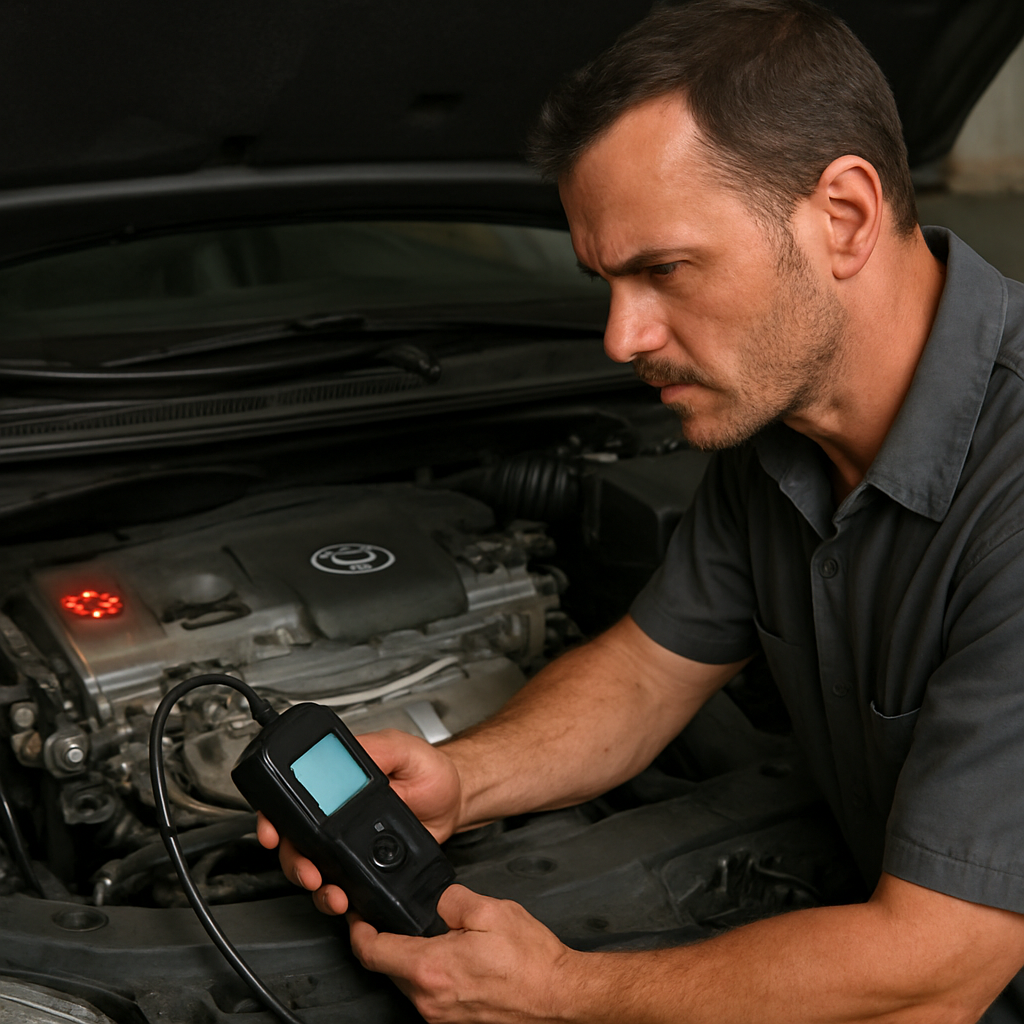
Possible symptoms of a bad oxygen (O2) sensor on a Toyota include a check-engine light, reduced fuel economy, hesitation or rough running, and emissions-related problems. Some vehicles may also have poor acceleration, misfires or stalling, or an unusual exhaust smell or black smoke. These signs do not confirm that the sensor has failed: other faults can cause similar symptoms, so diagnosis should include an OBD-II scan and live sensor data before parts are replaced. A Toyota-focused overview of oxygen-sensor symptoms and diagnosis makes the same distinction.
Common symptoms of a bad oxygen sensor on a Toyota
The symptoms can depend partly on which sensor is affected. An upstream sensor primarily contributes to air-fuel-mixture control, while a downstream sensor is used for catalyst monitoring. A fault in one position may not produce the same signs as a fault in another, and an oxygen-sensor problem is only one possible explanation for the symptoms below.
- Check-engine light: The light may illuminate or flash. It shows that the vehicle has detected a fault, but does not identify the oxygen sensor as the cause by itself.
- Reduced fuel economy: A noticeable change in fuel consumption can be a clue. A scan may also show irregular fuel-trim readings, although those readings need to be interpreted as part of a wider diagnosis.
- Changes in engine running: Possible signs include hesitation, a rough idle, misfires, sluggish acceleration, loss of power or stalling. Difficulty during a cold start may also occur.
- Exhaust or emissions concerns: Increased emissions or an emissions-test failure may be associated with a sensor-related fault. Some vehicles may develop a fuel-like or rotten-egg exhaust odour, or emit black smoke from the tailpipe.
None of these signs is inevitable, and none proves that an oxygen sensor is faulty. If your Toyota also has a random-misfire code, see our guide to how an O2 sensor may relate to a P0300 misfire code. The code and the symptoms still require proper diagnosis.
How to check whether the oxygen sensor is actually at fault
Read the OBD-II trouble codes and review live sensor data before replacing any part. A warning light or drivability symptom can direct a technician towards a diagnostic path, but it is not confirmation that the sensor itself has failed. Sensor position and function matter too: upstream sensors primarily affect air-fuel-mixture control, while downstream sensors influence catalyst monitoring.
Do not assume that either a mass air flow (MAF) sensor or an oxygen sensor is responsible from symptoms alone. The information available for this guide does not establish a technical comparison or a symptom-only method of telling the two apart. If you are researching the MAF separately, see our guide to safe steps for cleaning a mass air flow sensor; that is not evidence that cleaning it will resolve an oxygen-sensor-related problem.
A scan result is a diagnostic clue, not necessarily a verdict on a particular part. For example, if the scan reports P0171, consult our guide to Toyota P0171 code causes and diagnostic checks without treating the code alone as proof of an oxygen-sensor failure. If it reports P0138, our article explains what a P0138 code means and what to check; it should still be interpreted alongside the vehicle’s data and condition.
Where Toyota oxygen sensors are located
Toyota oxygen sensors have different roles depending on whether they are upstream or downstream: upstream sensors primarily affect air-fuel-mixture control, and downstream sensors influence catalyst monitoring. There is no single physical location that applies to every Toyota. The exact position depends on the model, engine and year, so use model-specific service information or ask a qualified technician to identify the relevant sensor.
A downstream sensor’s catalyst-monitoring role does not mean that a catalyst-efficiency code confirms the sensor has failed. For related Toyota context, see what a Toyota Camry P0420 code means.
Is there a temporary fix for a bad O2 sensor?
The available information does not establish a reliable temporary repair for a confirmed oxygen-sensor fault. The sensible next step is to scan the vehicle, review live data, identify the cause and carry out the appropriate repair. Do not treat masking a warning light or clearing a code as a repair. After the repair, the vehicle should be road-tested and the diagnosis checked again to verify the result.
How long can you drive with a bad oxygen sensor?
There is no supported safe mileage limit or guaranteed period for driving with a suspected faulty oxygen sensor. A vehicle may continue to operate with a non-working sensor, but that does not establish that continued driving is safe or consequence-free. Possible concerns include reduced fuel economy and catalytic-converter problems, so arrange diagnosis and service promptly rather than relying on a mileage estimate.
How long does a Toyota oxygen sensor last, and what does replacement cost?
The available information does not establish a Toyota-specific sensor lifespan or replacement interval. It also does not provide a reliable repair-cost estimate. Avoid assuming that a sensor needs replacement because of its age, a symptom or a code alone; check the service information for your specific Toyota and have the fault diagnosed before approving parts or labour.
What if the Toyota runs worse after new O2 sensors are installed?
The available information does not establish why a vehicle might run worse after new sensors are fitted, so it would be misleading to guess at a cause. As a limited verification step, have the OBD-II codes and live data checked again and road-test the vehicle to confirm whether the repair resolved the original fault. Do not assume that fitting new sensors has addressed the underlying problem without that verification.